‘It’s really about the strange shifting relationship with the landscape of truth’ … Morgann Runacre-Temple and Jessica Wright. Photograph: Yonathan Kellerman
‘It’s really about the strange shifting relationship with the landscape of truth’ … Morgann Runacre-Temple and Jessica Wright. Photograph: Yonathan Kellerman
In the choreographers’ new work, virtuosic movement and some green-screen magic unfurl the theatricality of high-stakes television interviews
It appears the interviewer has got him on the ropes. “For the record, I did not take part in a pagan ceremony with minor members of the royal family in which we daubed ourselves in paint,” states the beleaguered politician, caught outside Buckingham Palace with his flies undone and forced to defend himself. This is a fabrication, of course – I’m watching the scene play out in an east London dance studio – but it doesn’t feel miles away from something that could be true. And how do we know what’s the truth anyway? That’s the question in Deepfake, the latest piece from award-winning dance duo Jessica Wright and Morgann Runacre-Temple, AKA Jess and Morgs.
The pair tell modern stories with ambitious tech – film and live camera work – and often techy themes, too. “We’ve always been drawn to where there’s a crossover between the theme and the form,” says Runacre-Temple. “What gets us excited is seeing the contemporary world reflected back.” The pair scored a massive hit with their 2022 piece Coppélia, made for Scottish Ballet, which turned a twee 19th-century ballet about a dancing doll into a cautionary tale of AI automatons and unrestrained tech bro egos. Definitely not one-hit wonders, earlier this year they made their debut at the highly esteemed Paris Opera Ballet.
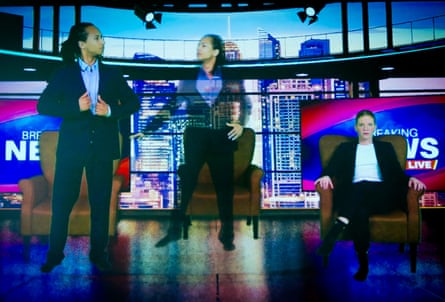
Gladiatorial drama in smart tailoring … Deepfake. Photograph: Chewboy
Deepfake is set in a green-screen studio, where the interview is taking place between a cool-headed journalist and a politician. With writer Jeff James, Jess and Morgs looked at a wealth of TV interviews, from Jeremy Paxman’s 1997 grilling of Michael Howard, where he asked the same question 12 times, to the former prince Andrew’s disastrous turn on Newsnight. They also took inspiration from the current ultra-media-trained politicos who “continually and bombastically evade any questions at all”, says Wright.
They liked the way the television interview is already a theatrical setup, says Wright. “I think there’s something fun about putting that on stage and asking the audience to engage with the theatricality as well.” It’s gladiatorial drama in smart tailoring. “It’s really high stakes; it’s win or lose for both of them,” adds Wright.
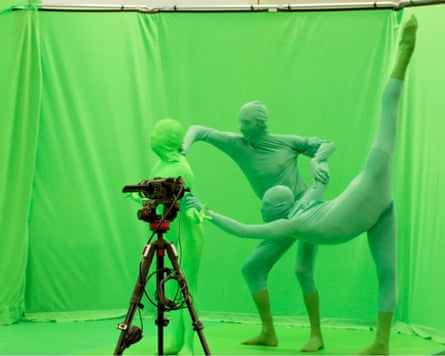
In the show, the interview will be filmed live by four cameras – then, as well as seeing what’s happening in reality, the audience will watch another version on screen with background footage edited in. We’ll be privy to the fabrication of the image and a number of possible realities. There are also seven dancers in green-screen suits who manipulate the environment but will disappear in the edit.
Privy to the fabrication of the image … Deepfake. Photograph: Chewboy
As Runacre-Temple says, green screen can actually look quite lo-fi – “It’s got that slightly absurd, playful, silent movie quality about it” – and it’s ancient tech compared with the kind of AI deepfakes that are emerging today. “They look so hyper real,” says Runacre-Temple. “The danger of deepfakes is not only that people believe things that aren’t true to be real, but that they start to disbelieve things that are true, and this gap opens up of doubt and scepticism about everything.” Or, as in their story, someone who has been caught out doing something they shouldn’t can insist it’s a fake image. “It’s really about the strange shifting relationship with the landscape of truth.”
I go to visit rehearsals on a day when there’s no tech in sight, bar a couple of laptops. “It’s good to go analogue to actually finish the choreography,” says Wright, wryly, counting the diminishing days to the premiere. All we have is an enormous studio and two incredible dancers: Rebecca Bassett-Graham, best known for dancing with Wayne McGregor’s company, who is playing the journalist; and as the politician, Kennedy Junior Muntanga, who has worked with Akram Khan.
‘It’s got that slightly absurd, playful, silent movie quality about it’ … Deepfake. Photograph: Chewboy
The text plays in voiceover while the two dancers embody and expand on its meaning. Their quick-fire movements visualise all the dynamics of a charged conversation: charm, challenge, cooperation, accusation, entrapment, etc. The feel is freewheeling, but each movement is tightly mapped to the syllable, every flex of muscle is considered. In certain scenes with the green screen, dancers will have to hit exact marks and even eyelines on exact words “or the whole illusion collapses”, says Wright. They’re creating their own high-stakes environment for the performers, where “the dancers’ virtuosity is a metaphor for these very virtuosic performances in interviews”.
Will this battle have a winner? Can we believe what we see? Jess and Morgs aren’t giving any spoilers. “Hopefully it will be surprising and mischievous,” says Runacre-Temple.
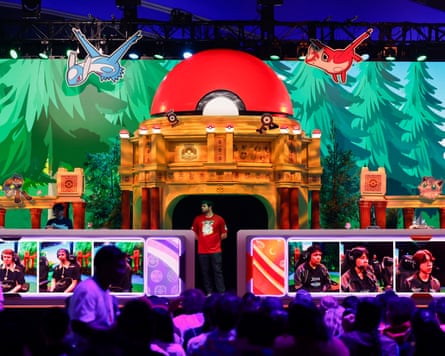
Let the battles begin … people attend the 2026 Pokemon world championships in San Francisco, California. Photograph: Frederic J Brown/AFP/Getty Images
Let the battles begin … people attend the 2026 Pokemon world championships in San Francisco, California. Photograph: Frederic J Brown/AFP/Getty Images
Meet the real-life Pokémon professors, the unsung heroes of competitive monster-battling
They offer advice, referee card games and manage players’ tantrums – we caught up with some of the volunteer profs who keep the competitive game going at this year’s world championships
Professors may be the most revered characters in the fictional world of Pokémon (apart from perhaps the Gym Leaders). In Pokémon Red and Blue, Professor Oak greets the player in a pixelated lab coat, and later provides trainers with their first battle partner; since then, each successive generation of games has introduced another professor to aid and guide trainers through their journeys. If you’ve ever played a Pokémon game, they are often the first people that you meet, apart from your in-game mom.
But you may not know that there are also real-world Pokémon professors – volunteers who help organise the game’s competitive communities around the world. Instead of lab coats, they can be seen at events wearing red Pikachu-mascot shirts labelled “staff”, paired with black trousers and shoes.
I spoke with several of these profs at the 2026 Pokémon world championships in San Francisco, California. Not only do they happily distribute their knowledge about Pokémon, but they also serve as vital staff at the tournament, working as referees and teachers, as well as event managers.
The official Pokémon website describes the Pokémon Professor Program as a “global network of passionate and knowledgable fans” who volunteer their time to help run official Pokémon events. There were roughly 300 Pokémon professors present at the 2026 Pokémon world championships, according to a representative of the Pokémon Company International. A professor’s responsibilities depend on the game they work with and their assigned role at the event. A Pokémon professor officiating a game such as Pokémon Unite might be hyper-focused on wrangling players and providing technical support, whereas a judge for a trading card game tournament might provide competitors with hands-on guidance as they navigate their first live competitive event.
The OG Pokémon prof … Professor Oak in Pokémon: Let’s Go, Pikachu! Photograph: The Pokémon Company/Nintendo
Gemma Byard, a head judge in charge of making the final call on any decisions or questions that arise, became a Pokémon professor after her son started competing in the trading card game. She says that she and the other professors help ensure the integrity of the tournament, describing what goes into the day-to-day work at worlds – such as ensuring that event officials record the results of competitions correctly.
“We’ve got to make sure that all of the match slips have the correct results on them and are signed by the players to ensure, you know, that we get the right results,” Byard said. “We have to make sure that the venue is safe for everybody that’s around. We’re constantly looking out for anything that may be unsafe, or anybody that shouldn’t be in the venue. There’s a lot to think about on top of the rulings.”
Professors often juggle multiple responsibilities on the competition floor and will travel across the world to staff an event such as the world championships. When asked about how the Pokémon Company International compensates its professors, however, most people I spoke to declined to disclose details. One Pokémon professor said that the European professors are compensated with goodies, such as a special staff kit with merchandise, whereas the professors at regional tournaments in the US are paid wages; the same professor said that the Pokémon Company International helped with travel, room and board for the event. (When asked for an official statement explaining how Pokémon professors are paid, a representative from the Pokémon Company International declined to comment.)
Evelyne de Groot travelled from the Netherlands to staff this year’s championships. Like the other Pokémon professors I spoke to, de Groot worked her way up to staffing worlds after organising local competitions in her home region. Before we spoke, she was helping usher players out of the Moscone Center after the main convention hall closed for the evening. This year, she worked at a trading card game side event called Pokémon Sisterhood League, dedicated to giving women and non-binary people a chance to compete and connect.
Passionate and knowledgeable …about 300 professors were working at this year’s Pokémon world championships in San Francisco. Photograph: San Francisco Chronicle/Hearst Newspapers/Getty Images
For her, a good Pokémon professor must balance enforcing the rules with giving competitors the tools they need to enjoy the game itself. She compared the position to working in “customer service”.
“[Players] make friendships. You see them smile. You see them have a good time, but you’re part of that,” de Groot said. “If you’re not organising it properly, if you don’t give them clear instructions, then you see some failure […] You will sometimes get questions. You need to make sure you’re knowledgable regarding that. If you don’t know what you’re doing, if you don’t know how the card game works, then you can’t help them.”
De Groot’s experience as a professor has been relatively relaxed. However, some professors must serve as referees and make contentious calls throughout the competition. For Byard, that means she sometimes needs to deal with upset players. At one point during the tournament, she had to manage a player who was upset with a ruling that didn’t go his way.
“I got called over to the table, and I said to him: ‘Look, I need you just to keep your voice down and be respectful, and we’ll talk through what’s happened.’ And he was like: ‘I don’t need to talk to you. I need to talk to the head judge,’” Byard said, chuckling. “Well, buddy, you are talking to the head judge. That’s the kind of sass that we deal with a lot.”
Tough calls … a judge surveys the scene at a previous Pokémon event. Photograph: Pokémon
A difficult call can lead to controversy. Earlier this year, a ruling from a different judge at another tournament made headlines when a competitive Pokémon Go player who goes by the name Firestar73 was disqualified after winning the final at the Pokémon Orlando regional championships. Many, including the competitor himself in a statement, conceded that the decision was a “good-faith mistake”.
I asked Byard about what it’s like to make tough calls at the tournament. She said that the professors are often seen as “the bad guys”. What does she wish competitors and viewers understood about the role?
“What they don’t understand is that they’re seeing a picture, but we’re getting the entire story, and we’re making the decisions based upon that story,” she said. “That can make a real difference. And we’re the ones putting ourselves out there to right a situation that’s been broken by players. We haven’t caused any distress. We’re there just to try and put it back together again.”
Interviews for this feature took place at the Pokémon world championships in San Francisco. The writer’s travel and accommodation expenses were met by the Pokémon Company.
Anthony Albanese (left) challenged the OpenAI boss, Sam Altman, after the company’s agent infiltrated systems run by the Australian Institute of Health and Welfare, Victoria’s Department of Health, the New South Wales Bureau of Crime Statistics and Research, and the Medicare statistics reporting service portal of Services Australia. Photograph: Getty Images
Anthony Albanese (left) challenged the OpenAI boss, Sam Altman, after the company’s agent infiltrated systems run by the Australian Institute of Health and Welfare, Victoria’s Department of Health, the New South Wales Bureau of Crime Statistics and Research, and the Medicare statistics reporting service portal of Services Australia. Photograph: Getty Images
AI hack of Medicare exposes Australia’s vulnerabilities and experts warn ‘there is more of this to come’
Council on AI Strategy chief says incident unlikely to be isolated and country should enhance capability to detect and report incidents
The prime minister, Anthony Albanese, challenged the OpenAI boss, Sam Altman, on Thursday after the company’s agent infiltrated systems run by the Australian Institute of Health and Welfare, Victoria’s Department of Health, the New South Wales Bureau of Crime Statistics and Research, and the Medicare statistics reporting service portal of Services Australia.
OpenAI alerted the government earlier this month to the June hacking via an email to a public-facing address, a situation Albanese called “obviously unacceptable”.
“All of the evidence shows that our operating systems are vulnerable,” she told Guardian Australia.
“Frontier AI now has capability to expose those vulnerabilities at a rate quicker than we can keep up, quicker than we can patch them.
“When the companies are undertaking tests in what they think are secure environments, and when there are breaches of those environments and these incidences do happen, whether it’s accidental or not, what we’re seeing is the frontier AI capability exposing these vulnerabilities.
“All evidence suggests that there is more of this to come.”
Arabia said Australia needed to quickly enhance capability to detect and report incidents, and the country should host AI training labs here.
Johanna Weaver, Australia’s former chief cyber negotiator at the United Nations, agreed more incidents were inevitable.
Weaver is a member of the advisory board to the minister for government services, Katy Gallagher, and the executive director of the Tech Policy Design Institute.
“Cybersecurity experts have been warning that frontier models and AI agents could expose vulnerabilities in critical systems. What we are seeing now is the tip of the iceberg.
“Governments need to draw a clear line: if companies cannot control their AI systems, they should not release them publicly.”
The US Studies Centre expert Olivia Shen warned AI companies should not be allowed to decide on their own disclosure obligations for hacks and breaches.
“We just don’t know how big the problem is. It could be the tip of the iceberg, but either way, we can’t be ignoring the risk.
“It’s all happening at a time when Australia is designing our national standards on AI. It hasn’t been entirely clear if those national standards were going to be very hyper-focused on datacentres and leave governance questions as a bit of a bolt-on.
“I think this strengthens the argument that you need to have some pretty clear standards, even just based on mandatory incident reporting, built in.”
Intelligence agency the Australian Signals Directorate (ASD) is reviewing how prepared the government is to block and respond to hacking by AI. Officials will look at policies around how AI companies should report cyber-incidents to the government, and how cooperative companies should be during and after an attack.
It will also investigate whether the current laws and systems are adequate to stop AI, and how government systems can be strengthened.
The shadow industry minister, Andrew Hastie, called for Australia to develop its own domestic AI capability, instead of relying on the US.
“If there’s rogue AI agents out there, we need to have our own defensive AI agents protecting Australian government data, our private sector, and other things that are important to us,” he said.
The Greens demanded Labor call in the new US ambassador, David Brat, to establish what President Donald Trump knew about the attack.
“This breach by a foreign AI company on an Australian government database is deeply alarming and brings home the risks that these out-of-control tech corporations pose,” acting leader, Mehreen Faruqi, said.
“The fact that the government did not even know it happened is disturbing.”
Price hikes, ads and lower quality: has ‘streamflation’ ruined the TV experience?
US consumers are starting to opt out of the streaming world as several services raise prices without offering many perks
It may not be quite as politically buzzy as the price of gasoline or eggs, but another household expense is going up for millions of people. Disney has brought the price-gouging experience of its theme park home again by raising the prices of most iterations and bundles of its Disney+ and Hulu streaming services. Whether you pay to watch them with or without ads, separately or bundled together, you’re probably getting a price hike of a couple of bucks per month. The few bundles that will remain the same price feature ad-supported versions of both services (plus ESPN). Don’t worry, though; paying extra to avoid the ad-supported versions of those services won’t mean that you’re missing out on some cross-promotional opportunities. Disney’s terms of service note that they reserve the right to insert ads before and after programming on whatever subscription tier they want, regardless of what you’re paying for. True magic!
This particular magic isn’t reserved for Disney, though. Price hikes among streaming services have become so common that The Verge has a dedicated page aggregating the news of them, which tends to arrive every few months. Apple, apparently high on Emmy fumes, has raised its prices four times in four years, keeping pace with many of its competitors despite a vastly smaller dedicated catalog. Depending on which version of Peacock subscribers use, they’ve seen their bills padded by five or six dollars a month just since the summer of 2025, including another increase last month. Netflix, meanwhile, hasn’t gone up since March 2026. That’s not a reprieve; that’s a sign another hike must be around the corner.
Consumers have noticed. Reportedly an estimated 39% of Americans canceled a streaming service in the past six months due to what’s been dubbed “streamflation”. Another survey indicates that a majority of people subscribe to at least three such services, which is consistent with estimates of streaming households spending about $70 per month. Access to the six big streaming services (Netflix, Disney+/Hulu, HBO Max, Paramount+, Apple TV, Peacock) will boost that number somewhere in the neighborhood of $120, on top of which subscribers need broadband internet for the services to actually work. For the total price, you might as well call the whole thing Cable+, in that it’s like your old cable bill, only there’s more of it. No wonder cancellations are rampant.
To retain subscribers without putting the screws directly to them, it might be viable for streaming companies to stabilize annual prices – typically a discounted lump-sum payment covering a full year of a service – even when raising monthly costs. Some, like Netflix, don’t offer this option. While those that do have kept annual subscriptions cheaper than the a year’s worth of month-to-month, companies don’t seem interested in maintaining bargain levels. The annual price for Disney+ at launch was $70. Now it’s $190, an increase of 170% – presumably to stay competitive with eggs. Amazon Prime, whose streaming service began as a perk for members already paying an annual membership fee for unlimited shipping and other benefits, has also risen while inserting more ads into its programming and downgrading the picture quality. You want higher resolution and fewer ads? That’s another $50 a year.
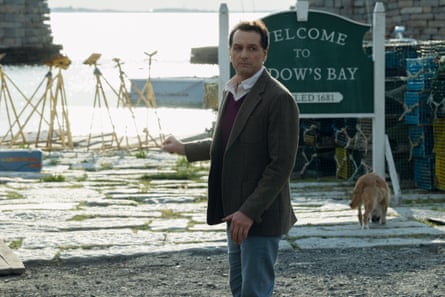
Matthew Rhys in Widow’s Bay, a big hit for Apple. Photograph: Robert Clark/Apple
The reasons for all this shameless gauging are pretty simple: Wall Street doesn’t just demand profits (though those have sometimes been scarce in the streaming world) but endless growth, and some services don’t have all that much more room, realistically, to sign up more users any more. Netflix has 325 million subscribers worldwide. What’s their reach goal? 500 million? Three billion? What happens when everyone on Earth with an internet connection and a credit card already has Netflix?
Not every service is so close to a saturation point (unless you count electricity as a streaming service). But it’s notable that even a supposedly lower-tier streamer like Peacock commands over 40 million monthly subscribers, equivalent to more than 10% of the United States population. (It’s a heavily US-skewing service, so unlike Netflix those users aren’t especially global.) By comparison, the biggest magazine in the US has a subscriber base of around half that (and that’s the AARP magazine, an outlier in that it’s distributed to paying members). The New York Times, considered an especially successful recent example of the subscription model, has 13 million subscribers. The AMC Stubs A-List program that allows moviegoers to see four films a week has about 1 million.
That’s all to say that streaming has unprecedented reach, which means the only realistic way to boost profits is to either raise subscription prices, or make less stuff. The latter might sound ridiculous, especially given that we’ve been living in the post-boom age for streaming shows for a while now. Then again, that’s worked out well for the catalog-based Tubi, whose original works are lower-profile and lower-budget than its competitors. One of several free streaming services, Tubi outstrips some of those paid competitors in market share and turns a profit based only on its ads.
Watching a movie or a show on a free service isn’t exactly an optimal experience; there are those ad breaks, sometimes the transfers aren’t top-notch, and the content churn tends to be a little faster than the subscription streamers. It’s definitely not a place where you can catch much of anything nominated for an Emmy in the past five or six years (though some Oscar movies or second-tier popular hits from that period might turn up). On the other hand, free streamers often manage to under-promise and over-deliver; at a time when paid subscriptions seem eager to offer less than ever, especially in the quite broad field of films made before 1995, Tubi, PlutoTV and their ilk always have at least a couple dozen stone-cold classics on hand that more than make up for not including the latest big-name time-wasters (looking at you, Matthew McConaughey/Woody Harrelson sitcom where they play themselves!). And the price always stays the same.
Tubi’s original works are lower-profile and lower-budget than its competitors. Photograph: Tubi
Still, some free streaming services with surprisingly robust and shifting catalogs aren’t exactly the dream of cord-cutting that was fed to consumers throughout the 2010s. The initial idea was to shed the bloat from all-or-nothing cable services that hold monopolies, or something close to it, in plenty of geographic areas. Competition for subscribers would keep good deals in the offing. Instead, what’s been happening over the past five years or so is a redistribution of that money from one set of giant companies to another. There’s slightly more consumer control over the size of the bills, in the sense that, yes, it’s possible to cancel a couple of services in a way that picking and choosing individual cable channels wasn’t possible outsidea few premium subscriptions. But there’s also far less clarity about how to catch the best shows and movies of any given year. For ages, it was mostly a simple formulation: have cable, add HBO. Now even the prestige of HBO seems a little more niche – a Game of Thrones spin-off; a well-liked Green Lantern show – than in the past.
There’s also a strange sense that this scramble of greed isn’t paying off as well as it should; many streaming services feel like they’re in far more precarious financial positions than most cable companies or channels were at their peak. It’s a dystopian development: corporations still want consumers on the hook for endless subscription payments, but also seem to want them to share in the nervous stock-checking of a shareholder, without any particular upside. Each month, you check your streaming holdings and see if you’re about to be charged even more, and whether you need to pick one to divest (cancel, whether for good or for now). You can toggle some of them on and off timed to the occasional appearance of a major series like Severance or The Pitt, but the onus for keeping track of erratic streaming schedules is on the subscriber. None of these shows are as necessary as basic groceries. But the ability to relax and watch TV after a long day is still in danger of becoming another budget-related stressor – an unholy combination of cable bloat and the endless doomscroll.
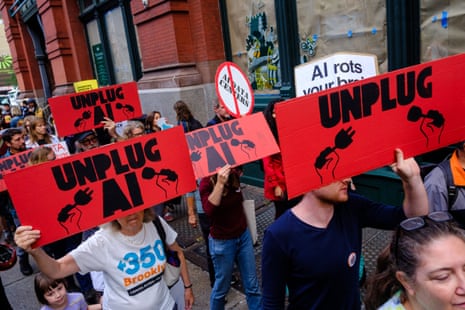
People protest outside OpenAI’s office in New York City on 21 September. Photograph: Julius Constantine Motal/The Guardian
People protest outside OpenAI’s office in New York City on 21 September. Photograph: Julius Constantine Motal/The Guardian
Climate protesters say tech companies, not AI, are the real ‘danger to humankind’ – and the planet
Activists gathered outside the OpenAI offices on Monday during climate week in New York City
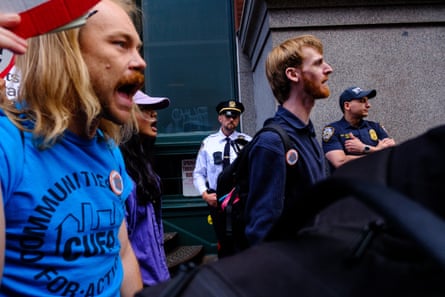
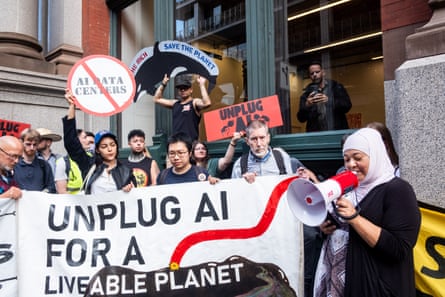
On Monday evening, protesters gathered outside the unmarked Manhattan offices of OpenAI, maker of ChatGPT, holding signs calling to “Eat the rich, save the planet”. Over the next two days, groups also picketed outside the offices of fellow tech giants Google and Amazon; other protesters, including clergy, were arrested while disrupting a closed-door AI health summit in the city. Tonight, protesters will target a Brooklyn gas power plant that was set to close – until it was purchased to power AI datacenters.
The protests come on the heels of an Anthropic employee quitting his job with a warning that intensified an already-growing AI panic: “The people building AI earnestly believe that it could kill us all by the end of the decade.”
Though it was far from the first time an AI expert had issued a doomsday message about the threat the tech poses, this time it dominated public attention, arriving as trust in big tech has hit an all-time low and communities across the country are trying to stop the building of datacenters. From 2024 to 2026, at least $64bn in proposed datacenter buildout was blocked by local organizing. Today, bans have been passed in at least 18 states at the local or county level, and New York passed a statewide moratorium this summer.
The protest outside OpenAI’s New York City office on Monday. Photograph: Julius Constantine Motal/The Guardian
“They are claiming that they have the power to end humanity, but at the same time can’t get AI to do a lot of major things that they’re pushing for,” said Jonathan Westin of Climate Defenders and the Stop Funding Billionaires campaign, which organized the “unplug AI” week of action.
Like Westin, many of the protesters at the anti-AI protests this week were part of climate organizations, in town for New York’s climate week, a global gathering of elected officials, policy experts and advocates timed to the meeting of the United Nations general assembly. Datacenters require significant amounts of water to function and an immense amount of energy to power, often using fossil fuels, bringing pollution into communities. Organizers are calling for more datacenter moratoriums and stronger commitments to protect water access and to block fossil fuels. They say tech companies’ greed is the real threat to the environment.
Even Wall Street has warned the AI boom could cause another economic bubble to burst – one that, protesters say, will be carried on the backs of working Americans. “Regular people shouldn’t be left holding the bag for a bunch of billionaires and trillionaires to play Monopoly with our economy,” Westin said.
Daisy Maldonado (right) of New Mexico at the protest outside OpenAI’s office building in New York City on Monday. Photograph: Julius Constantine Motal/The Guardian
Other groups at this week’s protests, like the anti-war organization Code Pink, called attention to how many big tech corporations work with the US military: the US has used tech made by Palantir, xAI and Anthropic to establish targets and rain down bombs in the war in Iran – all with far-from-perfect accuracy.
Alex Hanna, director of research at the Dair Institute, an AI research organization centering communities facing environmental damage and extraction from AI, said the doomsday prophesying from tech companies and former employees are a distraction amid “the climate and ecological crisis, the rising fascism that is borne out of climate politics, the making of climate refugees, and the growing inability of people just to get by from day to day. It’s such a disconnect from what seems to be actually happening.”
Some protesters outside the OpenAI offices Monday had traveled from New Mexico, where a planned datacenter threatens the already-sapped Rio Grande and a community facing a 20-year drought. Oracle’s Project Jupiter, which is contracted to OpenAI, was pitched as a job creator for the community, but organizers say the companies aren’t talking about how it would drain the area’s limited water resources.
“There’s just so much misinformation that’s being sold, not only to the elected [officials], but to the community, and I think it’s really a disservice to the people of New Mexico for these companies to come in and just basically lie about what they’re going to do and how these projects are going to benefit communities,” said Daisy Maldonado, a resident of Doña Ana county, the planned site of the datacenter.
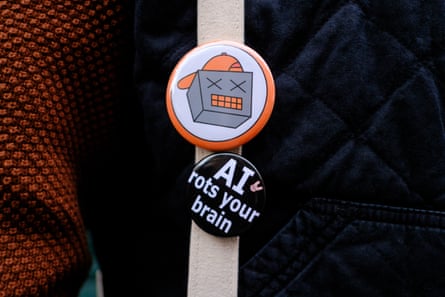
Justin Jones, the Tennessee state representative, wears anti-AI buttons on his bag at the protest on Monday. Photograph: Julius Constantine Motal/The Guardian
At an AI sustainability conference elsewhere in the city on Tuesday, five protesters were arrested for disrupting a keynote on using AI to solve the energy grid crisis. Activists called out the conference framing as “greenwashing”, or using misleading descriptions to brand something as eco-friendly or less harmful. “We do not want to greenwash these datacenters that are being built,” said Adrosto de Silva, who also traveled from New Mexico to the OpenAI protest. “There is no way that you can do harm reduction in any sort of datacenter whatsoever.”
At Monday’s protest, attendees – including the Tennessee state representative Justin Jones, who dropped in while in town for climate week – emphasized that many of these fights are happening in communities of color and poor communities, where the companies thought they wouldn’t face local backlash.
“This building behind me is a danger to humankind,” said Jones, gesturing at the OpenAI offices. “The confluence of this techno oligarchy is a threat to us all. I’m here because if they come for one of us, they’re coming for all of us.”
A global sell-off in government bonds has put fresh upward pressure on UK borrowing costs, before a tough budget for John Healey next month.
The yield – effectively the interest rate – on 10-year UK bonds, known as gilts, had risen to 5.38% by mid-morning on Thursday, approaching the 19-year high set last week.
Higher interest rates raise the upfront cost of government investment and feed through into Office for Budget Responsibility forecasts of whether the chancellor is on course to meet Labour’s fiscal rules.
Analysts believe recent increases in yields have wiped out more than half of the £24bn “headroom” against the rules that the former chancellor Rachel Reeves had built up at the time of the spring statement in March.
Healey, her successor, has repeatedly promised to meet the rules with a “buffer against uncertainty” but this is widely expected to be significantly lower than £24bn.
Rebuilding it to that level would be likely to require large tax increases or spending cuts; but Treasury sources insist the budget will be “focused”, with important spending decisions postponed to a review next year.
Investors across the main markets have been ditching bonds in recent weeks in a wave of selling prompted by fears of higher inflation and interest rates as the conflict in the Middle East rumbles on.
The Bank of England chief economist, Clare Lombardelli, said in a speech on Thursday that the longer oil prices remained elevated as a result of the war, the more likely it was that UK interest rates would have to rise.
“The longer higher energy prices persist, the greater the risk that indirect effects build and that inflation expectations, wage bargaining and price-setting behaviour begin to adjust in response,” she told an economic conference in Warsaw, Poland.
“On that basis, policy is increasingly likely to need to tighten if elevated energy prices persist, absent clear evidence of disinflation or weaker activity.”
Higher rates would mean increased mortgage costs for homeowners, at a time when Andy Burnham’s government has promised to offer consumers a “breathing space” against the rising cost of living.
The Bank is also expecting an eye-watering 24% rise in the quarterly energy price cap that determines household utility bills in January, if oil prices remain high.
She stressed that high oil prices had had less impact on other prices across the economy than the Bank had feared; but the longer they remained high, the greater the risk of inflation becoming entrenched.
As the bond sell-off continued to worsen on Thursday, yields on 30-year US Treasury bonds surged to 5.444% – the highest level since 2004.
Alongside higher inflation, investors appear to be concerned about the risks of uncontrolled US government spending. Some analysts also suggest large-scale bond issuance by AI firms is undermining demand for treasuries.
Sept. 23 (UPI) — Authorities in New Hampshire are searching for two minimum-security inmates alleged to have escaped from their transitional housing unit early this week.
The New Hampshire Department of Corrections said in a statement that Aris Karamousianis, 43, and James Brouillard, 63, signed out of their transitional housing unit in Manchester, located about 22 miles south of Concord, at 11:05 a.m. EDT Monday in search of employment.
“Neither returned to their transitional housing facility and their current whereabouts are unknown,” the department said.
The pair were placed on “ESCAPE” status at 5:30 p.m. Monday. Authorities said their last known location was near Manchester’s Delta Dental Stadium.
Karamousianis was convicted on charges of being a felon in possession of a dangerous weapon, and was to be released as early as Dec. 3, while Brouillard was incarcerated for armed robbery and had a maximum custody release date of Dec. 2, 2030.
Karamousianis is described as a White man about 6 feet, 2 inches tall weighing about 220 pounds with blue eyes and brown hair. He was last seen wearing jeans, a white T-shirt, a gray zip-up fleece jacket and a gold cross necklace.
Brouillard is also a White man, about 6 feet, 1 inch tall and about 200 pounds. He was last seen wearing jeans, a gray crew-neck sweatshirt and white sneakers. He also has several tattoos, including a skull with a heart and rose on his right forearm as well as the Grim Reaper on his right arm and a dragon on his left arm.
Anyone with information about their whereabouts is encouraged to contact the New Hampshire Department of Corrections.
Of all the displeasures that the Trump Administration has brought upon the District of Columbia, the most peculiar was the dinky little fairgrounds thrown up on the National Mall this past July. Crafted from the finest styrofoam and vinyl that misdirected donations can buy, its design unmistakably evoked the otherworldly classical ensembles of the 1893 World’s Fair and its imitators. In some ways, the choice is intuitive. The World’s Columbian Exposition was an exuberant expression of American wealth, power, and identity that cultural creators have returned to with fascination again and again. Make America Great Again, right?
But on the other hand, how did a festival that lasted only six months lodge itself so deeply in the American psyche? Why did we rebuild it in miniature on the National Mall? Why has it become a feature of more than one conspiracy theory about a suppressed glorious past? Why is its discernment invoked on every can of Pabst Blue Ribbon? Have we always been thinking about this plaster pop-up advertisement for American majesty?
The answer to all of these questions is… stranger than I had thought. Whether thinking back to 1893 or 1993, what draws us to an event, story, or image depends less on the context of the events than the context we inhabit. As a result, we interpret—or reimagine—the past differently from our predecessors. And I think the lingering memory of the World’s Columbian Exposition shows how it’s from these reimaginings, not neutral facts, that we reshape the world.
A New and Improved Jerusalem
One aspect of the fair that no historian will dispute is that, like the dinosaurs of Jurassic Park (1993), it blew people’s minds. Raves about the Exposition had begun even before it opened in May 1893 and continued well past its closure in October of that same year. Articles, telegrams, and diaries all testified to its wonder. For years after, both licensed and bootleg merchandise sold well, cluttering parlors into the new century.
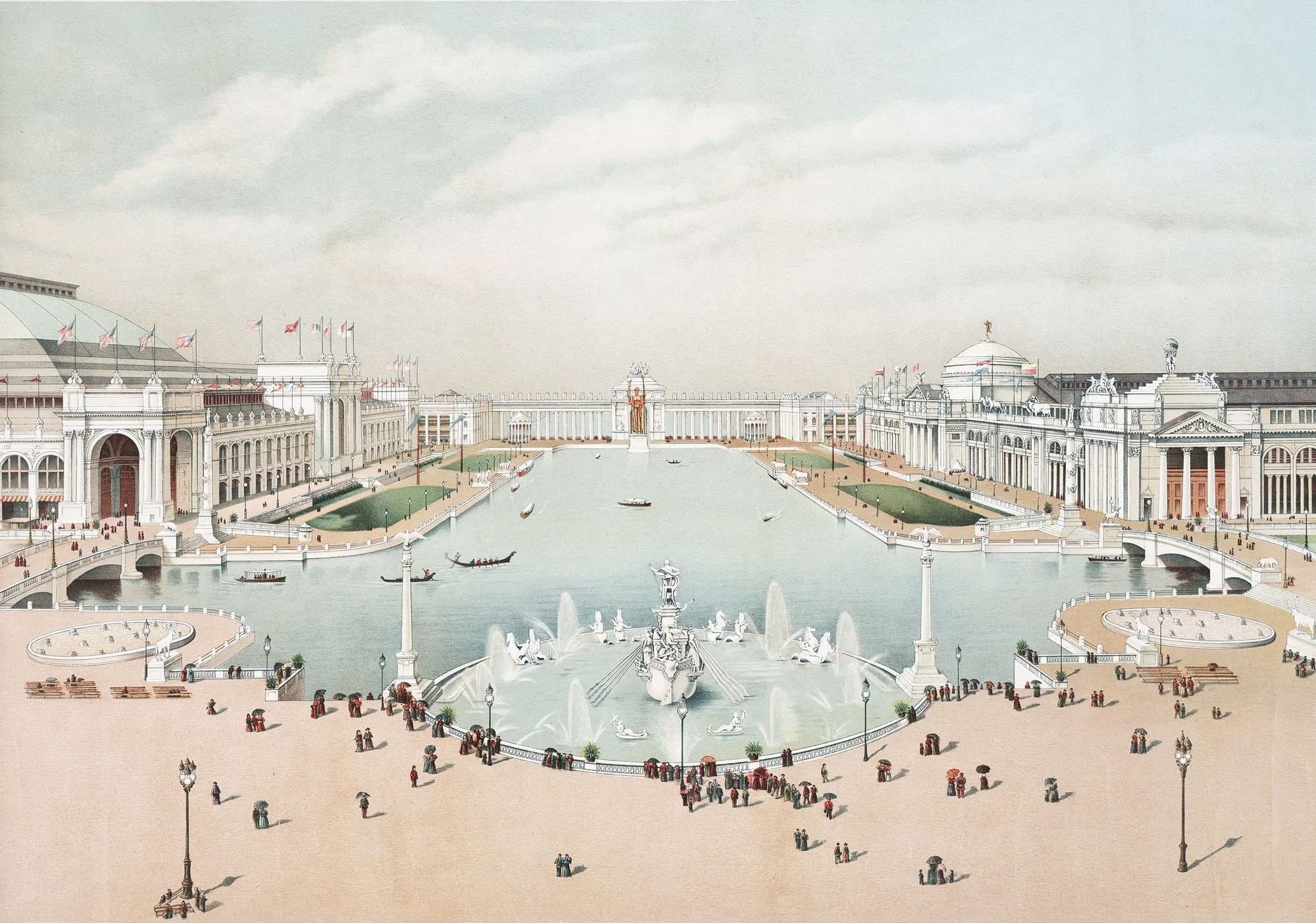
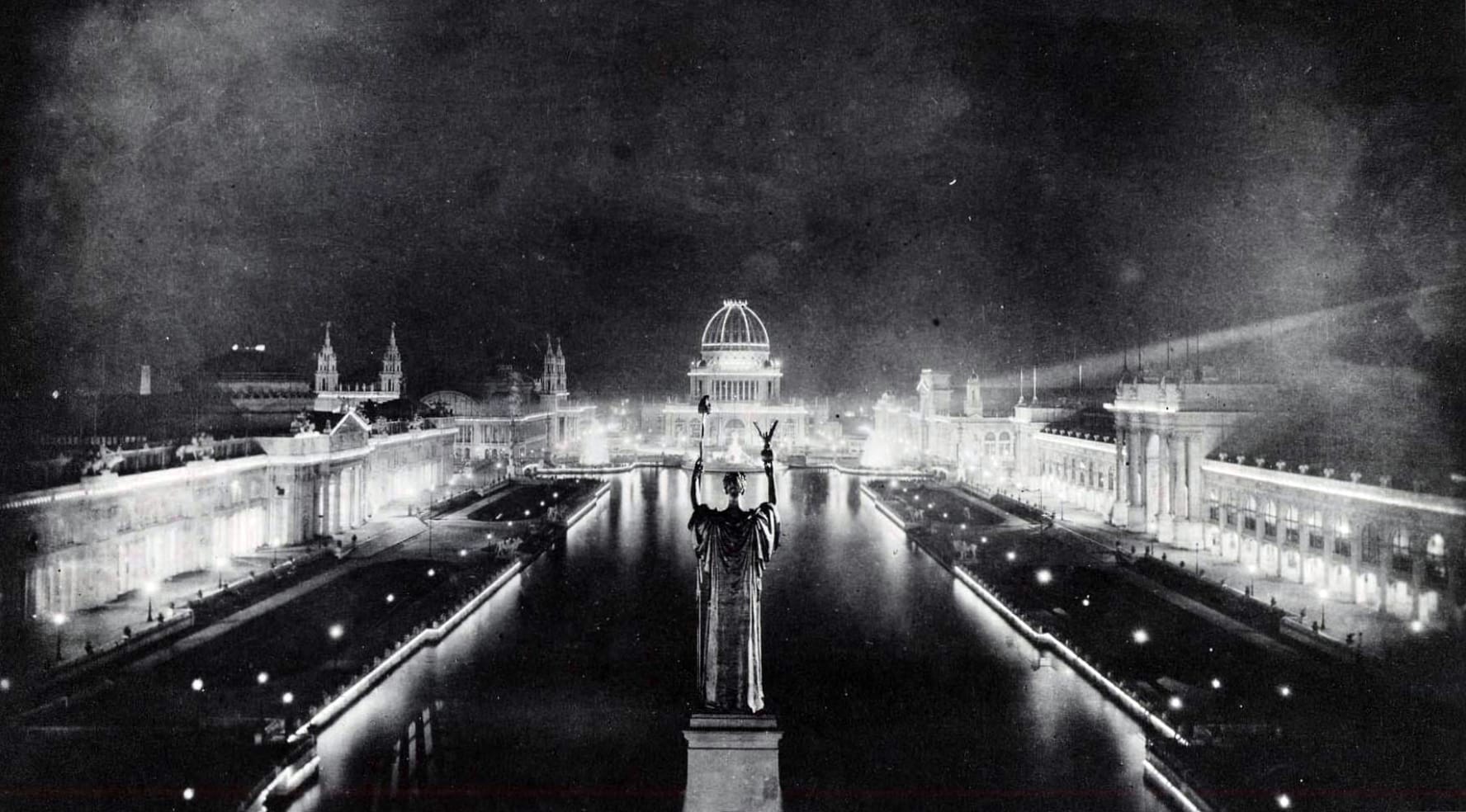
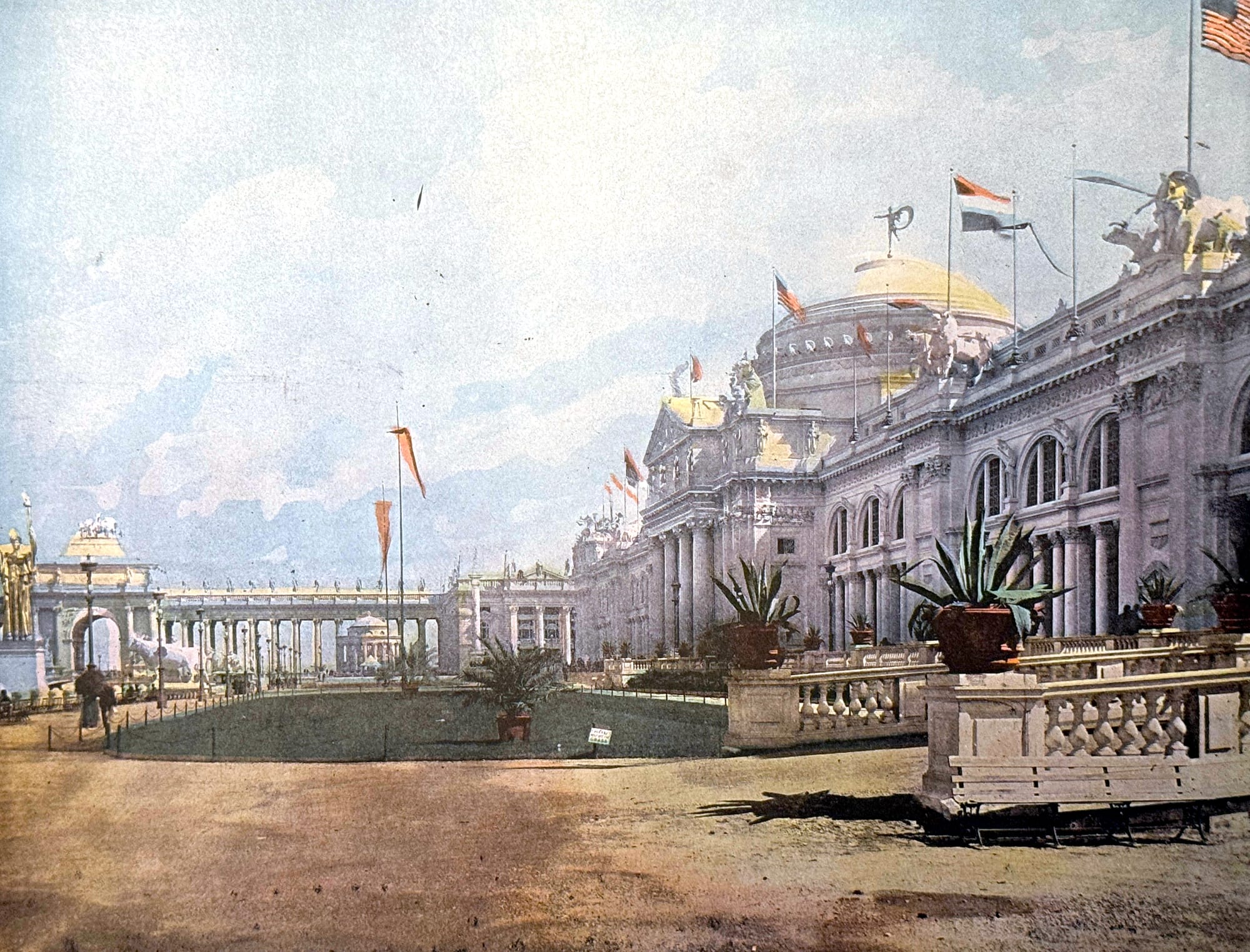
Writers of all stripes have catalogued the diversity of its appeal. For a population that had only just become majority urban, Chicago was an attraction in and of itself. Down in Hyde Park, the glass-roofed exhibit halls offered unbeatable publicity to manufacturers in an advertising environment of catalogues and newsprint. Over at the fair’s Midway, visitors delighted in its carnival attractions while its ethnographic displays shook assumptions about humanity. More than any of that, however, what lingered longer in people’s memory was the central complex of the fair. Known officially as the “Court of Honor,” and colloquially as the “White City,” it was an ensemble of monumental plaster facades that shone in the daytime and glowed after dark in a lavish display of Westinghouse electric light—still radiant with the shock of the new. Hundreds of organizations held their annual meetings behind its facades and nearly a third of all Americans visited.
Even the White City had its dark side.
It is not possible to trace every path that crossed in the White City. Some people were wowed and went home with the merch. Others were transformed. One such pilgrim was a journalist named Charles Mulford Robinson. In the 1897 official history the fair, he described the experience of entering the Court of Honor as something like an ego death:
The faculties were all alert; he forgot himself or he felt the limits of his own personality slipping away, extending widely, boundlessly, until the whole scene was in his own soul. That was the first, unanalyzed impression of the Fair; not the impression merely of the artist, the architect, or the poet, but of the everyday person, sounding infinite depths whose existence he never had known before.
He was far from alone in seeing the otherworldly in the design. In 1895, Frances Hogson Burnett, better known as the author of The Secret Garden, published a children’s parable, Two Little Pilgrims’ Progress, A Story of the City Beautiful. The short book follows two orphan children as they visit the fair while reading the 17th century Christian allegory Pilgrim’s Progress. In Burnett’s retelling, the spiritual journey is a physical one. The Celestial City that serves as Pilgrim’s aim in the fable, it turns out, was right there on the shores of Lake Michigan, reached for reasonable fare. Contemporary reviews of the book were mixed. None that I have found, however, objected to the comparison she made between this for-profit festival and actual literal Heaven.
Here’s another question. How much do you think about the Barcelona Summer Olympics? Woodstock ’94? Michael Jackson’s halftime show at Super Bowl XXVII?
Each of these brief events from roughly thirty years ago was deeply influential in its own time and on the industries they were part of. Yet I think it’s safe to say that they don’t hold our memory as well as media from 1993 like Whitney Houston’s rendition of I Will Always Love You or Stephen Ambrose’s A Band of Brothers. Events are definitionally less tangible and less accessible. The memory itself persists more in more the fragments of souvenirs. The historian David Burg counted over a dozen novels featured the Fair as a setting or even plot device over the following decades. Some reveled in its heyday; others frolicked in its ruins. In most cases, it was a setting or even a plot device, not the character that Burnett made it.
Colorized engraving from The Book of the Fair, by H. H. Bancroft, 1893
On the other side of the First World War I, the only people who seem particularly interested in the fair are urban planners. Seeing it as the spark for their movement, they approached it with historical, rather than immediate, reverence. Like the general public, their eyes were focused on the unfolding of modernity. As charted by economist Robert Gordon, the technology that had seemed magical in 1893 grew increasingly mundane. Its aesthetics, on the other hand, looked quainter with every year. Not only was there no jazz at the Columbian Exposition, there wasn’t even ragtime. When Chicago again hosted a World’s Fair in 1933, it invoked its predecessor primarily to emphasize just how far they had come in two generations.
Perhaps the clearest illustration of the Exposition’s faded mystique is its absence in the artistic medium that dominated the 20th century. From the establishment of the first studio in Hollywood in 1912 until 2017, only a single major motion picture covered the Fair—and even then, it dramatizes the Midway, not the White City. It’s a biopic of skimpresario Florenz Ziegfeld featuring Myrna Loy as Billie Burke, who herself was about to achieve immortality for introducing the world to another fantasy city—this one, Emerald.
Honestly, I was surprised at how thin the fair’s top-line cultural impact was for most of the 20th century. Not that I did a truly exhaustive search, but outside of Chicago it was a topic for the history books and apologetic statements by urban planners, especially when compared to the city’s dark side. Only PBR, it seems, held to the faith.
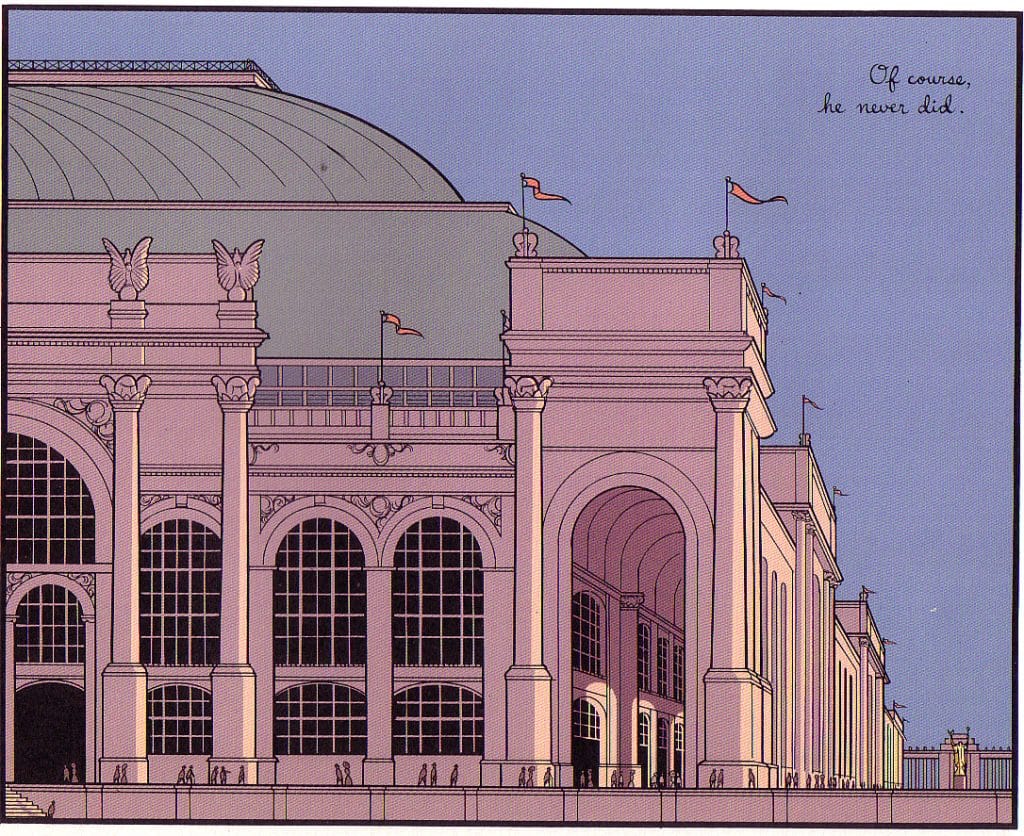
Frame from Chris Ware’s Jimmy Corrigan, the Smartest Kid on Earth
The dream of the 90s was the dream of the 90s
Things changed in the 1990s. The centennial of the Fair in 1993 summoned a host of books, local TV documentaries, and exhibits.
Still, these might not have added up to much, if a cartoonist named Chris Ware hadn’t broken his legs. Unable to walk for weeks, he read up on Chicago’s history and began to incorporate some of this background into the strip he ran in the local alt weekly (what could be more 90s than that?). Definitively published in 2000, Jimmy Corrigan, the Smartest Kid on Earth, features multiple sequences set at the fair. More so than almost any work since Burnett’s fable, it shows the White City as a space of unmatched wonder. The ornate structures fill page after panel and from every angle. Ware’s style draws heavily from severe technical drawing and slick advertisements. Yet rather than dulling the grandeur of the Roman designs, it makes them look Platonic—celestial even.
Ultimately, though, it looks like the revival of interest in the World’s Fair was actually the work of the Devil: 2003’s The Devil in the White City. Hanging 300 weeks on the New York Times bestseller list, Erik Larson’s narrative nonfiction book revived not only the magic of the Court of Honor, but also the motif from 19th-century works that the rest of Chicago was a place of lethal danger. The moment by Lake Michigan had an alluring ambiguity, like CK One.
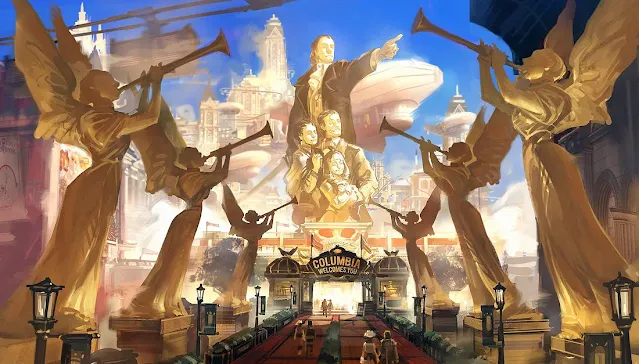
Others saw it too. Novels, movies, shows, video games, memes: every medium and every genre has found its way to the Court of Honor since then. It been a setting for both Thomas Pynchon and the Marvel Cinematic Universe, it was namechecked by Sufjan Stevens, and it inspired the richly disturbing first person shooter BioShock Infinite. Of all the media that has riffed on Fair since hipsters started drinking PBR in Williamsburg, this game best tackles the themes that historians had been uncovering beneath the great plaster facades: Christian nationalism, racism, and patriarchy—all on the eve of Ferguson and Gamergate, organic cultural events that, like the Chicago Fair, continue to shape our culture even if they aren’t on our minds.
In-game advertisement for the floating city of Columbia in BioShock Infinite.
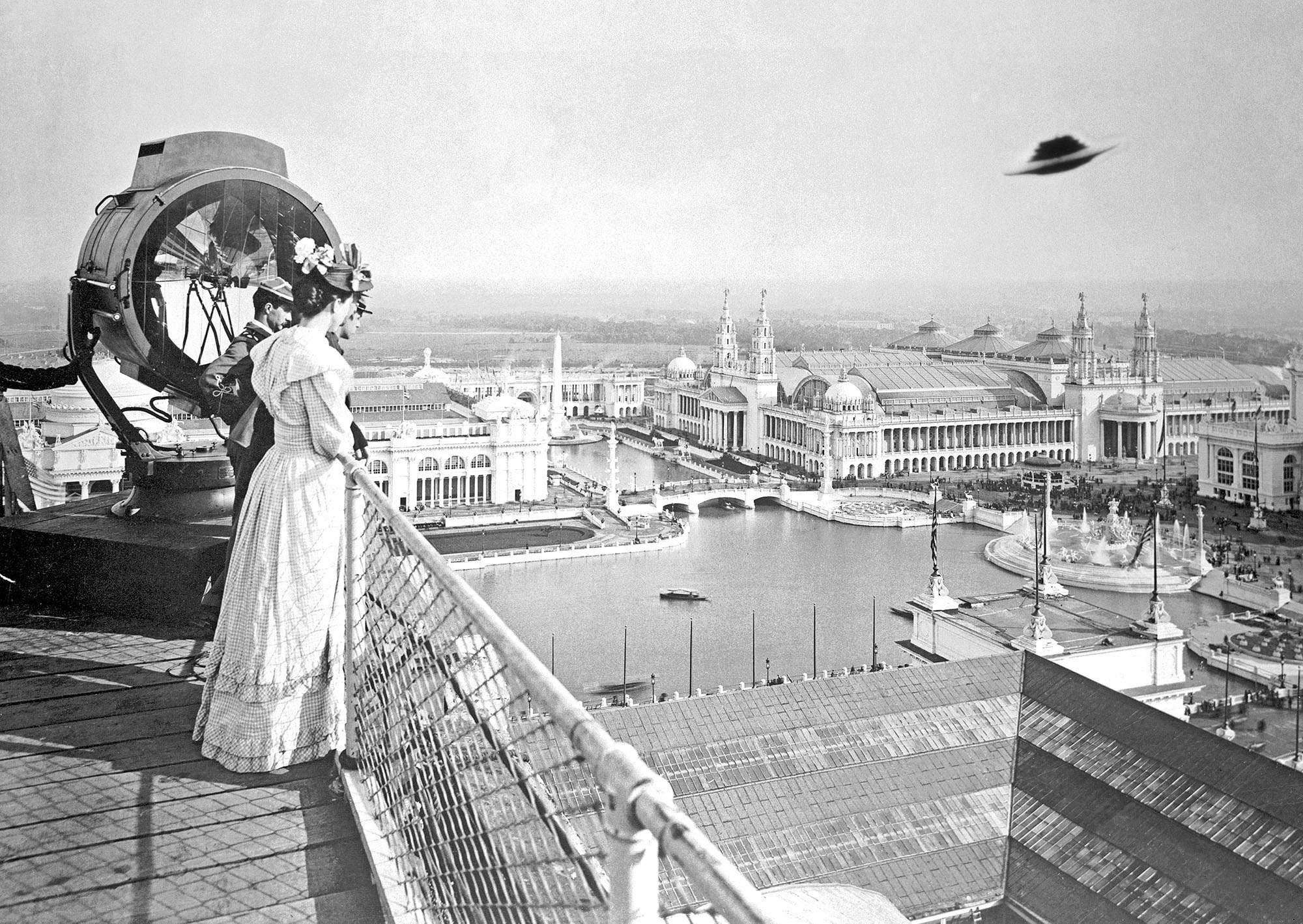
One advantage the game had over any of the novels about it was that it is a visual medium. Architecture photographs better than it reads. So perhaps it’s not a surprise that we also see a simultaneous revival of wonder around the fair on the basis of photographs alone. The internet made sharing image across the globe incomparably easy. With this came a collapse in context. A scan posted by the Art Institute of Chicago with academic reserve might get shared on Reddit with Millennial amazeballs, and then after six other reshares, appear on the Facebook feed of someone who began to wonder if our dysfunctional society really built all that grandeur for a single summer before even the automobile.
By 2016 at least, an the skepticism had hybridized with Russian “phantom time” theories: it like so many other grand 19th Century buildings was, in fact, the ruins of a superior lost airborne Tartarian civilization, destroyed in a great flood that left mud all over the streets. Don’t believe it? Then why is there mud all over the streets in these photos I found on Telegram? I bet you really think that guy lit the Olympic cauldron in Barcelona with an arrow.
As seen in the 1993 documentary series “The X-Files.”
You are part of the creative process
But as I said at the beginning, I think there is a surprising throughline from Burnett to Larson to u/TengristMulder93, which is… imagination. Both fiction and nonfiction require re-interpreting the bare existence of the Court of Honor, a space that most interpreters did not visit. When trying to re-present historical events, we must undertake process that is inherently imaginative, if not creative in its own right. Both conspiracists and historians of imperialism like Robert Rydell must dig beneath the White City to find a deeper meaning. Others like Burnett or the designer of that sad little Great Fair, architect Nicolas Charbonneau, need to color well outside those lines to get their point across.
The difference, then, is what each of these creators brought to the Fair. Ware built his depression-fueled vision of the White City off of extensive research in both secondary and primary historical sources. Those, in turn were built off of imaginative processes that were disciplined by historical methods: theory, the archive, and a consensus that the centuries between the fall of Rome and the construction of Monadnock Building actually happened.
In contrast, for believers in the Mudflood or those yearning to RETVRN, the historical context is of negative value. For the former group, their deep distrust in the institutions that provide provenance means they are free to read between the lines at a level a historian can only dream of. And once that skepticism has generated has generated a theory, it enables more, richer readings, and on and on until you conclude that H. H. Richardson is a composite character invented by the Preceptors of the Hollow Earth. In that way, Tartaria is an unmistakable a product of another invention released in ’93: the World Wide Web.
For the more learned reactionaries who want to reheat the White City (and the National Mall is just the beginning), the images of the fair are likewise a pinboard for their own imagining. While utterly fantastical, the buildings are nevertheless just familiar enough. The spaces are as bare of street filth as they are flush with the kind of ornament that to many seems less possible in 2026 than space travel did in 1893.
So, the minds behind statue avatars on x dot com revel in the capital-o Order and capital-b Beauty of the images, without much concern the underlying reality: the photos show not a city, but a temporary theme park. That is not the point; like Burnett or Charles Mulford Robinson, they believe that the grand halls could be how our cities look. Whether they are willing to develop the expertise and create a social movement like visitors to the fair did is a different story. This past summer’s styrene Midway wasn’t promising.
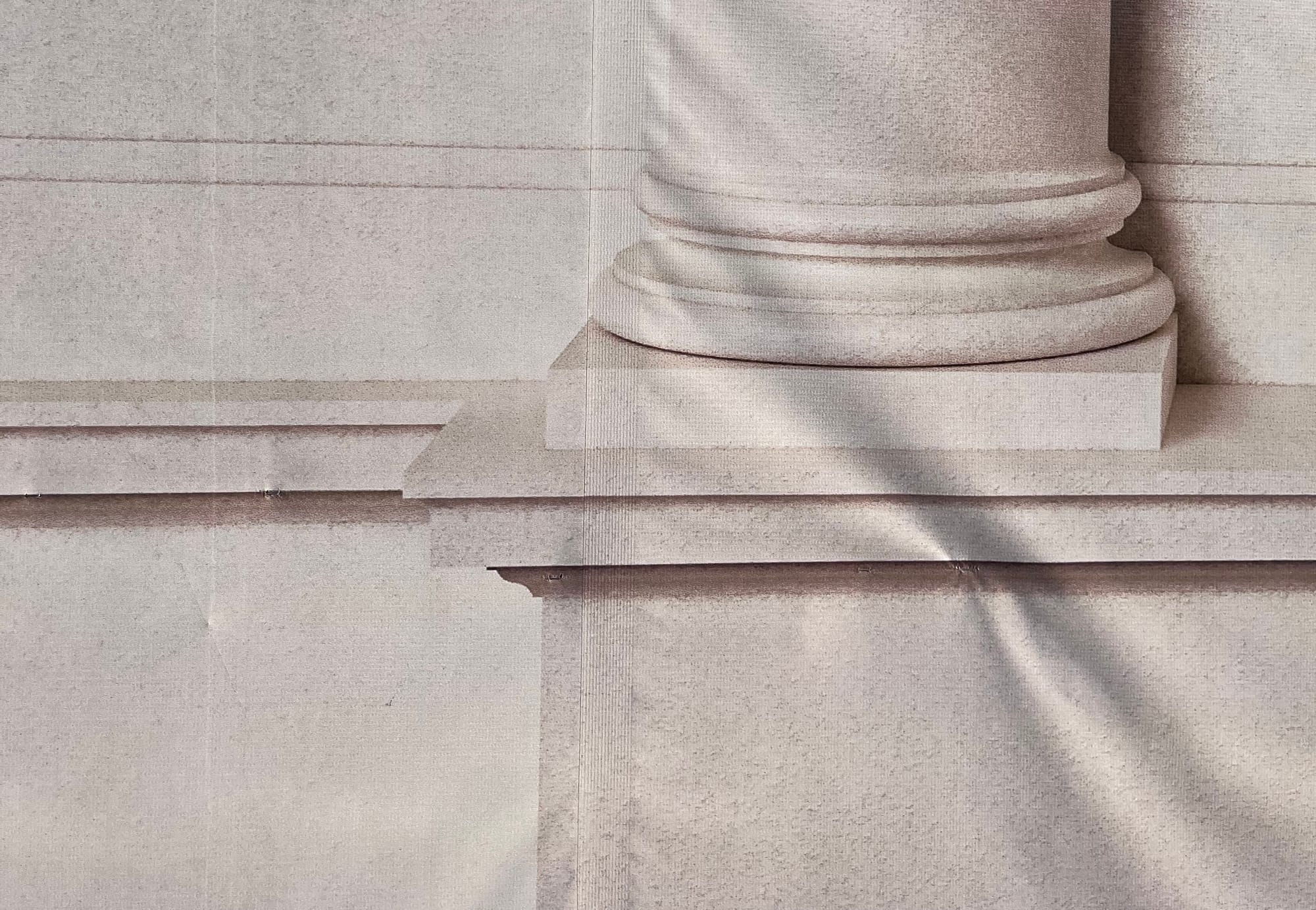
Tuscan column printed on to a vinyl tent at the Great American State Fair.
As an architect, I get it. Stripping context from a reference is often the beginning of aesthetic innovation. Proof is right there in the White City, where motifs had been borrowed from huts to temples to churches to palaces and last of all to grand light filled halls that helped sell sewing machines. As Fair designer Henry Van Brunt described the design team’s objectives in 1892:
It was considered that a series of pure classic models, in each case contrasting in character according to the personal equation of the architect… would present to the profession here an object-lesson so impressive of the practical value of architectural scholarship and of strict subordination to the formulas of the schools… This is not architecture in its highest sense, but rather a scenic display of architecture.
In other words, the White City was a creative act of deracination that in turn was meant to spur the imaginations of others. Sampling European opulence to the rhythm of American consumerism produced a powerful eyeworm. It was an advertisement for a certain kind of architecture, a certain approach to city making, and a certain way of organizing labor. Just like influencers cultivate interaction and imitation, Burnham’s boys created participatory spectacle… and it worked. You and I are still thinking about it now.
So maybe the more revealing question is: why did people stop thinking about it?
In my opinion—and this is just my interpretation—is context. With a new style of architecture debuting at each subsequent fair, even those who experienced the Court of Honor directly brought that sense of obsolescence to their own memories of the Fair. For those who only encountered it secondhand, they did so within the context of narrativized and constructed history. If they saw images, they found them on grandma’s shelves or on the right column of their AP US textbook.
This presents a challenge to those, like historians, who aim to convey what exactly the Columbian Exposition was and meant. To provide context—to say nothing of critique—is to get in the way of the fundamental purpose of the great White City on the shores of Lake Michigan: to invite people to imagine what the world could be.
I still think it’s possible. But on the other hand, historians can’t even agree on how important the Fair actually was. I will talk about that in a future newsletter.
The Great Ziegfeld, dir. Robert Z. Leonard. (Metro-Goldwyn-Mayer, 1936).
Jurassic Park, dir. Steven Spielberg (Universal Pictures, 1993).
The Wizard of Oz, dir. Victor Fleming et. al. (Metro-Goldwyn-Mayer, 1939).
Ambrose, Stephen E. Band of Brothers: E Company, 506th Regiment, 101st Airborne, from Normandy to Hitler’s Eagle’s Nest. New York: Simon & Schuster, 1992.
Ross, Rebecca. “Picturing the Profession: The View from Above and the Civic Imaginary in Burnham’s Plans.” Journal of Planning History 12, no. 3 (2013), 269-281. https://doi.org/10.1177/1538513213481762
Rydell, Robert. All the World’s a Fair: Visions of Empire and American International Exhibitions, 1876–1916. Chicago: University of Chicago Press, 1984.
Schuyler, David. “Frederick Law Olmsted and the World’s Columbian Exposition.” Journal of Planning History 15, no. 1 (2016): 3-28.
Selzer, Adam. H. H. Holmes: The True History of the White City Devil. New York Skyhorse Publishing, 2019.
Stevens, Sufjan. “Come On! Feel the Illinoise! (Part I: The World’s Columbian Exposition).” Track 4 on Illinois.
Taylor, Dorceta. The Environment and the People in American Cities, 1600s-1900s: Disorder, Inequality and Social Change. Durham: Duke University Press, 2009.
Ware, Chris. Jimmy Corrigan, the Smartest Kid on Earth. New York: Pantheon Books, 2000.
Wilson, William H. The City Beautiful Movement. Baltimore: Johns Hopkins University Press, 1994.
Van Brunt, Henry. “Architecture at the World’s Columbian Exposition.” The Century Magazine 44, no. 1 (May 1892) p. 81-99.
There is a huge amount of work on the Fair. If you’re interested, this website has compiled an extensive bibliography and indexes of all the other media you can consume with or without context.
And why would you remember that old Fair, when didn’t have real innovation:
Sept. 22 (UPI) — A former U.S. Postal Service worker has been indicted forallegedly throwing away about 300 mail-in ballots earlier this year in Utah.
The U.S. Department of Justice unsealed the indictment Tuesday as Damon Matai Seei, 34, of Payson, Utah, appeared for his arraignment at the Orrin G. Hatch U.S. Courthouse in Salt Lake City.
Seei was indicted by a federal grand jury on Wednesday. He faces charges of unlawful secretion, destruction and delay of mail for allegedly throwing the ballots into a dumpster in a church parking lot.
Justice Department officials alleged in a detention memo that Seei said in an interview that he threw away the ballots and other mail on June 3 to “lighten his workload.” He said in a written statement that he felt “overwhelmed” that day and decided to “get rid of advertisement mail.”
Seei said he had no political agenda and didn’t mean to throw away ballots, the memo said, but that he made a “poor decision” out of “frustration” and “laziness.” The ballots were to be delivered to Eagle Mountain, Utah, residents to allow them to vote in the June 23 primary election.
“When American voters lawfully cast their vote, they should feel confident that it is counted,” said acting Deputy Attorney General Trent McCotter in a statement. “Allegedly throwing away hundreds of ballots is a serious federal crime that undermines the integrity of our elections. Ballot integrity is not a partisan issue.”
Seei’s next court appearance is set for Nov. 30.
The indictment comes as U.S. President Donald Trump has, without evidence, alleged an epidemic of voter fraud, especially in mail-in voting. Last week, the U.S. Supreme Court rejected the administration’s plans to limit mail-in voting for the November midterm elections.
Sept. 22 (UPI) — U.S. Treasury Secretary Scott Bessent said Tuesday that the Trump administration is looking into whether a diesel export ban would help surging diesel prices in the United States.
“We’re examining whether it’s feasible in terms of the overall refining capacity and whether a full or partial ban would work,” Bessent said at a meeting between U.S. President Donald Trump and Ukrainian President Volodymyr Zelensky at the United Nations in New York City.
Asked if he would endorse a ban, which other Republicans have called for, Trump said Tuesday that he has called for the measure as well.
“I said let’s not send out the diesel,” he said. “We make a lot of diesel.”
The United States is experiencing record high prices for diesel, with the fuel’s price soaring to an average of $6.53 per gallon Monday, according to AAA. U.S. refiners have escalated diesel exports as refineries in Russia and the Middle East deal with attacks and transportation issuescontinue.
Trump said the decision on a ban would be “fast, one way or another.”
Economists and energy experts said that a diesel export ban would could lower U.S. prices in the short term but would eventually backfire and lead to higher prices globally, including in the United States, Axios reported.
Sen. Chuck Grassley, R-Iowa, is one of the Republican lawmakers calling for a diesel export ban as prices climb and the November midterm elections approach. Others, including Sen. John Cornyn, R-Texas, called it a “gimmick.”
Mike Sommers, American Petroleum Institute CEO, said a ban would “only compound the problem” and eventually hurt consumers.
“The answer is more supply and more flexibility — not new restrictions that risk making a difficult situation worse,” Sommers said, Axios reported.