Preloader

Technology

China’s Huawei branded a criminal enterprise as tech firm’s US trial opens

a courtroom sketch of a lawyer speaking in front of people

Taylor Stout, a lawyer for the Department of Justice, makes opening statements at the start of the bank fraud trial against China’s Huawei Technologies as judge Ann Donnelly presides in federal court in Brooklyn, New York, on Wednesday in this courtroom sketch. Photograph: Jane Rosenberg/Reuters

Taylor Stout, a lawyer for the Department of Justice, makes opening statements at the start of the bank fraud trial against China’s Huawei Technologies as judge Ann Donnelly presides in federal court in Brooklyn, New York, on Wednesday in this courtroom sketch. Photograph: Jane Rosenberg/Reuters

China’s Huawei branded a criminal enterprise as tech firm’s US trial opens

The defense says: ‘It’s about competition, not conspiracy’

A US prosecutor described China’s Huawei as a criminal enterprise that stole from US companies to build its telecommunications empire, as ⁠the trial against the tech company kicked off in Brooklyn federal court on Wednesday.

“Theft, lies, cover-up,” Taylor Stout, a trial attorney from the US Department of Justice, said in the government’s opening statement. “For 20 years, that’s how Huawei, a massive Chinese telecommunications company, victimized American companies ⁠and abused the American financial system, all ⁠in an effort to dominate the telecommunications ​industry around the world.”

Huawei conspired to steal trade secrets from five US companies, including operating system source code for internet routers from Cisco Systems and a robotic arm to test phones from T-Mobile, to gain an unfair competitive advantage and grow its business, ⁠the prosecutor told jurors.

“We’ll hear from people who caught Huawei red-handed trying to steal American tech,” Stout said, adding there was video of an employee stealing the robotic arm.

The defense painted a very different picture of the company and its success in court.

“It’s about competition, not conspiracy. Innovation, ⁠not theft. Ordinary business dealings, not criminal conduct,” Brian Heberlig, one of a team of lawyers representing Huawei, said in his opening. “Huawei earned its success … There was no blueprint for crime.”

Huawei is known ​for its telecommunications equipment, mobile phones and, in recent years, AI chips. It does ‌business globally but its networking gear is restricted in ‌the US and suppliers are banned from exporting US goods and technology to the company without approval from the Department of Commerce.

On Thursday, a Chinese foreign ministry spokesperson said “the Chinese ‌government firmly opposes the US side’s suppression and containment of Chinese enterprises,” when asked about the case and the US prosecutor’s “criminal enterprise” description.

China “firmly supports Chinese enterprises in safeguarding their legitimate rights and interests”, the spokesperson said at a regular press conference.

The case against Huawei began in 2018 with an indictment charging the company and its chief financial officer with bank fraud and sanctions violations for allegedly misrepresenting its business in Iran to get around US sanctions and move millions of dollars through the US financial system.

In the ensuing years, it grew into a sprawling indictment that includes racketeering, a pattern of illegal activity conducted by an enterprise to generate profit.

Heberlig, defending Huawei, told jurors that prosecutors will describe routine activities ‌by global tech companies “but will twist those ordinary activities to try to make them look criminal”.

skip past newsletter promotion


He said the incidents involving Cisco and T-mobile were “actions by individual employees” and that ​management worked to make things right after learning of them.

The prosecutor also accused the company of keeping the nature of its work in Iran secret so it could launder US dollars through the financial system and could help the Iranian government spy on its own citizens. The defense said there was no evidence Huawei knew the dollar-clearing would violate US sanctions law.

In 2018, Huawei’s chief financial officer, ​Meng Wanzhou, was detained in Vancouver after being picked up on ​a US warrant as a part of the original indictment. She fought extradition for nearly three years before being freed to return to China ​in a diplomatic agreement between the US, China ‌and Canada.

The charges against her ​were dismissed in 2022 as part ​of a deferred prosecution agreement but admissions she made are set to be introduced as evidence at the trial, which is expected to last three months.

Explore more on these topics


Source: Technology

I turned off my algorithm for 24 hours. Is this how social media used to be?

Caitlin Cassidy stands against a brick wall

‘For 24 hours, I decided to manually turn off my algorithm via little-known settings on Instagram to get a sense of how the reforms might change my feed,’ Caitlin Cassidy writes. Illustration: Guardian design

‘For 24 hours, I decided to manually turn off my algorithm via little-known settings on Instagram to get a sense of how the reforms might change my feed,’ Caitlin Cassidy writes. Illustration: Guardian design

I turned off my algorithm for 24 hours. Is this how social media used to be?

Thanks to a little-known feature in Instagram, I try to travel back to 2012 – before everything on the internet was an ad

I have a confession. I love my social media algorithm. It is a perfectly curated window into my insane and inquiring mind. It knows precisely which videos will tickle me and which memes will gently distract me from the slow collapse of humankind.

On Tuesday the Australian government announced “world-leading” reforms that would force social media platforms to allow users to opt-out of algorithms, dubbed “my feed, my way”. On the same day, I was delighted to be confronted with a video on Instagram of a woman accidentally spilling a bucket of eels on a Chinese train. Dozens of eels slithered among the passengers, who appeared not as surprised as I would have expected.

In bed that night, after sending the video to several friends and watching it multiple times, I lamented to my partner how I would find content like this if my accounts weren’t at the whim of the algorithm gods. “You can still search for eels,” he said. But would it be the same?

So, for 24 hours, I decided to manually turn off my algorithm via little-known settings on Instagram to get a sense of how the reforms might change my feed. This feature – accessed simply by tapping on the Instagram logo at the top of the home screen – allows you to limit your feed to posts from accounts you are following, in chronological order. This is basically what social media feeds, including Facebook, looked like when they started.

Would I be thrust back into the old days of social media, to how things were before artificial intelligence and Elon Musk bought Twitter and everything became an ad?

Caitlin Cassidy restarts her algorithm. Photograph: Blake Sharp-Wiggins/The Guardian

As a reminder of how things used to be, I scroll back to my first posts on Instagram and find sepia-heavy pictures of trees, gigs and friends. “The SKY,” says one, simply showing a sunset.

I am gripped with nostalgia for 2012, when all my posts got eight likes and no comments and I only followed two dozen close friends from school.

For a truly “authentic” social media experience, I trawl through my contacts and unfollow any account that isn’t a person I have met in real life. It is refreshing to unfollow news accounts, and politicians, but sad to let go of funny influencers and meme accounts and chefs.

“Goodbye, Ottolenghi,” I think wistfully. “Farewell, woman from Dallas Cowboys cheerleaders.” In total, about 100 accounts get the axe. I refresh my feed, and it only takes about 10 minutes of scrolling to run out of content to look at.

Anthony Albanese announces the digital duty of care draft law, which would allow Australians to opt out of algorithms used by social media companies. Photograph: Lukas Coch/AAP

For the first time in years, Instagram informs me I have reached the “End of following”. “There are no more posts from accounts that you follow from the past 30 days,” it says.

I am floored and unmoored. Each time I refresh my feed for the next few hours, there is nothing new for me to mindlessly scroll. Instinctively, I keep clicking on the app but it’s futile. Is this how social media used to be? A tool to communicate with people rather than a way to remain constantly distracted?

What disturbs me, though, scrolling through a feed that should theoretically be made up of friends and family updating me about nice moments in their lives, is that it still feels hollow and impersonal.

Mostly, people are using it for self-promotion, whether it be posting about something they’ve published, projects they’ve done, brand partnerships or attempts to “go viral”. The only ones who seem to be using social media as it used to be are my mum and her friends, who still upload happy snaps with abandon. This is soothing but also very boring. And do I really need to know or care that someone I met backpacking in 2015 is appearing at an art festival in Amsterdam?

Caitlin Cassidy’s algorithm. Photograph: Caitlin Cassidy/The Guardian

During my lunch break, instead of hitting the apps, I read my book and look at my surroundings. It’s nice. Maybe the solution is not to opt out of algorithms but to opt out of social media altogether.

The justification for turning off algorithm-driven content makes sense. The federal government and many experts have raised concerns about how dangerous and divisive content can be pushed into people’s feeds, drawing them further and further into rabbit holes.

I have watched on with concern as figures from the “manosphere” gain traction across the world alongside the rise of far-right parties, and how thinness appears to be the new norm in Hollywood, with eating disorder content proliferating on X, TikTok and Instagram.

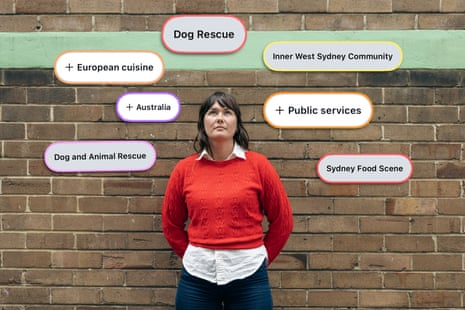
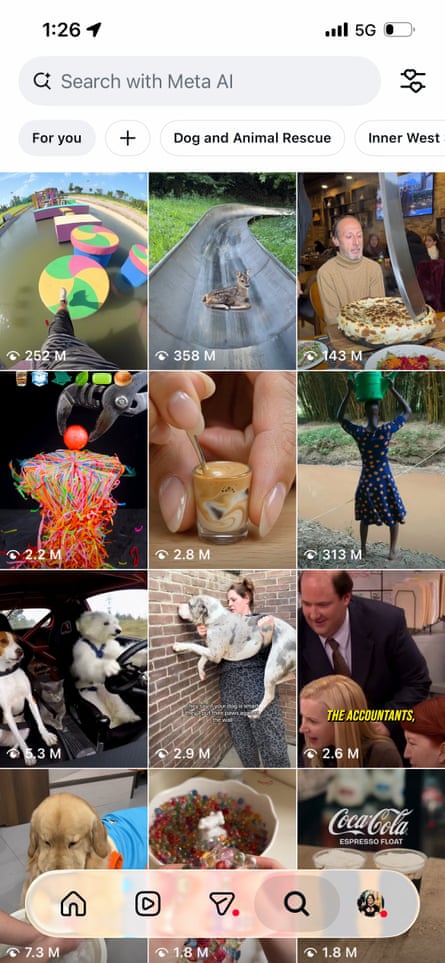
Thankfully, this has not been my social media experience. According to Instagram’s AI summary of my algorithm, a little-known feature of the app, I enjoy “community events” and “saving furry friends”, with a particular penchant for content related to the “Sydney food scene” and, somewhat vaguely, “Australia” (click on the reels icon and then the double-heart symbol in the top-right corner to see yours).

My “For You” page is a haphazard collection of animals, food and gossip about reality TV. The top posts are an old man who summarises the latest episodes of Below Deck Mediterranean, a dachshund being pet with a spatula and someone making a cake with the face of Edward Cullen. It knows me so well!

But is this healthy? Do I really need to spend my time watching AI-generated dogs dancing in the shower, or marvelling at a man attempting to eat an extremely gigantic cone of soft-serve ice-cream? After 24 hours switching off, my conclusion? It’s numbing my brain and turning my own thoughts into slop.


Source: Technology