✓Showcase your talent and win big in Artists Network prestigious art competitions! Discover competitions in a variety of media and enter for your chance to win cash prizes, publication in leading art magazines, global exposure, and rewards for your hard work. Plus, gain valuable feedback from renowned jurors. Let your passion shine through – enter an art competition today!
Showcase your talent and win big in Artists Network’s prestigious art competitions! Discover competitions in a variety of media and enter for your chance to win cash prizes, publication in leading art magazines, global exposure, and rewards for your hard work. Plus, gain valuable feedback from renowned jurors. Let your passion shine through – enter an art competition today!
We’re pleased to present the winners of our annual competition, juried by Patrick Saunders (Dog Category), Rita Kirkman (Cat Category), and John Plishka (Other Category), with Best in Show selected by our editorial team. Thank you to everyone who entered! Your work not only makes for an exceptional field, but also helps support efforts to reduce animal homelessness and suffering through our partnership with the American Society for the Prevention of Cruelty to Animals (ASPCA).
TAKE A LOOK AT THE WINNERS’ CIRCLE
BEST IN SHOW
Velvet (watercolor on paper, 15 x 13) by Bev Jozwiak
✓Showcase your talent and win big in Artists Network prestigious art competitions! Discover competitions in a variety of media and enter for your chance to win cash prizes, publication in leading art magazines, global exposure, and rewards for your hard work. Plus, gain valuable feedback from renowned jurors. Let your passion shine through – enter an art competition today!
Blue by You (oil on panel, 8 x 8) by Diane Hoeptner
“Sibling rescues as witnessed at a Northeast Ohio animal shelter were the inspiration for Blue by You. I loved how differently they presented here. One looks rather forlorn; the other is occupied with grooming.
“My intention was to capture what I saw, based on reference photos taken at the shelter and my memory, and try to accentuate the differences between the cats. I had a vague notion to play up opposing colors: blue and orange. I cooled down the background colors and then spent a lot of time fine-tuning the fur texture and patterns.
“Nearing the end, I decided the piece needed more oomph. I tried a band of saturated turquoise in place of the shelter-issued white identification collar, and it was the finishing touch that brought the composition together. It’s a good reminder that, sometimes, it’s those last strokes that can really make a painting.” —Diane Hoeptner
Why it Stands Out
“This one hit me straight in the heart at the very first glance! Aside from the confident brushwork and daring composition, this pose packs an emotional punch. The softly harmonious colors enhance the sweetness between these two cats, and their connection transcends mere felinity, attaching deeply to the viewers’ humanity.” —Rita Kirkman, Juror
Honorable Mentions
Abbee (acrylic on board, 2 x 3) by Linda Rossin
Footloose (acrylic on canvas, 36 x 12) by Vie Dunn-Harr
King of Time (charcoal on paper, 13 x 20) by Rosanna Gaddoni
Jasmine (acrylic on panel, 30 x 24) by Jasmine M. Brodrick
The Critic (watercolor batik on rice paper, 14 x 19) by Kathie George
Meet the Artist
Ohio-based artist Diane Hoeptner is known for her small oil paintings of cats. Drawing inspiration from rescue shelters, cat shows and rural farms, she creates evocative narratives that resonate with collectors worldwide. In addition, small animals, vintage patterns, drifting leaves, and butterflies offer enchanting components to her compositions. Notable books featuring her art include Cats in Art, The Book of the Cat and Daily Painting. She holds a B.A. in studio arts from California State University, Northridge.
✓Showcase your talent and win big in Artists Network prestigious art competitions! Discover competitions in a variety of media and enter for your chance to win cash prizes, publication in leading art magazines, global exposure, and rewards for your hard work. Plus, gain valuable feedback from renowned jurors. Let your passion shine through – enter an art competition today!
The annual AcrylicWorks: Best of Acrylic competition has been celebrating incredible skill and talent in the medium of acrylic for more than a decade. We’re grateful to Juror of Awards Marc Hanson and the many luminaries who have served as jurors over the years, as well as the thousands of artists who have participated. Together, we’ve created a prestigious, highly anticipated showcase that not only applauds artistic excellence but also celebrates a thriving acrylic community that just keeps getting stronger. We’re delighted to reveal the top three prizewinners of this year’s competition, and share Hanson’s insights on what made these works stand out.
First Place: Moonlight on the Robe (acrylic on canvas, 36×24) by Xiaopeng Liu
“I found this painting to be beautifully and competently painted in every regard. More than that, I had an emotional response at first viewing that never left me as I continued to consider it, and all the other paintings. The beauty of the paint surface, the use of a specific color scheme for effect and a masterful rendering of the figure all combine to make a very powerful image––one that I’m thrilled to be able to award with a first-place accolade.” ––Marc Hanson, Juror
Second Place: Snapdragons (acrylic on canvas, 60×48) by Paul Vollman
“This is an outstanding example of a powerful, but sensitive, use of the acrylic medium. The artist did a wonderful job of applying the academic principles of painting to the composition. I was also impressed by how beautifully he used the complements of red and green in various mixtures––two colors that, in combination, can be a nightmare to handle––to create such a soothing painting.” ––Marc Hanson, Juror
Third Place: Walk of Adoration (acrylic and ink on canvas, 30×48) by Jennifer Sowders
“The artist who painted this piece has been in this woodland, and it shows. I was amazed that the work has a lot of rendering, but it’s done so well. And I was surprised by how accurate it is without being overdone. It’s a beautiful example of using acrylic in a bold-yet-delicate way—and it’s outstanding.” ––Marc Hanson, Juror
About the Juror
Marc Hanson majored in illustration at the Art Center College of Design, in Pasadena, Calif., before moving to Minnesota, where he lived for 33 years while raising a family and pursuing his career as a professional artist. He currently lives near Savannah, Ga., on Tybee Island, with his partner—fellow painter, Dottie T. Leatherwood—and their three dogs. His paintings, which have received numerous awards, have been shown in galleries and museums nationally and internationally for more than 40 years.
*The Best of Acrylic: Winners of the AcrylicWorks 13 Competition special issue hits newsstands today! Print and digital issues are available for purchase at Artists Network.
Take on complex, multi-figure compositions with California artist Warren Chang’s step-by-step demo! Learn how Chang combines multiple photo reference into a harmonious scene, establishes depth through a tonal underpainting, and a practical framework for organizing figures to create compelling narratives!
✓Showcase your talent and win big in Artists Network prestigious art competitions! Discover competitions in a variety of media and enter for your chance to win cash prizes, publication in leading art magazines, global exposure, and rewards for your hard work. Plus, gain valuable feedback from renowned jurors. Let your passion shine through – enter an art competition today!
By John Roman
If there’s one word in an artist’s vocabulary that’s most likely to induce panic, it’s this one: perspective. Not to worry, though. In this illustrated guide, you can learn the basics of linear perspective with visual aids—and even poetic rhymes—to help you keep the information fresh in your mind and ready to put into practice.
The Drawing the Third Dimension Guide is a free verse, end-rhyming poem that describes the technical terms of Linear Perspective with accompanying illustrations to clarify each definition. In the days prior to the printed word, lessons were learned by setting them to rhyme. With that in mind, I created this guide to be read, re-read, absorbed, and practiced over the entire course of one’s artistic journey. Download it here. Print it out. Put a copy above your art table where you can reference it as often as you need to.
And, if you’d like to dig even deeper into the topic of perspective, check out these additional articles I’ve written about the history, the workings and the power of perspective:
John Roman is an award-winning illustrator and the author of The Art of Illustrated Maps: A Complete Guide to Creative Mapmaking’s History, Process and Inspiration (HOW Books). He has taught illustration and perspective drawing at Boston’s Massachusetts College of Art and Design since 1993.
✓Showcase your talent and win big in Artists Network prestigious art competitions! Discover competitions in a variety of media and enter for your chance to win cash prizes, publication in leading art magazines, global exposure, and rewards for your hard work. Plus, gain valuable feedback from renowned jurors. Let your passion shine through – enter an art competition today!
An exhibition of the artist’s emotionally charged floral paintings goes on view, in London, for the month of September.
By Anne Hevener
Sun and Shadow (1999–2001; oil on canvas, 96×72)
The celebration of the work of American artist Jimmy Wright is hopping the pond this month with a 5-week exhibition at Thomas Dane Gallery, in London, in collaboration with Chicago gallery, Corbett vs. Dempsey. Entitled “After the War,” the London show will feature the artist’s flower paintings, made in oil and pastel, from 1992 onwards.
Born in Union City, Tenn., in 1944, Wright grew up in rural Kentucky. As a young man, he moved first to Chicago, where he studied at The Art Institute of Chicago, and then moved to New York City in 1974, where he has lived since. It was when his partner, Ken Nuzzo, was diagnosed with AIDS, in 1988, that Wright began his paintings of flowers, infusing the traditional still life subject with an emotional vitality that communicated feelings of pain, grief and the enduring power of love. Characterized by thick applications of paint and an underlayer of acrylic modeling paste that creates a sculptural quality, Wright’s initial series of works, called “Flowers for Ken,” launched what would be a lasting creative inquiry. The Thomas Dane Gallery writes that the artwork being shown in the “After the War” exhibition, “can be seen as portraits of the artistic community lost to the pandemic.”
An Inside Look at Sun and Shadow
Wright’s story of the making and meaning of the piece, Sun and Shadow (seen above; 1999–2001; oil on canvas, 96×72), a monumentally sized piece that the artist worked on for more than three years, describes the hidden tension behind bold, powerful floral imagery and the fragility they represent:
“I had completed a series of flower-basket paintings as diptychs—familial twin baskets of flowers that could be installed either as a single painting in two parts, averaging 12 feet in length, or as two individual, 6-foot paintings that communicated across a room or wall,” he says. “The Shadow is the top basket of cool blue sunflowers—a heavy, overbearing storm cloud passing over the lower basket of warm, sunlit sunflowers, The Sun, which formally pushes forward in the pictorial space. A silver slice of white light on the left side of the composition acts like the lever on a slot machine, propelling the heavy, cool basket forward in an endless, visually dynamic struggle of opposing forces on a flat canvas.
“I call my flower paintings ‘Trojan Horses,’ because—while they masquerade as appealing, seductive still lifes of flowers—they are memento mori representations of nature that explore themes of loss, survival and memory, serving as monuments to the fragility of life and beauty.”
“After the War” is on view from September 4 to October 1, 2026, at Thomas Dane Gallery, 11 Duke Street, St James’s, London SW1.
In an article for Pastel Journal(February 2019), Wright advised artists not to let technique overpower the art. “Many artists put the cart before the horse,” he said. “And they apply technique with such rigidity that it suffocates the art. Technique has to come out of the search for art.” Here are some additional examples of works by the artist, created in pastel, that demonstrate putting the expression at the forefront.
✓Showcase your talent and win big in Artists Network prestigious art competitions! Discover competitions in a variety of media and enter for your chance to win cash prizes, publication in leading art magazines, global exposure, and rewards for your hard work. Plus, gain valuable feedback from renowned jurors. Let your passion shine through – enter an art competition today!
[SPONSORED CONTENT]
Traveling offers a unique window into new cultures, distinctive landscapes, and unforgettable moments. While it’s easy to rely on smartphones to snap quick photos, being an artist offers a profound alternative that allows us to slow down and connect more deeply with world. Embracing art on your journeys can transform a simple vacation into a deeply immersive and reflective experience.
Tips for Painting on Location
When you plan to paint during your travels, the first step is to be highly intentional about your energy and focus. Time on location is often limited, meaning you cannot do everything. Rather than stressing over the absolute perfection of drawing accuracy or complex compositional framing, consider shifting your perspective entirely. Use the painting process primarily to record your personal experience, emotions, and presence in the moment. Letting go of rigid structural expectations frees your mind from distractions and anchors you in the immediate environment.
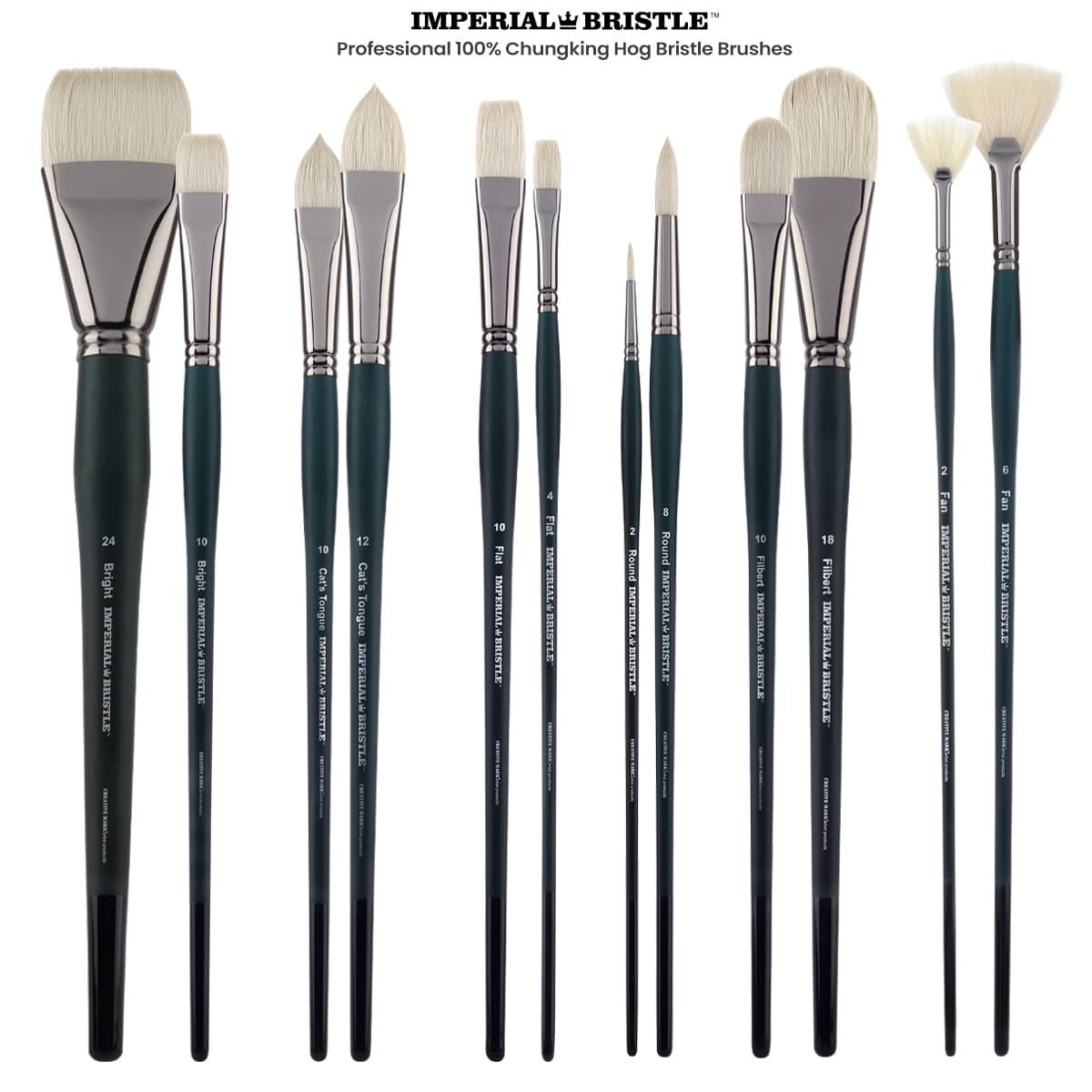
To make the most of your time on location, your choice of materials plays an essential role. It is highly recommended to pack high-quality paints, brushes, and surfaces that you are already thoroughly familiar with. Traveling is not the time to test new paints, mediums or equipment. When you use tools you trust, you already know exactly how the colors mix and how the paint performs on the surface. This ensures you do not waste precious time fighting your materials when you should be absorbing the landscape.
When painting outdoors, let your primary artistic goal be an exploration of changing light and color. The aim isn’t to create a flawless masterpiece on the spot, but to capture an authentic color study that reflects your real-time sensory experience.
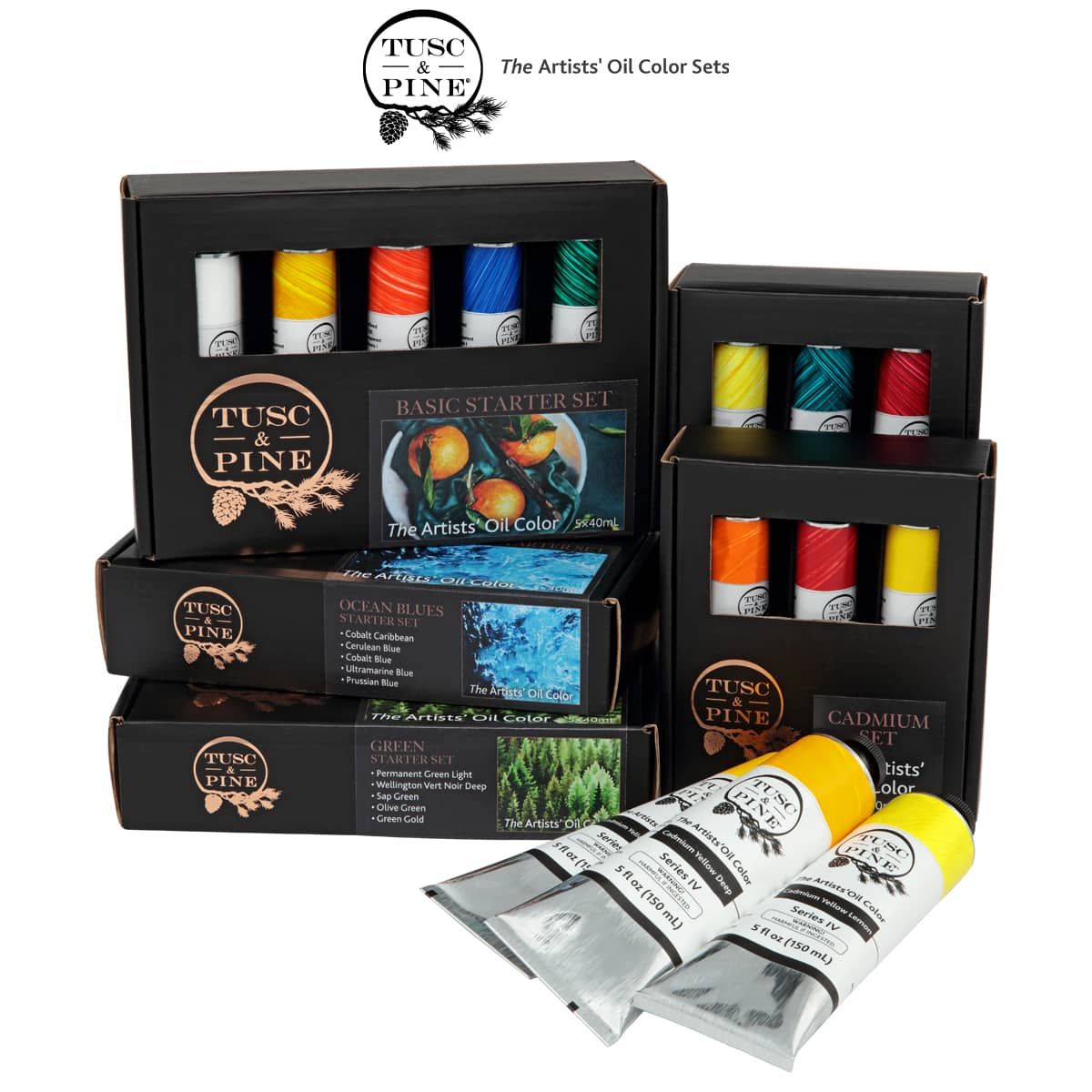
Working with Tusc & Pine Artists’ Oil Paints as part of my plein air setup.
Once your outdoor session is complete, your plein air study becomes a valuable building block. Back in the controlled space of a studio, you can revisit the piece. Here, away from the changing elements, you can use reference photos to adjust proportions, fix drawing errors, and refine the composition. In this workflow, the initial outdoor painting doesn’t act as a rigid, restrictive roadmap; instead, it serves as a powerful psychological trigger that unlocks memories of the experience.
Ultimately, travel painting leaves you with three distinct gifts: your raw plein air study, a finished studio piece, and a concrete, multi-sensory memory of the space. Long after you return home, looking at your work will bring back more than just a visual image. It will vividly recall the sounds of the environment, the scent of the air, the quiet atmosphere, and the exact feeling of watching the light move across the land. By being selective with your energy and prepared with your tools, you can build a deeper, lifelong connection to the world through your art.
About the Artist
Scott Maier is an artist, instructor, and a content contributor to artistsnetwork.com. He’s an adjunct instructor at Rocky Mountain College of Art and Design, as well as the author of these instructional art books:
✓Showcase your talent and win big in Artists Network prestigious art competitions! Discover competitions in a variety of media and enter for your chance to win cash prizes, publication in leading art magazines, global exposure, and rewards for your hard work. Plus, gain valuable feedback from renowned jurors. Let your passion shine through – enter an art competition today!
The first day of a new school year—traditionally the Tuesday after Labor Day in the U.S.—means new notebooks, fresh pencils and, if you’re lucky, a little art history. Step into the classroom paintings of Winslow Homer (American, 1836–1910) and find out if you can make the grade on six school-day scenes from one of America’s great painters.
Shown above: School Time (ca 1874; oil on canvas, 12 1/2 x 19 1/4) by Winslow Homer. Credit: National Gallery of Art, Collection of Mr. and Mrs. Paul Mellon, 2014.18.19.