Preloader

Technology

Meta bets big on wearable AI, new AI agent as Zuckerberg pushes back against AI doom

Meta bets big on wearable AI, new AI agent as Zuckerberg pushes back against AI doom

Andrew Zinin

Chief Editor

Meta bets big on wearable AI, new AI agent as Zuckerberg pushes back against AI doom
Meta CEO Mark Zuckerberg speaks during the Meta Connect conference, Wednesday, Sept. 23, 2026, in Menlo Park, Calif. Credit: AP Photo/Jeff Chiu

Meta is going all in on a consumer-friendly AI agent and pushing forward with AI-powered wearable devices during a moment in the industry when its CEO Mark Zuckerberg acknowledged it is a “wild time to be building.”

At the company’s annual Connect conference on Wednesday, Zuckerberg opened his keynote address by saying “it’s no secret that people in the industry have a wide range of views about how the future is going to go.” But at Meta, he said, “we are optimists because we believe in people.”

Zuckerberg has distanced himself and Meta from recent calls by rival companies for a coordinated slowdown in the development of advanced artificial intelligence, arguing that individual labs can and should ensure their technology is safe.

“We believe that the best way to create a positive future for everyone is to put power in people’s hands,” he said at the conference. “We believe that empowering people is the source of prosperity in the world, that the highest purpose of superintelligence is creation and invention—not automation—and that the path to a safe future is to distribute this technology widely and create the right checks and balances, rather than concentrating it in the hands of just a few.”

Zuckerberg has long said he believes wearable AI will eventually replace smartphones as the primary way people interact with technology. At the conference, the company unveiled a slew of updates to its smart glasses and virtual reality goggles, which let people control their interface using their voice, eyes and hand and finger movements.

Meta bets big on wearable AI, new AI agent as Zuckerberg pushes back against AI doom
Meta CEO Mark Zuckerberg speaks during the Meta Connect conference, Wednesday, Sept. 23, 2026, in Menlo Park, Calif. Credit: AP Photo/Jeff Chiu

AI agent Muse is the ‘centerpiece’ of Meta’s vision

Zuckerberg said that Meta’s recently launched agent Muse is the “centerpiece” of Meta’s hopeful outlook for the future of AI.

Having an AI agent, which goes beyond chatbots in that it can act and perform tasks on a person’s behalf, has been a “sign of someone who is completely AI-pilled,” Meta’s chief AI officer Alexandr Wang said at the conference. With Muse, Wang said, Meta is making agents more accessible and bringing “personal superintelligence” to everyone.

With the help of a mascot for the agent that looks like a plush toy, Wang and senior leadership at Meta demonstrated different uses for the Muse in everyday life. Users will be able to have real-time voice conversations and video chats with their version of the agent, which can also be customized to look and sound unique. The agent can help users plan travel, book reservations, order groceries and complete other helpful tasks. Meta has partnered with companies like OpenTable, Spotify, Ticketmaster and more to help its agents complete these tasks.

Meta bets big on wearable AI, new AI agent as Zuckerberg pushes back against AI doom
Attendees wait for Meta CEO Mark Zuckerberg’s keynote address during the Meta Connect conference, Wednesday, Sept. 23, 2026, in Menlo Park, Calif. Credit: AP Photo/Jeff Chiu

The company is working to bring Muse to its AI glasses lineup for hands-free access.

Zuckerberg also said Meta is planning to release a keychain-like device that has the “whole Muse experience” packed into it, called Muse Charm, in time for the holidays in December. The palm-sized device will allow users to engage with a personal AI agent without using a phone, computer or smart glasses.

New AI audio glasses and new updates to popular models

Meta is launching an audio version of its more widely known smart glasses. The new product will let users listen to music, make calls and talk with an AI assistant—there’s just no screen, and no video recording, which has raised privacy concerns with some users recording people without permission. Called Ray-Ban Meta Audio, it will be available in October and the cost starts at $349.

Meta bets big on wearable AI, new AI agent as Zuckerberg pushes back against AI doom
Alexandr Wang, Meta Chief AI Officer, speaks during the Meta Connect conference, Wednesday, Sept. 23, 2026, in Menlo Park, Calif. Credit: AP Photo/Jeff Chiu

Meta is also building upon a previous feature that allowed glasses wearers to better hear a conversation in a noisy environment. Now, Zuckerberg said, a feature called hearing enhancement turns your glasses into an “FDA-cleared, over-the-counter hearing aid” that can “compensate for perceived mild to moderate hearing loss.” The feature will launch in the U.S. later this year and will be available to add to supported AI glasses for $150, or with a Meta One subscription.

The Meta Ray-Ban Display glasses have been upgraded with new features, including improved cycling and transit navigation and a personalized hologram for video calls.

The company is also offering more styles to appeal to a broader range of people and says it will have more than 100 different options across its Ray-Ban, Oakley, and Meta Glasses by the end of the year. The glasses will also be available in more countries, including Turkey, Hong Kong and the Philippines.

The newest generation of the classic Ray-Ban Meta glasses is also now available, with what the company touts as a slimmer, sleeker design and increased battery life, among other upgrades. The Generation 3 models are available now with prices starting at $449.

Meta bets big on wearable AI, new AI agent as Zuckerberg pushes back against AI doom
Meta CEO Mark Zuckerberg speaks during the Meta Connect conference, Wednesday, Sept. 23, 2026, in Menlo Park, Calif. Credit: AP Photo/Jeff Chiu

Virtual reality gets a makeover with Meta VR

Glasses

The most drastic update announced at the conference is to the company’s VR device, now called Meta VR Glasses. That is because the previous bulky headset has been replaced by a set of glasses, which weigh about 100 grams (3.5 ounces), or roughly as much as a deck of cards. In comparison, the Meta Quest 3, which launched in 2023, weighs about five times that much. The difference feels similar to that between scuba diving and swimming goggles.

While they are significantly lighter and more sleek than VR predecessors, the glasses require a wired connection to an external puck for battery, storage and compute.

Instead of controllers or a neural wristband that past headsets or glasses required, the VR glasses use an eye-tracking camera and sensor that essentially lets your eyes be the computer cursor and your fingers the mouse clicker. If you want to open an app, for instance, you look at it and use hand and finger gestures, or use voice commands to talk to the Meta AI agent.

In a demo at its Menlo Park, California, headquarters on Tuesday, Meta showed off entertainment and work offerings on the glasses, including sports events and concerts that replicate the experience of having courtside or front-row seats. A new feature called “VR Enhanced Cinema,” meanwhile, seeks to immerse viewers in the movie by transforming their surroundings beyond the screen into a virtual world inspired by the movie, with dynamic effects, 3D visuals and spatial audio.

Once the glasses launch, users will have access to more than 100 immersive live sports events from that courtside-like view, because of partnerships with ESPN, MLB, NBC Sports, TNT Sports and UFC. The glasses can also function as a gaming console, Meta said, and there will be more than 75 games at launch that users can play solely with hand gestures.

The glasses can also be used for work. Users can conjure a virtual keyboard on any flat surface and use the display as their computer screen (or several screens) only they can see. For even more of a robust setup, users will be able to connect their Mac or Windows PC to seamlessly transition onto these screens, and bring their own keyboard and mouse. The VR glasses, unlike headsets of the past, will let wearers see their desk setup and surroundings while they work.

One of Zuckerberg’s live demos of the night also showed off the glasses’ ability to use hologram technology to project a photorealistic digital version of a person, including their real-time expressions and reactions, for hands-free video calling.

The VR glasses will launch in the spring of 2027 and cost $1,300.

Key concepts

Agentic consumer AIAI wearables

Who’s behind this story?

Andrew Zinin

Andrew Zinin

Master’s in physics with research experience. Long-time science news enthusiast. Plays key role in Science X’s editorial success.

Full profile →

© 2026 The Associated Press. All rights reserved. This material may not be published, broadcast, rewritten or redistributed without permission.

Citation:
Meta bets big on wearable AI, new AI agent as Zuckerberg pushes back against AI doom (2026, September 24)
retrieved 24 September 2026
from https://techxplore.com/news/2026-09-meta-big-wearable-ai-agent.html
This document is subject to copyright. Apart from any fair dealing for the purpose of private study or research, no
part may be reproduced without the written permission. The content is provided for information purposes only.

Source: Tech Xplore

As compact as reinforced concrete, but more sustainable: Wood-based floor slab passes load test

As compact as reinforced concrete, but more sustainable: Wood-based floor slab passes load test

Swati Mestri

Scientific Editor

Andrew Zinin

Chief Editor

As compact as reinforced concrete, but more sustainable: Wood-based floor slab passes load test
Load test of the UniversalTimberSlab demonstrator with a 20-metric-ton load in front of visitors at the Future Cleantech Festival in Remscheid. Credit: University of Stuttgart / ICD/ITKE/IntCDC

Reinforced concrete floor slabs account for about 40% of buildings’ embodied carbon emissions. Until now, however, there has been no practical alternative for complex, multistory buildings.

Using a construction demonstrator, researchers at the University of Stuttgart have shown for the first time how floor slabs can be built sustainably with an innovative timber-concrete composite system.

The demonstrator, tested in June as part of the Future Cleantech Festival in Remscheid, showcases “UniversalTimberSlab”—the first point-supported timber-concrete composite flat slab for long, two-way spans.

“With the UniversalTimberSlab, we aim to make multistory timber-concrete composite construction significantly more flexible, performative and adaptable. The demonstrator is the result of several years of research at the University of Stuttgart and is based on innovative digital design and manufacturing methods,” says Achim Menges, professor and director of the Institute for Computational Design and Construction (ICD) and spokesperson for the Cluster of Excellence “Integrative Computational Design and Construction for Transformative Architecture” (IntCDC).

A timber-concrete composite flat slab for multistory mixed-use buildings

“UniversalTimberSlab” is as slender and performative as a reinforced concrete slab but significantly more sustainable. The system relies largely on wood, a renewable resource, as well as material-efficient construction and circular design.

As compact as reinforced concrete, but more sustainable: Wood-based floor slab passes load test
Prefabricated glued-laminated timber segments make the new floor slab system cost-effective. Credit: University of Stuttgart / ICD/ITKE/IntCDC

Compared with conventional post-and-beam timber floor slab systems, which require deep beams for larger two-way spans, the compact “UniversalTimberSlab” reduces the structural height by 30 to 70 centimeters (12 to 28 inches). That offers a significant cost advantage: With the same floor-to-ceiling height, a building can accommodate more stories, and the facade area is reduced by up to 20%.

“UniversalTimberSlab” also sets new standards for design possibilities in timber construction. The structural system is based on point supports, meaning building loads are transferred through columns that can be spaced relatively far apart. Load-bearing partition walls are not required; walls can be arranged freely as needed. In mixed-use buildings, this allows for flexible layouts tailored to retail, dining, offices and residential spaces.

Floor plans can also be reconfigured later if the building is repurposed. The new floor slab could thus help expand timber construction in urban areas.

The game-changers: New slab segmentation and digital design methods

In timber construction, larger slabs are divided into individual prefabricated elements. Previously, these elements and their supports had to be arranged along rigid grids for technical reasons. The “UniversalTimberSlab” system makes it possible to build both regular and irregular floor slab geometries.

The approach is based on a new, patent-pending segmentation method. Glued-laminated timber segments with straight laminations that are easy to prefabricate help keep costs down. The fibers in the floor slab are arranged to follow the flow of forces, optimizing the system’s load-bearing capacity.

The project also developed new digital design methods for timber buildings. During planning, AI-powered tools generate detailed models for numerous floor plan and building variations and assist with design optimization. For example, if a planner moves a column, the impact on costs, slab height and sustainability can be shown immediately.

Milestone: Successful demonstrator in Remscheid

“What was particularly exciting for us was that the first load test wasn’t conducted in the lab, but in front of the approximately 200 visitors at the Future Cleantech Festival in Remscheid. This made it possible to verify the load-bearing capacity required for construction under real-world conditions,” says Jan Knippers, professor and director of the Institute of Building Structures and Structural Design (ITKE).

For the structural test, the team built a full-scale floor slab demonstrator measuring 9 x 5 meters (30 x 16 feet), with a two-way span of 8 x 4 meters (26 x 13 feet), in just three months. At just 36 cm (14 inches) thick, it was as thin as a reinforced concrete slab with an equivalent load and span, yet required about two-thirds less reinforced concrete.

As a preliminary step, the researchers performed computer-aided calculations—so-called FEM simulations—to investigate how the floor slab deforms and vibrates under load. In the structural test, the demonstrator was loaded with a total of 20 metric tons in addition to its own weight. This allowed the team to test the load-bearing capacity for a heavily used office building with finish loads of 1.4 kN/m² and a live load of 3.0 kN/m².

The measurements confirmed the simulations, with a maximum deformation of only 12 mm. With a natural frequency of over 8 Hz—that is, eight oscillations per second—the floor slab met the deflection and vibration requirements for multistory buildings.

Prospects for rapid technology transfer: First pilot project in the planning stages

With the successful feasibility test, the researchers have reached a crucial milestone toward widespread use of “UniversalTimberSlab” in multistory wood construction. “The system builds on the existing manufacturing expertise of the wood construction industry. This means it has the potential to be rapidly deployed in larger construction projects once further development work is successfully completed,” says Hans Jakob Wagner, group leader at the ICD and head of the EIC Pathfinder project “UniversalTimberSlab.”

The first pilot building is already in the works: The town of Oberkochen in the German state of Baden-Württemberg is planning the “Zukunftsforum,” a three-story, 1,400 m² (15,000-square-foot) building constructed using the “UniversalTimberSlab” method. The building is intended to house exhibitions, workspaces, makerspaces, workshops and laboratories.

Key concepts

Low-carbon construction materials

Who’s behind this story?

Swati Mestri

Swati Mestri

Swati Mestri holds a bachelor’s degree in Electronics Engineering and has worked as a content editor since 2019. She has experience editing research documents across technology, health care, and materials science, and has a particular interest in technology and space.

Full profile →


Andrew Zinin

Andrew Zinin

Master’s in physics with research experience. Long-time science news enthusiast. Plays key role in Science X’s editorial success.

Full profile →

Citation:
As compact as reinforced concrete, but more sustainable: Wood-based floor slab passes load test (2026, September 23)
retrieved 24 September 2026
from https://techxplore.com/news/2026-09-compact-concrete-sustainable-wood-based.html
This document is subject to copyright. Apart from any fair dealing for the purpose of private study or research, no
part may be reproduced without the written permission. The content is provided for information purposes only.

Source: Tech Xplore

Engineers connect health wearables and implants using the body as the network

Engineers at a leading research institute have unveiled a novel way to link health wearables and implanted medical devices by treating the human body itself as a communication network. The new system, demonstrated in laboratory trials, uses the body’s natural electrical properties to transmit data between sensors on the skin and internal implants, eliminating the need for bulky external antennas or high‑power transmitters.nnThe technique relies on low‑frequency radio waves that propagate through body tissues, guided by the electrical conductivity of skin, muscle, and bone. By tuning the signal to match

Chinese auto companies race ahead on EV technology, achieving 5-minute ultrafast charging

Chinese automakers have announced a breakthrough in ultrafast charging, with several models now capable of reaching 80 % battery capacity in just five minutes. BYD, NIO, Xpeng, and Li Auto showcased proprietary high‑power charging systems that deliver up to 800 kW, a dramatic leap from the 150‑200 kW chargers common in the industry. The new technology relies on advanced battery chemistries and redesigned thermal management to handle the intense power flow without compromising safety or longevity.nnThe announcement comes amid a global push to shorten charging times, a key hurdle in mainstream EV adoption. China’s aggressive investment in battery research, coupled with supportive policies and a rapidly expanding charging infrastructure, has positioned it as the front‑runner in this race. Industry analysts note that the five‑minute benchmark could erase range anxiety for many consumers, making electric cars more comparable to gasoline vehicles in terms of convenience.nnWhile the breakthrough is a milestone, experts caution that widespread deployment will require significant upgrades to the national

Making AI more trustworthy by making it red-flag its own doubtful answers

Making AI more trustworthy by making it red-flag its own doubtful answers

Lisa Lock

Scientific Editor

Robert Egan

Senior Editor

online ads
Credit: Unsplash/CC0 Public Domain

Artificial intelligence models can give users the wrong answer and do so with great confidence. They can also hedge and warn that they are unsure—even when they get the answer right.

A study led by UC Riverside computer scientists helps explain why. Researchers found that confidence and correctness can arise from different internal features within large language models, challenging the assumption that a model’s confidence reliably indicates whether its answer is accurate.

Their discovery, published on the arXiv preprint server, could help build more reliable AI models. As large language models are increasingly used to inform decisions and complete tasks, developers need better ways to determine when their answers can be trusted.

By identifying internal features associated separately with confidence and correctness, the UCR-led research points toward ways AI systems could be adjusted so they are more confident when they are right and more cautious when they are likely to be wrong.

“The main assumption in the field is that when the model is confident, it is likely to be correct, and when the model is unsure, it is more likely to be incorrect,” said Het Patel, a UCR computer science doctoral student and lead author of the study. “But we often see the counterexamples that are well documented. A model can answer with certainty, but also be wrong, or it can answer while being less confident and can be correct.”

The researchers went beyond documenting that mismatch. They identified internal features associated with confidence and correctness and showed that altering some of them could change model behavior without the costly process of retraining an entire model.

Separating confidence from correctness

Patel explained that modern AI models are created by training enormous networks of mathematical units on vast amounts of data. During training, the network repeatedly adjusts billions of numerical parameters, called weights, as it learns patterns in the data. In a language model, those learned patterns allow it to predict which words are likely to follow others and ultimately generate responses to questions.

Patel and his colleagues wanted to know what was happening inside the models when confidence and correctness did not match.

They studied two “open-weight” large language models—Meta’s Llama-3.1-8B and Google’s Gemma-2-9B—whose internal workings researchers can examine. Using multiple-choice questions, they separated responses into four groups based on whether answers were correct or incorrect and whether the models were confident or uncertain.

They then used tools called “sparse autoencoders” to examine the models’ internal activity. That allowed them to determine which features became active with particular behaviors.

The analysis identified three kinds of features: those associated primarily with uncertainty, those associated primarily with incorrect answers, and “confounded” features associated with both. The researchers then suppressed selected features as the models answered questions. Patel compared the process to “turning knobs” inside a model to see how its behavior changed.

Different features, different effects

The differences were striking. Turning off features associated purely with uncertainty sharply reduced accuracy, suggesting those features play an important role in producing good answers. By contrast, suppressing most features associated solely with incorrect answers had little effect.

The confounded features produced a different result. Suppressing features associated with both uncertainty and incorrectness improved accuracy by up to 1.1% while reducing the models’ uncertainty by up to 75%. Similar effects appeared across different question-answering benchmarks.

The interventions are made when an already-trained model answers questions and do not require retraining it.

“In a sense, it’s kind of like adjusting or modifying the values of these activations or features after the fact to kind of get the behavior you want,” Patel said.

Internal signals flag risky answers

Another experiment suggests the internal signals could eventually help AI systems decide when not to answer. Using just three of the confounded features from a single middle layer of the Llama model, the researchers could predict whether the model was about to answer incorrectly. Having the model decline to answer the questions flagged this way raised its accuracy from 62% to 81% while it still answered about 53% of the questions.

By comparison, giving the model an “I don’t know” option and letting it abstain on its own raised accuracy only to about 64%. The results show the findings are not only observational; the same internal signal points to a practical step developers can take to make AI systems more reliable.

The researchers also found evidence that these internal features were not tied narrowly to individual benchmarks. Features identified using one benchmark produced similar effects when applied to others, suggesting they reflected more general characteristics of the models.

Beyond confidence and correctness

Patel said the approach could extend beyond confidence and correctness. Researchers could search for internal features associated with other desirable or undesirable AI behaviors and test whether manipulating them changes how models perform.

“You could pick another behavior you want or don’t want, find the features related to it the same way, and then work on those internal features to drive that behavior or reduce it,” Patel said.

Publication details

Het Patel et al, Are LLM Uncertainty and Correctness Encoded by the Same Features? A Functional Dissociation via Sparse Autoencoders, arXiv (2026). DOI: 10.48550/arxiv.2604.19974

Journal information:
arXiv

Key concepts

Large language models

Who’s behind this story?

Lisa Lock

Lisa Lock

BA art history, MA material culture. Former museum editor, paramedic, and transplant coordinator. Editing for Science X since 2021.

Full profile →


Robert Egan

Robert Egan

Bachelor’s in mathematical biology, Master’s in creative writing. Well-traveled with unique perspectives on science and language.

Full profile →

Citation:
Making AI more trustworthy by making it red-flag its own doubtful answers (2026, September 24)
retrieved 24 September 2026
from https://techxplore.com/news/2026-09-ai-trustworthy-red-flag.html
This document is subject to copyright. Apart from any fair dealing for the purpose of private study or research, no
part may be reproduced without the written permission. The content is provided for information purposes only.

Source: Tech Xplore

Albanese says OpenAI hacked Medicare and told Australia months later via email to generic inbox

Australian Prime Minister Anthony Albanese confirmed that OpenAI’s large‑language‑model system was used to breach the Medicare database, exposing personal health data. The breach, discovered in 2023, was not reported to Australian authorities until months later, when the company sent a generic‑inbox email to the government. Albanese said the delayed notification violated privacy laws and raised concerns about the security of sensitive medical records. He called for stricter oversight of foreign AI firms operating in Australia and urged a review of how such breaches are investigated and reported. The incident highlights growing tensions over data protection and AI accountability.

Meta debuts no-camera smart glasses and virtual reality spectacles

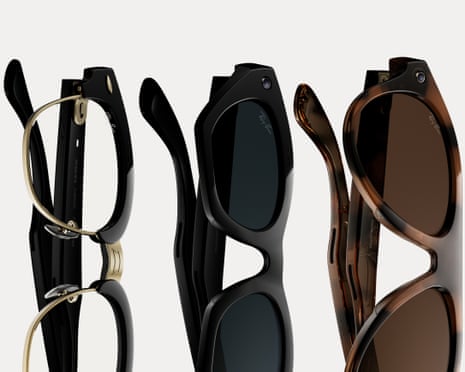
Three styles of Ray-Ban Meta Gen 3 glasses pictured on a white background.

The new Ray-Ban Meta Gen 3 AI glasses come in various styles, with or without a camera. Photograph: Meta

The new Ray-Ban Meta Gen 3 AI glasses come in various styles, with or without a camera. Photograph: Meta

Meta debuts no-camera smart glasses and virtual reality spectacles

The new wearables come at a time of uncertainty for smart glasses, which are facing backlash over privacy concerns

Meta announced an advanced new set of virtual reality glasses and a collection of new smart glasses Wednesday, including an audio-only version without a camera.

At the firm’s Meta Connect conference in Menlo Park, California, executives said the new Ray-Ban Meta models set new standards for battery life and weight. They said the new glasses with screens in the lenses squeeze capabilities previously reserved for a full headset into a light set of spectacles that rest on a user’s ears.

The new wearables come at a time of uncertainty for the smart glasses category, which is broadly facing a backlash from sceptics and privacy campaigners around their ability to record video, frequently being dubbed “perv glasses” or “spy glasses”. Meta’s smart glasses are the most popular gadget in the category.

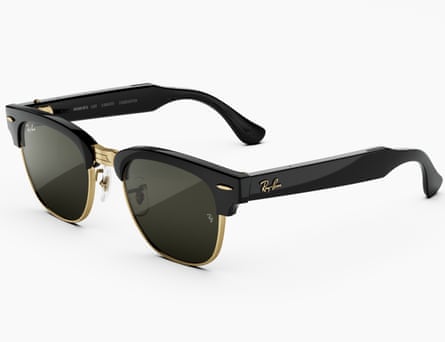
The Ray-Ban Meta Audio AI glasses Photograph: Meta

The Ray-Ban Meta Audio AI glasses seem tailored for the time. Lacking a camera, they may help avert some privacy worries, though Meta claims they have been in the works for several years. The glasses have microphones and speakers for music, calls and interacting with the company’s AI assistant, taking the recognizable form of Ray Ban’s Clubmaster or Burbank styles. The new versions are thinner and lighter than the camera versions and last up to 12 hours on battery and will cost £319 (€349/A$529).

The Ray-Ban Meta (Gen 3) aviators Photograph: Meta

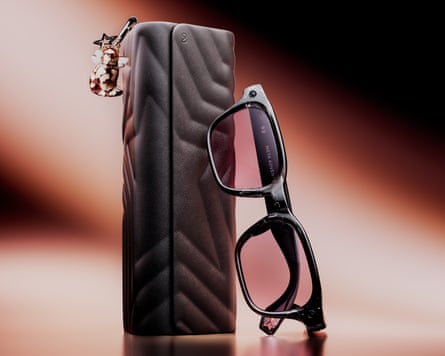
The new Ray-Ban Meta Gen 3 glasses, which do sport cameras, have longer battery life than their predecessors, lasting up to nine hours with support for Dolby Atmos audio. They will cost £409 (€449/A$679). Meta is also launching two new styles of its own-brand glasses in partnership with singer and actor Lisa. All of the firm’s smart glasses have an LED warning light that flashes when recording, but Meta said it has made improvements to its tampering detection, including during a livestream.

A set of Meta Glasses by Lisa in Adventurer style with their case. Photograph: Meta

Finally, Meta is expanding availability of its Meta Ray-Ban Display smart glasses to outside the US for the first time since their announcement a year ago. The glasses with a virtual display in the right lens will go on sale in the UK and Canada from 23 September priced at £749 (CA$1,149) and will later expand to France, Germany and Italy on 13 October for €899.

Meta VR glasses

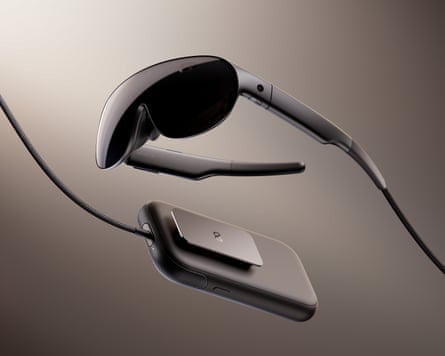
The Meta VR glasses and tethered compute puck Photograph: Meta

The new Meta VR glasses are an evolution of the company’s pioneering Quest VR headsets, which have become some of the most popular on the market. But instead of being a bulky plastic headset, the 100g device is made of magnesium alloy and looks like an oversized set of glasses. The wearer peers through small lenses on to a 5K microOLED screen with a crisp 37 pixels per degree, making text look sharp and rivalling Apple’s high-end Vision Pro headset. Users can see out of the sides and through a camera system at the front for augmented reality features and awareness of their surroundings.

skip past newsletter promotion


The glasses are tethered by a cable to a pocketable 300g puck containing the computing power and three-hour battery pack, which helps to remove the weight from a user’s head and makes the glasses five times lighter than the Quest 3 headsets, according to Meta.

The glasses are fully compatible with the vast Quest software library, but are designed for productivity and entertainment rather than games. The company described the glasses as “IMAX Enhanced” and supportive of 3D for movies. At launch, they will showcase a new Disney+ immersive experience that reflects landscapes from films such as Avengers: Infinity War surrounding a virtual cinema screen.

A woman works with multiple virtual windows in a cafe wearing the Meta VR glasses. Composite: Meta

The glasses have the ability to display multiple virtual windows and to connect to a Mac or PC to mirror its displays. They have eye-tracking and hand-gesture control, including a virtual keyboard projected on to any desk or table, but also support Quest’s hand controllers or an Xbox game pad for games.

The Meta VR glasses will cost $1,299.99 and will be available from spring 2027 in North America, Europe and Asia.


Source: Technology

‘I miss old Google’: readers tell us how they search the internet in the age of AI

an ad reads 'AI Mode'

Google’s AI mode is advertised on 30 October 2025 in London, United Kingdom. Photograph: John Keeble/Getty Images

Google’s AI mode is advertised on 30 October 2025 in London, United Kingdom. Photograph: John Keeble/Getty Images

‘I miss old Google’: readers tell us how they search the internet in the age of AI

A feature called AI Overviews has been a profound change, and the browsing habits of billions of people are shifting

Google has put artificial intelligence at the front and center of its search bar. The most-visited site on the internet still shows the same list of links to users, but they have to scroll past a summarized response from an AI chatbot, a feature Google calls AI Overviews. The change to what was once the gateway to the rest of the internet has been profound, and the browsing habits of billions of people are shifting.

“AI is driving the most significant upgrade of the Google Search experience ever,” wrote Liz Reid, Google’s vice-president of search, last August. In May, the company said more AI is coming.

As people grow accustomed to AI chatbots, they’re spending more time with Google’s and therefore more time on Google.com. Academic studies are finding that people navigate less to sites beyond Google if an AI Overview can give them a good enough answer, even if the bot cites the sites that feed it. Clicks, also known as traffic, are often the most significant way a website earns money from advertising. Media outlets and website owners are enduring a sustained traffic decline. Large US media companies are suing Google, alleging that AI summaries have redirected and reduced traffic to their sites, cutting into their revenue.

Google said it had not seen a decline in aggregate traffic and that such accusations are based on “flawed methodologies”. Reid, the company’s vice-president of search, wrote last year: “Total organic click volume from Google Search to websites has been relatively stable year-over-year.”

The Guardian asked readers whether Google has improved or worsened in the age of AI and how their habits of searching the internet have changed.

‘Google is better now’

Better, mainly because it leads you in your quest rather than you having to search on yourself. I am happy to have the AI lead me to an answer but the mega caution is that Google AI or any of them are not at all trustworthy. I have had it admit that it was lying to me and apologise! Sionn Achog, retired teacher 76, Dublin

I find that AI responses are more informative than previously, which simply referred the user to other relevant websites. Peter Warb, 75, UK

AI has made Google better. I use AI mode for all my searches. Jose Garcia Jr, 40, recovery coach, Dallas, Texas

Jose Garcia

AI has improved Google search. The analysis and chat functions are so much more useful than a ranked list of websites that still need to be explored by the user. Reviewing a list of websites is still an option but is very time consuming, and frustrating. Alan Caruana, consultant, 62, Malta

Far more better, faster and real. I search now with confidence, complete assurance and a high degree of accuracy. Eleazar Eke, electrical engineer, 67, Onitsha, Nigeria

Much better. It hasn’t changed my behavior, just getting better and more focused results. Catherine Weber, former political analyst, 57, Oregon

It’s made Google search much better, I find that I rarely actually click on the website links any more. I find information I want much faster and have a deeper understanding of any topic as I can ask questions about it and drill into the areas I’m interested in. Mark Johnson, 52, software engineer, London

Greatly improved it by getting at more arcane info regarding subject matter. Juxtaposition has improved with AI and abstruse knowledge of subjects becomes more accessible to layman. Wonderful tool with power to extend mind through sensing connections and very akin to human thinking. Samuel Lieberstein, 90, retired teacher, Cherry Hill, New Jersey

‘Search has gotten worse’

Search has become worse. Google AI obscures sources and tries to claim information it did not create while diverting traffic from the sources it steals from. Sean Peters, document processor, 41, Portland, Oregon

skip past newsletter promotion


Sean Peters.

Every time I search I have to scroll down to find an actual real website to find a full article or discussion or to confirm that the AI summary isn’t making things up. Occasionally when I am feeling particularly bitter, I remember to add the ““-ai”” tag to my search. Ewan Herbert, English teacher, 33, Japan

Worse. I have disabled AI overviews using an extension. Chris Gibson, Dundee

Absolutely worse. I want to be able to decide for myself which results are the most useful and relevant, and we’re no longer able to turn off the AI summary results. Jon Wilkinson, personal trainer, 43, Manchester, UK

Jon Wilkinson.

‘It’s so bad I quit Google’

Google has been enshittified … I do miss old Google Search and I really hope something of equal capabilities eventually comes to replace it.

The search engine I currently use is good for a lot of things, but if I need to look for something in languages other than English, the quality of the results is much lower. Image search is also not as good as that of Google used to be. Sofia, postdoctoral physics researcher, 30, Lausanne, Switzerland

My first stop now is Duck Duck Go, a pale imitation of Google’s search engine at the height of its powers. Unfortunately, the top results often include Grokipedia entries and other garbage. Craig Garrett, book editor, 52, New York City

Craig Garrett.

I have stopped using Google. I now use another search engine with no AI overviews. Guy Arthur Simpson, writer 66, Spain

I’ve made a conscious effort to find a browser which does not lead with the AI results. Mine is now Ecosia. Dan Jennings, IT, 54, Southampton, UK

I do a lot of research for my studies, and the AI features are a nightmare! I’m still scouring for a decent search engine without any of these ‘AI features’, the last thing i want is to accidentally utilise a water-wasting AI behemoth datacentre when I forget that crucial suffix. I’ve even resorted to using my local library’s resource of legal cases for my work, at least it is trustworthy. Catherine O’Leary, student studying law, politics and sociology, 17, Newcastle Upon Tyne

Google has become almost useless, searches I’ve made in the past which yielded specific results, (news articles, local information, historical references) no longer appear. I no longer submit to Google search first, I go directly to Wikipedia as my first source, then to DuckDuckGo, (with AI disabled) then to Reddit and only to Google as a last resort. Pedro Reyes, 61, Galicia, Spain


Source: Technology

Xi says China and US must ensure AI ‘is always under human control’ as Trump touts ‘great friendship’ before White House talks – live

Here is brief recap of the remarks made by Donald Trump and Xi Jinping just now on the Chinese president’s landmark state visit to Washington.

Trump touted their “truly great friendship” and that they had made “tremendous strides on the issues facing our countries” as he welcomed Xi to the White House. He kept his remarks vague and focused on their personal relationship, of which he said he is “very proud”. Trump said the two leaders would focus on security, technology and artificial intelligence at their summit today, and are working towards “a more balanced trade relationship”.

Xi, meanwhile, struck a very different tone, acknowledging that he and Trump have built a “personal rapport” but concentrating his remarks on geopolitical concerns. Xi called for continued dialogue and the building of mutual trust, understanding and peaceful co-existence between the two countries and to avoid conflict. He stressed that Chinese and US interests are “deeply intertwined” and that they “stand to gain from co-operation and will both lose in conflict”. He also stated clearly his hope that Chinese companies would be “treated fairly” in the United States.

The Chinese leader also emphasised their joint, historic responsibility as leading nations in artificial intelligence. Both the US and China have the capability and responsibility to manage AI for good, he stressed, and must “ensure the development of AI is always under human control and serve the wellbeing of the people”.

The two men are meeting now in the Oval Office, where they will discuss the fragile trade-war truce, Taiwan, AI and China’s support for Iran and for Russia’s war in Ukraine. A breakthrough is unlikely today for the world’s two most powerful nations, but stick with us as we bring you all the latest out of the meeting.

Donald Trump and Xi Jinping meet in the Oval Office for bilateral talks. Photograph: Jacquelyn Martin/AP

Source: Technology

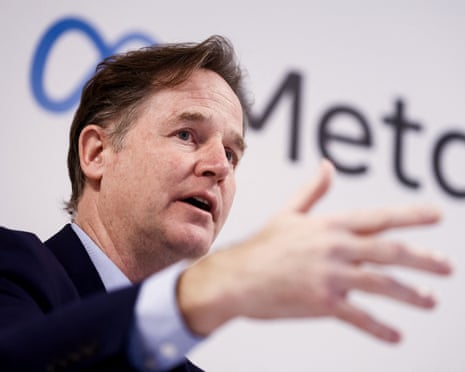
Nick Clegg plays down fears ‘godlike’ AI could exterminate humanity

Clegg gesturing while speaking in 2022 with Meta logo behind

Nick Clegg, who stepped down from Meta in 2025, said one person who runs an AI lab told him the current discourse was ‘totally silly’. Photograph: Kenzo Tribouillard/AFP/Getty Images

Nick Clegg, who stepped down from Meta in 2025, said one person who runs an AI lab told him the current discourse was ‘totally silly’. Photograph: Kenzo Tribouillard/AFP/Getty Images

Nick Clegg plays down fears ‘godlike’ AI could exterminate humanity

Former deputy PM now involved in tech industry says many within sector are ‘winding themselves up into a lather’

Nick Clegg has dismissed fears over AI’s “godlike power to exterminate humanity”, calling it a sign that tech bosses are “breathing their own fumes”.

The former UK deputy prime minister said that tech bosses should focus on addressing known specific threats such as cybersecurity and bioweapons rather than the “slightly hand-wavy view that this technology is unavoidably going to develop some godlike power which is going to turn on us and exterminate humanity”.

Speaking to BBC Radio 4’s Today programme, he said: “I think it is perhaps accidentally self-serving, because it sort of implies that we can only be made safe by having everything controlled, in effect, by an oligopoly of a small number of companies, and I think it slightly paralyses the political debate.”

Clegg, who was formerly the president of global affairs at Meta and owns more than 917,000 shares in Nscale, a UK-based datacentre, and is a cofounder of the AI startup AMI Labs, said he spent “a huge amount of time” with people in the tech industry.

“They don’t agree amongst themselves at all. Of course, we hear the most apocalyptic voices,” he said, noting that one person who runs an AI lab said the current discourse was “totally silly”.

“There is a culture in Silicon Valley – it’s an odd place for those who haven’t been there. It is in many ways the centre of the universe, or at least claiming to shape it. It’s also an oddly parochial place. It’s a strange sort of culture where the engineers can get quite close to the technology and start slightly breathing their own fumes as they wind themselves up into a lather about these things,” he said.

Asked about the autonomous hack conducted by a group of OpenAI agents on a major real-world company, Hugging Face, Clegg said there was a case for “tramlines and greater transparency”.

However, he said this would be unlikely to happen under a Trump administration given its competitiveness on AI. He also suspected China’s cooperation would be limited, since the development of AI technologies was viewed as a “national mission” after the country was “cheated out of the Industrial Revolution”.

He added: “I think there’s a great potential for the big three techno democracies in the world – India, Europe and the US – to collaborate more.”

skip past newsletter promotion


Asked whether the British prime minister, Andy Burnham, could take a lead on such efforts, Clegg noted the UK was not a world leader on AI: “We need to be realistic about what influence we can and cannot exert.”

Clegg also disagreed with other proposed remedies, such as introducing a “kill switch”, which he said would be unworkable; or only producing closed models, where source code is not made public, which he said were no safer than open source models according to the evidence.

Instead, he suggested: “There is a lot that can be done both voluntarily and through regulation, to enforce far greater transparency on the way in which these models are concocted and how they operate.”


Source: Technology