Sept. 22 (UPI) — The U.S. State Department imposed cybercrime-related visa restrictions on 32 individuals, most of whom are linked to Prince Group, a Cambodia-based conglomerate the Trump administration accuses of being a transnational criminal organization behind cyber scams targeting Americans.
The individuals blacklisted Monday were not identified by the State Department, whose spokesman, Tomas Pigott, accused in a statement of being “responsible for or complicit in defrauding Americans through cybercrime, cyber-enabled crime and related activity.”
Pigott said all those targeted Monday were involved in cybercrime and that the majority were affiliated with the Prince Group, which the United States designated a transnational criminal organization in October 2025, when Britain jointly imposed sanctions on the group in what the U.S. Treasury called at the time the “largest action ever targeting criminal networks in Southeast Asia.”
Based in Phnom Penh, the Prince Group has investments in entertainment, finance and real estate while also engaging in transnational crimes, such as the construction, operation and management of scam compounds that rely on human trafficking to conduct cyber fraud operations targeting victims around the world, according to the U.S. Treasury.
The Treasury sanctioned 146 targets, including Prince Group’s 38-year-old founder Chen Zhi, who also goes by Vincent, as well as 117 affiliated businesses in the initial Prince Group-related sanctioning, followed by an expansion of the sanctions to nine individuals and 26 entities in June.
Pigott said cybercriminals scam Americans out of tens of billions of dollars a year, including $18.2 billion last year alone.
“The Trump administration will use every available tool to protect Americans, dismantle criminal scam networks and impose costs on those who enable them,” Pigott said.
“Those complicit in devastating families and communities nationwide will be denied entry into the United States.”
South Korea and the European Union have also sanctioned the Prince Group.
Sept. 22 (UPI) — President Donald Trump told the U.N. General Assembly on Tuesday that he has a decision to make on Iran-make a deal to end the war or “annihilate the Islamic republic.”
The war in Iran was one of several topics Trump addressed at the 81st session of the U.N. General Debate, held annually at U.N. headquarters in New York City. He called Iran “the No. 1 sponsor of terror.”
“While others have talked, I have acted,” he said of the joint U.S.-Israeli strikes on Iran beginning Feb. 28.
Since the start of the war, the United States and Iran have been involved in negotiations to end the conflict, including reopening the Strait of Hormuz to traffic and addressing Iran’s development of nuclear weapons.
“I have a big decision to make,” Trump said in his speech Tuesday. “Will a deal be made with Iran that lets them rebuild and create a far greater country than it ever was before … or do I annihilate the Islamic republic, and do it quickly?”
It’s not the first time Trump has openly discussed the idea of an attack on Iran so large critics suggest it would constitute a war crime. In April, he threatened that “a whole civilization will die tonight” if Iran didn’t re-open the Strait of Hormuz.
Later, during a meeting with British Prime Minister Andy Burnham, Trump said he believed he could reach an agreement with Iran, The New York Times reported.
During his speech, he said Iran was waiting to see how his Republican Party fares in November’s midterm elections before agreeing to a deal.
Trump also took aim at Cuba in his speech, calling the island nation “an absolutely failed state,” saying that the government “will fall.” The four members of Cuba’s delegation stood up and left the assembly during the comments.
He called the International Criminal Court a “rogue institution” and boasted that “to the victor belong the spoils” in regards to the operation in Venezuela in which the U.S. government captured former Venezuelan President Nicolás Maduro.
Scenes from the 81st U.N. General Assembly
President Donald Trump speaks at the United Nations General Assembly at U.N. Headquarters in New York City on September 22, 2026. Photo by John Angelillo/UPI | License Photo
Sept. 22 (UPI) — DoorDash has settled for $131.5 million with New York City allowing closer monitoring of payment methods to employees after it underpaid delivery workers.
“When a worker earns a wage,” Mayor Zohran Mamdani said in a statement, “they deserve to be paid that wage — not tomorrow, not after a lawsuit, but on time and in full.”
“Simply put, we screwed up. Our mistakes meant some Dashers were underpaid or paid late. While these mistakes weren’t intentional, that doesn’t make them okay. We pride ourselves on operational excellence at DoorDash — and this was not excellent, nor was it acceptable. Dashers should be paid in full, on time, every time. We are sorry to the Dashers we let down,” DoorDash said in a statement.
The settlement was with New York City’s Department of Consumer and Worker Protection.
The $131.5 million settlement with the City includes $12.3 million for 264,000 delivery workers who were underpaid or paid late, and over $83 million to resolve a disagreement over how to calculate pay for time they spend online between deliveries. DCWP is getting $16.7 million in fines owed to them as part of the settlement.
The city has been cracking down on delivery companies for mistreating workers for years, The Times said.
DoorDash said it believes that its way of paying workers is “fair, practical and legal” but “rather than spend years fighting over whose method was right, we chose to pay Dashers sooner and use the city’s method going forward.”
The settlement also includes a three-year monitoring program that requires the company to send detailed data to the city for auditing.
“This sends a strong message that we are in a new era of enforcement in New York,” said Samuel Levine, DCWP commissioner, in an interview with the New York Times. “We will not tolerate nickeling and diming New York City workers.”
The company didn’t adhere to a 2023 law meant to improve the pay of delivery workers in New York. It helps workers get paid for the time they spend waiting for the orders to arrive and increases pay for the time they spend delivering.
DoorDash said the workers will get about $48 each. But Levine said some will be paid more than $10,000.
The settlement “should send a clear message to every other app that we’re going to go after them,” said Ligia M. Guallpa, executive director of the Workers Justice Project, The Times reported. “For too long DoorDash has treated workers as disposable,” she said.
This week in Washington
President Donald Trump speaks to more than 100 hunters and fisherman at a dinner in the Rose Garden of the White House on Thursday. Photo by Jim Lo Scalzo/UPI | License Photo
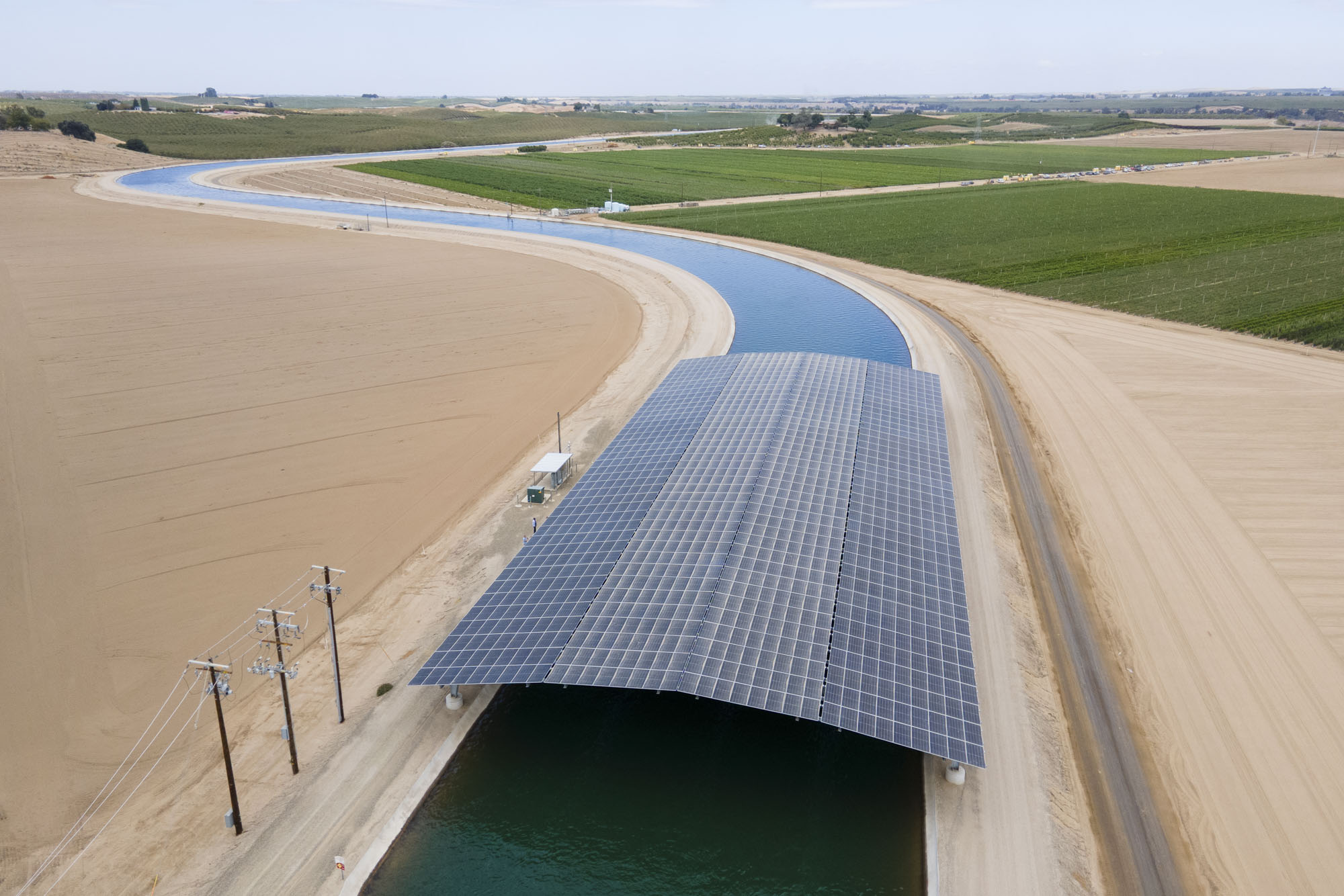
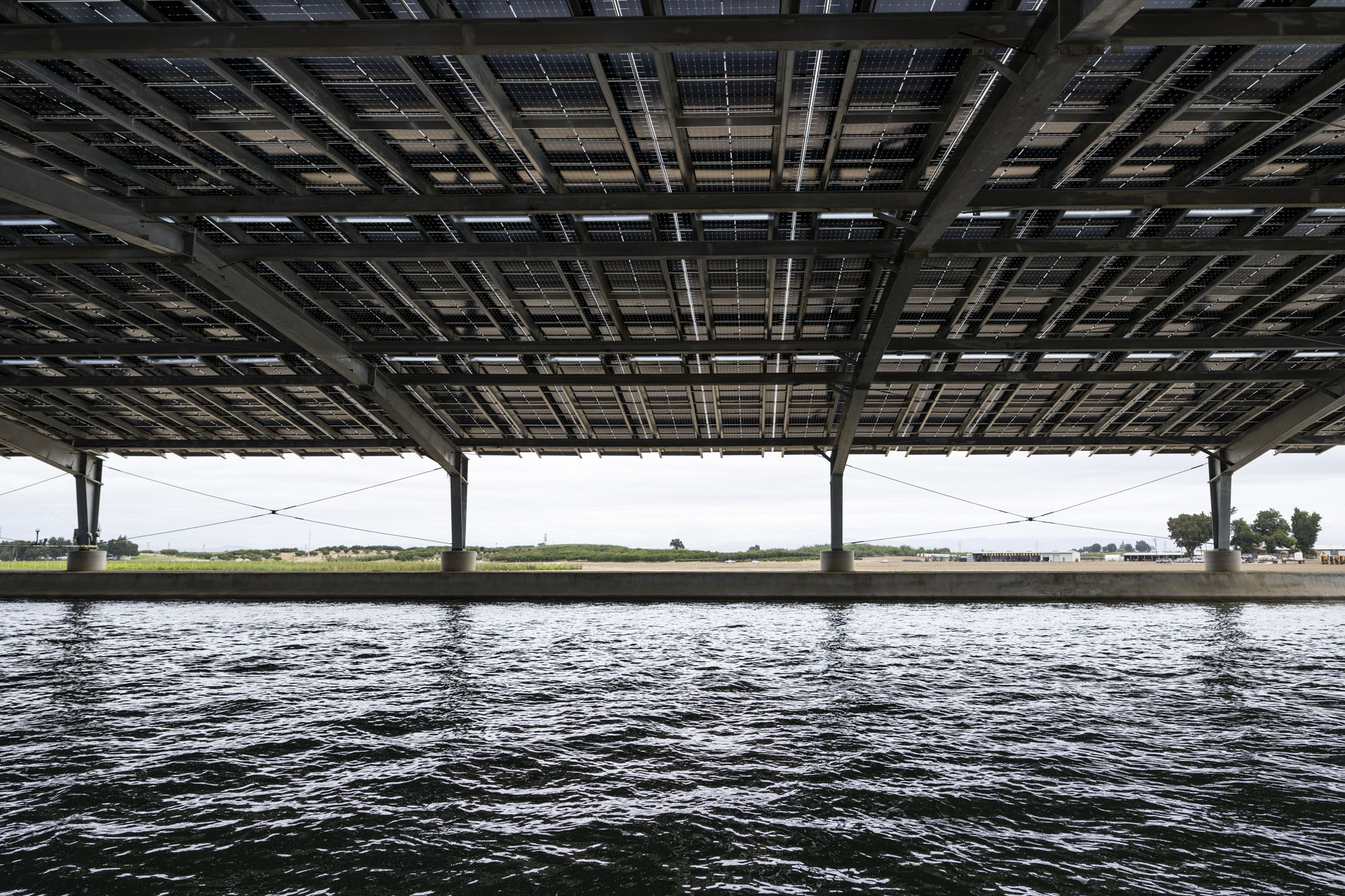
Solar panels cover part of a Turlock Irrigation District canal as part of Project Nexus in Hickman, California, on Sept. 4, 2026. The pilot project is testing the use of solar panels over working irrigation canals to generate renewable energy. (Beth LaBerge/KQED)
This story is part of Flipping the Switch, KQED’s series about California’s transition to clean energy and what it means for you. What works? What doesn’t? And how much does it cost?
Driving from Los Angeles to San Francisco, Jordan Harris saw the concrete canals that transport water across the state slowly evaporating under the scorching West Coast sun.
Harris said he spent a lot of his life in France, where he noticed how trees lined the canals and protected their precious water from the wind and sun. “And so I started thinking, could we do something similar in California?”
California’s extensive network of canals and aqueducts is the lifeblood of the state, providing clean water to populous cities and expansive farms that wouldn’t otherwise have it. While the state has long struggled with evaporation, researchers at UC Davis estimate that California’s total water supply could shrink by up to 25% by 2050, the equivalent of two Lake Shastas. They attribute the decline, in part, to hotter temperatures caused by climate change.
In an effort to limit warming poised to dry out the state, California pledged to shift to 100% clean electricity by 2045.
Solar panels cover part of a Turlock Irrigation District canal as part of Project Nexus in Hickman, California, on Sept. 4, 2026. (Beth LaBerge/KQED)
The state currently generates 62% of its electricity from renewable and zero-carbon sources, with the largest percentage of that coming from solar. But meeting California’s energy demand will require an unprecedented expansion of solar and storage capacity.
Thinking back to the baking concrete canals, Harris pitched an “obvious” solution to his friend Robin Raj: Why not build solar panels on top of California’s 4,000 miles of open canals that transport water across the state? The panels would produce clean energy while limiting evaporation by shading the canal — a win-win.
The duo went on to start Solar Aquagrid, an advocacy firm dedicated to reimagining aging canals, and partnered with the Turlock Irrigation District, UC Merced and the California Department of Water Resources to cover small sections of Turlock’s canals with solar panels. The new “solar canal” provides shade to limit evaporation and generates power all in one neat package. They call it Project Nexus, and it operates at the intersection of the state’s need for clean water and energy.
Related Article
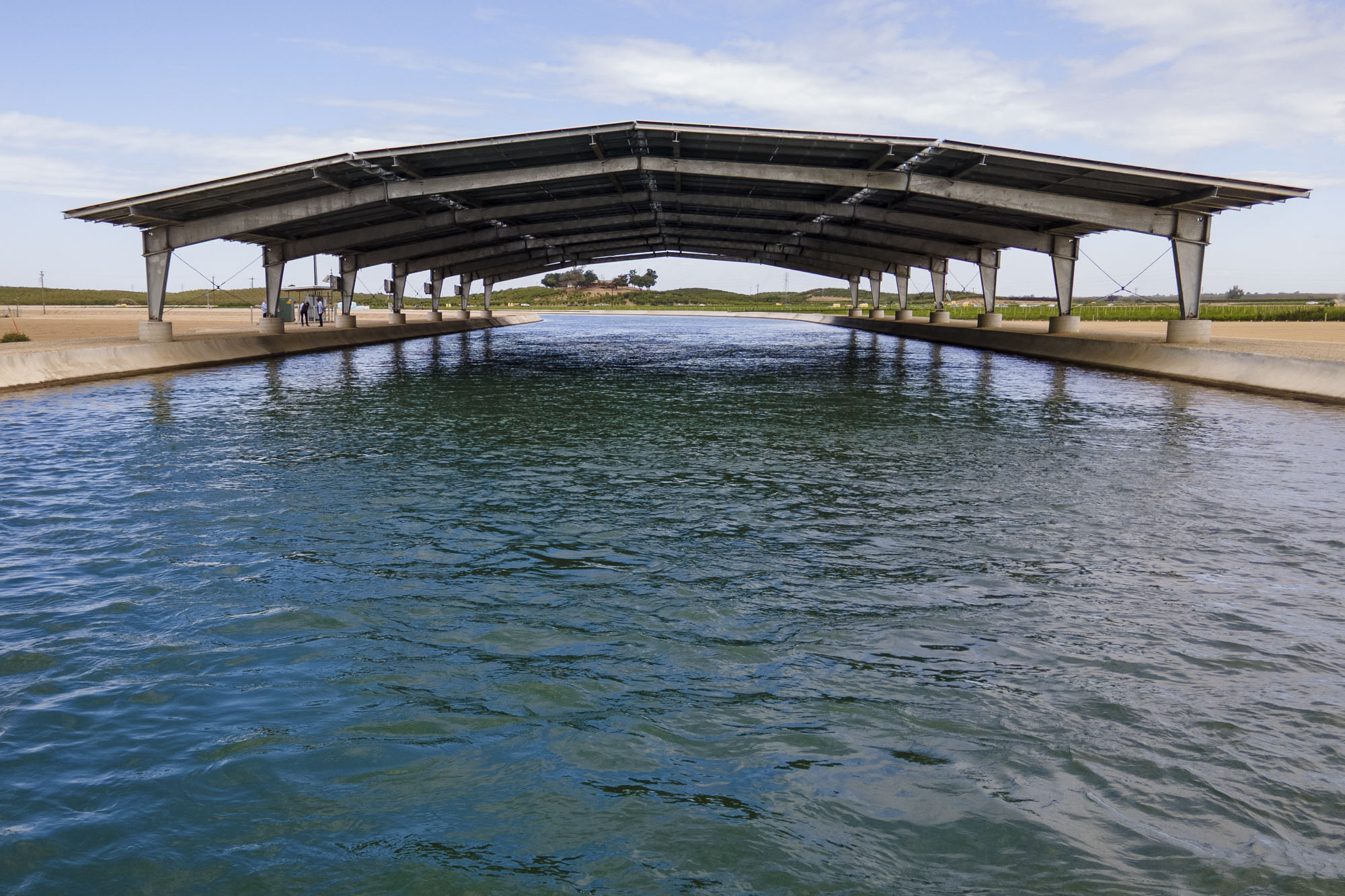
Project Nexus tests not one, but three different solar canal models. A wide-span canopy rises over one of Turlock’s 115-foot canals, resembling the top of a barn. A more classic set of slanting solar panels sits atop a 20-foot canal. And accordion-like retractable panels are positioned low across the narrow canal, ready to roll up at a moment’s notice.
Raj affectionately called the wide-span canopy his “singular field of dream.”
Roger Bales, a professor at UC Merced who co-authored a 2021 study that helped convince the state to invest in this pilot, said his initial calculations indicate that putting panels over 100 miles of Turlock’s narrow canals could save enough water for 2,700 households annually.
If the state put panels over 100 miles of the wide canals, it could save 11,000 households’ worth.
He also estimates that the narrow and the wide canal could generate 330 to 1,4000 megawatts per hundred miles respectively — enough to power 77,000 to 304,000 households.
The pilot was fully completed and energized last year. Earlier this month, Harris walked alongside the solar panels that arched over a 115-foot canal.
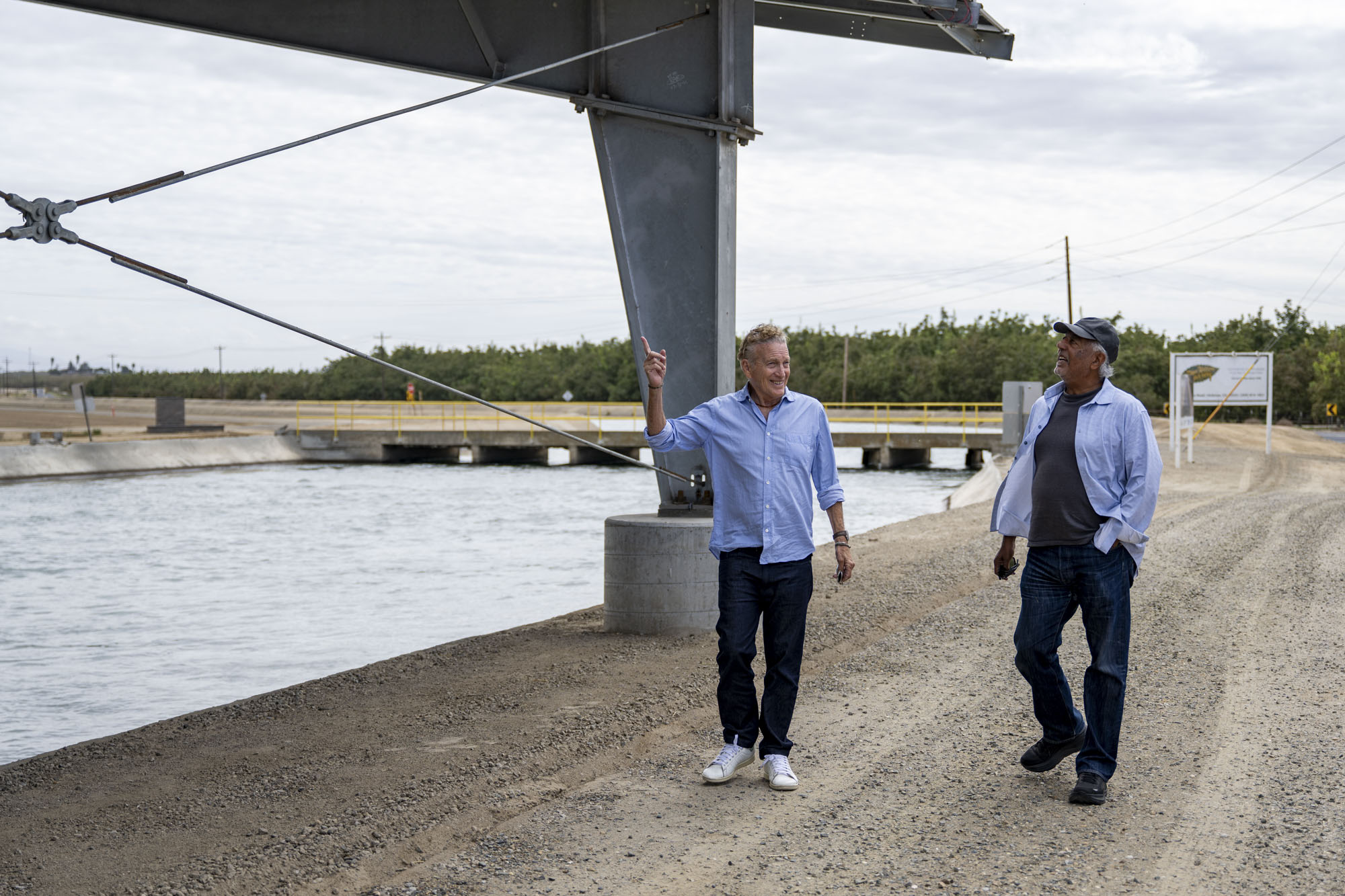
Solar AquaGrid co-founders Jordan Harris (left) and Robin Raj walk alongside solar panels covering part of a Turlock Irrigation District canal in Hickman, California, on Sept. 4, 2026. Solar AquaGrid helped develop Project Nexus, a pilot project testing the use of solar panels over working irrigation canals. (Beth LaBerge/KQED)
“These are disturbed spaces,” Harris said, pointing to the concrete ditch filled with murky water. “So why not take advantage of the fact that we’ve already done that and help them work harder, be more efficient, produce more and protect what’s around us?”
The research team also found numerous “co-benefits,” or silver linings that make the project more valuable than the sum of its water and power.
Bales said shading the canals led to less algal growth and less fixed aquatic weed growth — reducing maintenance and improving water quality.
Preventing new solar development on natural land benefits both people and planet, Bale added, emphasizing how preserving these lands is essential for maintaining life “as we know it on the Earth.”
Acquiring permits to build on undeveloped land can be a major bottleneck for developers, too. Building on open space takes 621 days on average, compared with 110 days for projects on developed land, according to a study from The Nature Conservancy.
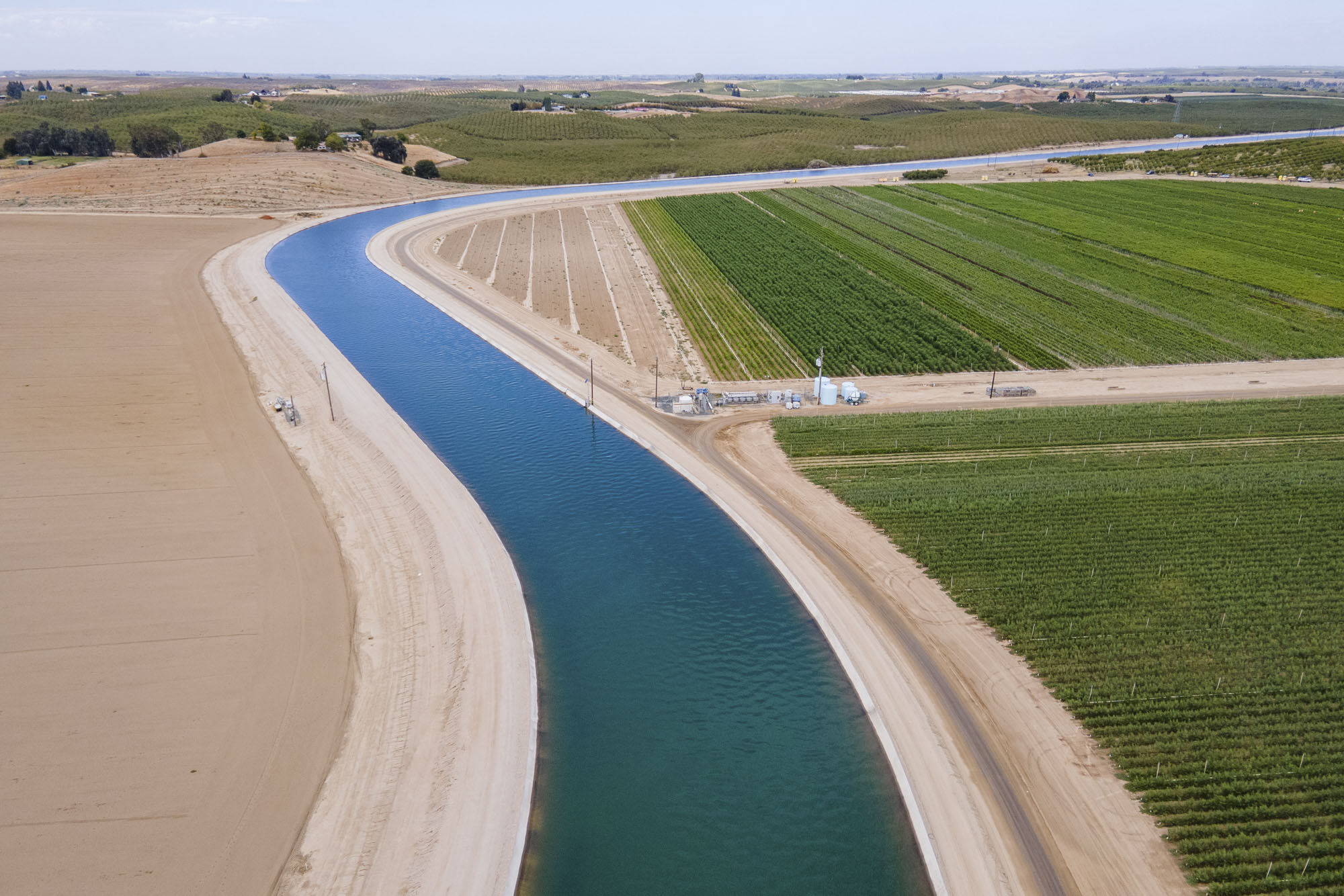
A Turlock Irrigation District canal in Hickman, California, on Sept. 4, 2026. (Beth LaBerge/KQED)
Given the numerous benefits, Bales said the project “just makes sense.”
But just because something makes sense does not mean it’s easy to implement. “We often talk about the challenges of getting to the obvious,” Harris said.
Projects touching land, water and power often involve coordinating many stakeholders. California’s canals can be managed by state or federal water agencies, as well as municipal governments and local irrigation districts. These operators often do not own the land around the canal, let alone the infrastructure to transmit the power to utilities — one of the most expensive parts of renewable energy projects, according to Harris.
Harris and Raj found their “ideal” partner in Turlock Irrigation District, a 139-year-old irrigation district operating 250 miles of canals that provides both water and power to nearly 5,000 farmers in the Central Valley growing everything from beans to peaches.
Related Article
It is one of four irrigation districts in California providing both water and retail power, noted Josh Weimer, a spokesperson for Turlock.
Weimer said that the project received little pushback from locals, in part because, while the Irrigation District used some staff time for the project, a $20 million state grant paid for both the research and the infrastructure.
Weimer described the project as a “proof of concept” that generates just 1.7 megawatts of energy, a tiny fraction of the 56 megawatts that they generate with a solar farm in the desert.
But the canal site hosts more than just panels. Bales said they “have instruments out there to measure temperature, relative humidity, wind speed, incoming radiation, outgoing radiation, and a prototype instrument to measure evaporation directly.”
When it comes to algae, the panels helped. “Last year when we drained the canal at the end of the irrigation season, there was a physical line on the sun side of the canal that had algae growth and then not algae growth from where the shade was,” Weimer said.
Turlock’s solar panels tower above the water because the irrigation district cleans the canals on a regular basis with equipment.
Solar panels cover part of a Turlock Irrigation District canal as part of Project Nexus in Hickman, California, on Sept. 4, 2026. (Beth LaBerge/KQED)
“This isn’t gonna be the only way to do it,” Weimer said — describing how they drag a massive anchor chain through the water to rip out weeds. Similar panels in India and Arizona sit low over the canals, leaving little room for the kind of cleaning that Turlock needs to do.
Over in Contra Costa County, the urban landscape makes any kind of solar canal project unrealistic, said Jennifer Allen, a spokesperson for the county’s water district.
The Contra Costa Water District manages 48 miles of canals winding from Knightsen to Martinez. The Bureau of Reclamation built the system back in the 1930s when the region was predominantly farmland — much like Turlock.
Today, the canal system runs through backyards and public parks.
Something like Project Nexus wouldn’t work because maintenance workers need to access the canals and have limited space to work alongside them, Allen said.
Solar AquaGrid co-founder Robin Raj stands near solar panels covering part of a Turlock Irrigation District canal in Hickman, California, on Sept. 4, 2026. The company helped develop Project Nexus, a pilot project testing solar panels over working irrigation canals. (Beth LaBerge/KQED)
Even though the canal is fenced in, “we have instances where we have cars go into the canal — we’ll have people go into the canal, and animals go into the canal,” Allen said, describing some of the challenges they faced as an urban water district.
“What Turlock is doing with their projects is very impressive, but we have a different-looking canal system going through our service area,” Allen said. They are looking to put their canals into pipes to avoid evaporation, instead.
Andrew Schwarz, a spokesperson for the state’s Department of Water Resources, said that they are waiting to see the final report before deciding to invest in more projects. “These canals vary widely — from narrow, unlined dirt channels that deliver irrigation water to individual fields, to concrete-lined channels over a hundred feet wide that transport water across California,” Schwarz said.
The state remains focused on “evaluation, continued study, potential scaling and lessons learned.”
“Critical infrastructure change is really hard, and if you don’t have science behind it to justify the expense and be able to quantify the benefits, then you’re not gonna scale,” Harris said.
“We are fortunate to live in California where this is a priority and where our state agencies are open to this level of examination and exploration,” Raj said. “That can’t be taken for granted.”
The final report comes out later this year.
From KQED’s Climate desk, “Flipping the Switch” documents California’s transition to clean energy and what it means for you. What works? What doesn’t? How much does it cost? Help us find these answers and more by donating today.
The UV index is not the warm sensation of sunlight on bare skin
The warmth of sunlight is not a reliable indicator of how quickly you will sunburn in a given situation. On one hand, you can still get sunburned on a cooler cloudy day, while on the other hand, the sun can feel scorching hot on your skin in the morning and yet you won’t sunburn (very quickly).
You probably knew this already, but it still feels unintuitive to me. I’m going to look at numbers and think about them until I convince myself, and perhaps you, that this is true.
How does sunburn happen
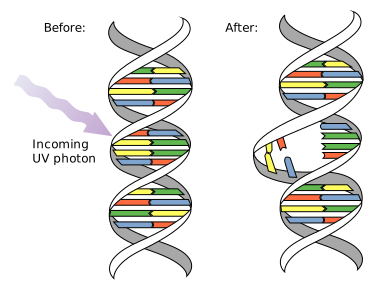
Sunburn is triggered when your DNA is damaged from light absorption – in particular, UV-B (and to a limited extent, UV-A) is absorbed in a way that alters DNA’s molecular structure1.
Image: DNA UV mutation by Mouagip (derivative of a NASA / David Herring original), released into the public domain.
This interferes with protein synthesis and wreaks havoc in your body over time, but the DNA damage itself is painless2.
Why does the sun feel warm
Sunlight feels warm because visible and infrared light excites vibrational modes in various molecules in your skin, especially water and melanin. For physics reasons, this is strictly a form of heating and never directly damages molecular structure.
And if you have a darker skin tone, the sun will feel warmer to you, yet you’ll sunburn much more slowly.
Visible light, near-IR and mid-IR are absorbed to different degrees and at different depths of the skin, but they all contribute to that feeling of warmth.
Different mechanisms, different scales
Not only are the mechanisms completely different for sunburn and solar heating, the orders of magnitude of energy are as well.
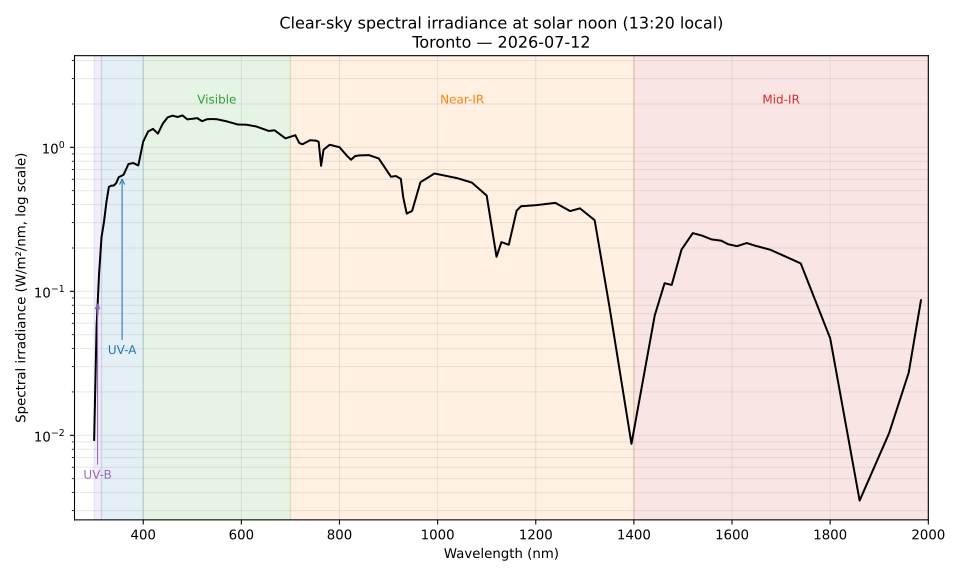
At the Earth’s surface, the UV-B band is hundreds of times less intense than near-IR. Reasonably, it takes a lot more power to toast your buns (and the rest of your body) than it does to toast your DNA3.
For some reason, knowing this makes it more intuitive to me that sunlight’s warmth is disconnected from the rate of sunburn. Even if you were absorbing all that UV-B as heat, the resulting warmth would be completely imperceptible.
Time of day affects UV and IR differently
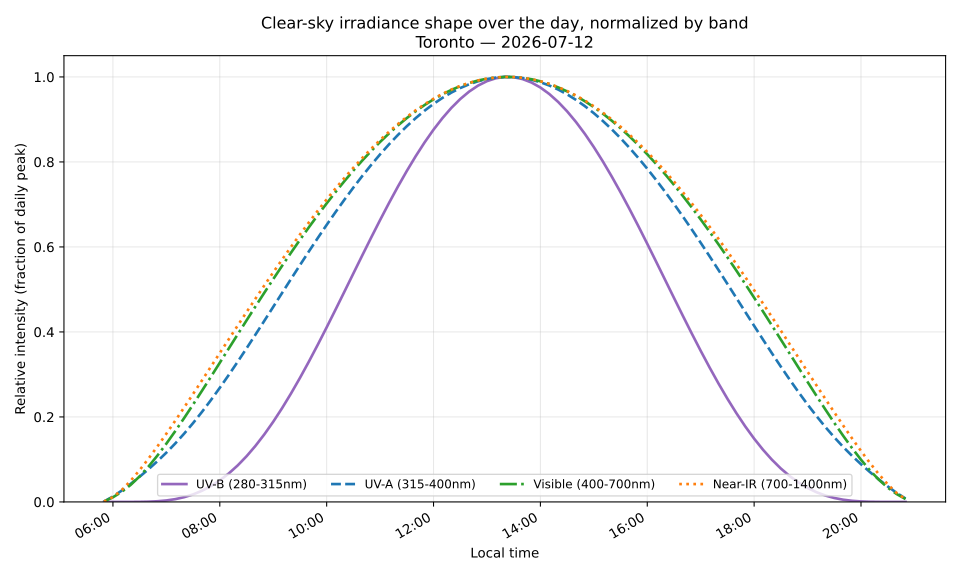
The sun is by far the most intense when the sun is overhead – solar noon. This is true regardless of wavelength of light. However, UV intensity drops off more rapidly than IR as you get further away from noon, as it gets scattered more heavily by the atmosphere.
So, the sun may still feel pretty intense in the morning or late afternoon, but the risk of sunburn is considerably lower.
Wait, what about the weather?
Clouds are made of water, which scatters UV and absorbs IR. On a uniformly cloudy day, both UV index and perceived warmth from the sun drop substantially. However, if there are gaps in the clouds, it can actually amplify the UV intensity at ground level. Snow and ice contribute to this effect as well.
Where did these plots come from?
These plots are simulated measurements created using pvlib, an open-source Python library for modeling solar energy, using its implementation of the SPECTRL2 model to estimate the spectrum of sunlight reaching the ground throughout the day.
Anderson, K., Hansen, C., Holmgren, W., Jensen, A., Mikofski, M., and Driesse, A. “pvlib python: 2023 project update.” Journal of Open Source Software, 8(92), 5994, (2023). DOI: 10.21105/joss.05994.
Some caveats:
pvlib is designed for solar panels, not human bodies
assumes a perfectly clear sky over Toronto (43.8°N, 79.4°W) on 2026-07-12, with the sun hitting a horizontal object
other model parameters are set to reasonable defaults and do not come from historical measurements
SPECTRL2 cuts off at 300 nm, so UV-C and a part of UV-B are not shown
But with the dust still far from settled, a different controversy is emerging: Did OpenAI even solve the right Navier-Stokes problem?
Generated by an internal large language model (LLM), OpenAI’s proof relies on an approach that many experts find unnatural. It solves a variant of the problem that mathematicians say is disconnected from reality and thus less interesting. In a sense, the LLM found and exploited a loophole in the framing of the question.
On supporting science journalism
If you’re enjoying this article, consider supporting our award-winning journalism by subscribing. By purchasing a subscription you are helping to ensure the future of impactful stories about the discoveries and ideas shaping our world today.
“The most important problem is unsolved,” says Luis Silvestre, a mathematician at the University of Chicago. “The Clay problem is settled, but the main problem for the Navier-Stokes equations is not.”
Furthermore, last Thursday, three mathematicians posted a proof of their own that showed that OpenAI’s method can never be extended to solve the full problem. In other words, the loophole will never be closed, barring some completely new idea.
The Navier-Stokes equations are supposed to describe how fluids flow, but mathematicians doubt whether they can always be trusted. The million-dollar problem is about whether the equations ever “blow up,” which would mean they’d allow the flow to be infinitely fast at points—something that can’t happen in the real world.
But there’s one piece of the equations that’s optional—sometimes it’s there; sometimes it isn’t. The “it” here is an external force such as gravity that affects how a fluid moves. “All fluids we know of are under some kind of external force,” says mathematician Diego Córdoba. “So to have the force makes complete sense.”
When most experts think about the Navier-Stokes problem, though, it’s without this force. They want to find a purer, more fundamental way for the equations to blow up by using only the intrinsic forces within any fluid—not by applying some specific, precisely contrived external force. “Most of the other groups, it’s true, were specifically considering the scenario without a force,” says mathematician Luis Martínez-Zoroa.
In the past few years, though, Córdoba and Martínez-Zoroa put all their focus on this niche piece of the equations and laid out a method to build a very specific external force to trigger a blowup. On September 7 two other mathematicians used their program (and AI) to produce a blowup for a frictionless fluid—considered a major step toward blowing up Navier-Stokes. OpenAI finished the job less than a day later—timing that has led to a heated dispute between the latter two mathematicians and the company.
But the new work released last Thursday shows unequivocally that if the force is removed, the blowup will disappear. OpenAI’s method can never work, in fact, without using a very contrived equation for the force that is unlike anything that could occur in the real world. “They essentially prove that the formulation with an external force was different from the problem we really wanted to solve,” Silvestre says.
In other words, the LLM’s result does not—and will never—answer the Navier-Stokes problem that mathematicians really care about.
It did, however, unambiguously solve the problem according to the Clay Institute’s original formulation. The official problem statement, penned in 2000 by mathematician Charles Fefferman, offers an option called “C,” in which solutions are allowed to use an external force like OpenAI’s.
Now fluid dynamicists are grappling with a possibility few had considered before: the idea that the Navier-Stokes equations can blow up but only with an external force. In this scenario, you can mathematically place a fluid in a specific, unrealistic situation to break the equations, yet the blowup can never come from the fluid itself.
“It’s really uncertain at this moment,” says mathematician Gonzalo Cao-Labora. “Depending on the answer to this, I think the contribution of OpenAI will be regarded differently.” If it turns out to be true, he adds, “people would probably think about the Clay problem and say, ‘We shouldn’t have put the external force in the statement.’”
This might even be good news for “team humanity.” LLMs are great at finding blowups that exist—at searching the infinite landscape of fluid scenarios and plucking out the precise situation that breaks the equations. But proving that blow-up is impossible is a kind of math AI still struggles with. “We may be at less of a disadvantage, or maybe an advantage, compared to LLMs,” says Cao-Labora. “LLMs are especially good at constructing things that are very explicit and not as good—for now—in making new theory.”
But regardless of whether the path to solving the full Navier-Stokes problem requires a clever new blowup or a whole new mathematical discipline, everyone is becoming more hesitant to bet against the machines.
“We are really amazed with how [the technology] has evolved in the last year—so we don’t know how it will look in one year,” says Cao-Labora. “It’s really a wake-up call to the community.”
Subscribe to Support Independent Journalism
Great science journalism requires human expertise, time, effort and creativity. And it costs money. That’s why I and the journalists here at Scientific American hope you’ll join our community.
When you subscribe, you are supporting staff and freelance journalists who are passionate about telling science stories that are true, important and compelling. Our editors and reporters are often experts in their fields, which means they understand the nuances of big discoveries and can untangle the breakthroughs from the hype. With a subscription, you are also supporting rigorous fact-checking to ensure the words we publish are precise and accurate. And you’re supporting original illustrations, graphics and photos that bring you closer to an advanced laboratory, an ice sheet in Antarctica or a space mission in orbit. You’re helping us craft other types of high-quality journalism as well: Our newsletters are carefully written, edited and curated by staffers you have or will come to know and love. Our Science Quickly podcast is based on original reporting, collaboration with editors and scientists and exacting production.
Subscriptions keep this engine running so we can continue to deliver thoughtful, rigorous and independent science journalism to you. In an era of viral misinformation, this work is crucial. If you value what we do, I hope you’ll consider joining us as a subscriber
Thank you,
Jeanna Bryner, Editor in Chief, Scientific American
This October we challenge you to abstain from LLM based tools entirely. Think of this as a fast for your mind! This is not a judgement of others, but a personal challenge to you.
Nuance is hard (if not impossible on the internet), and so is balance.
Develop your own sense of nuance around LLMs what they're good for what they're bad for.
No AI/LLM tools whatsoever at home or work, do it the hard (core) way.
"Agents can only maintain or INCREASE entropy in a system. Humans are uniquely capable of decreasing it"
In the words of my toddler "I do by MYSELF"
"Hey , let's see if we can do some cost risk analysis around our LLM usage. Let's experiment with reduced/no LLM usage and measure our teams/orgs velocity, incident rate, and cost and see if there are any potential savings or risk mitigations we could enact in the future."
Or perhaps using the "iron triangle" proposition of software development. You can have things good, cheap, or fast… pick two.
Understand where your own gaps are in your own knowledge and capabality, and are you okay delegating those?
Are there truly tasks that have no value? Can they be automated deterministically cheaply and fast?
Learning takes mental effort and friction
Unfortunately, corporations sometimes have an "AI under duress" to keep your job. Do what's right for your life and family and adjust these suggestions as needed to keep the overlords happy. ↩︎
Language translation tools are incredibly useful, and help others participate globally in their non-native tongue. I think this is a uniquely human exception, and an extremely pro-human use, but I leave this up to you. However I do not want to diminish the importance of professional human translation and localization in products and services, these require a level of accuracy that I think should not be delegated to a machine. ↩︎
Meat Proxy is a term used for people that launder their work conversations through a chatbot and apply no thought or no/minimal editorial review to the output and posting it back to you. I find it personally EXTREMELY disrespectful, I'd prefer no response at all. ↩︎
Markdown is becoming source code, not documentation
That Markdown should be checked in to /src, next to the code it produces
Code and tests should be derived from that Markdown, rather than from ephemeral prompts (or at least prompt sessions should eventually turn into persisted Markdown)
In order to supplement my income as a professor at Montana State University, I do consulting on the side. I enjoy consulting and the act of writing code & helping build systems, both for their own sake and also because it keeps my skills relevant and allows me to teach students about the latest ideas in software development.
Obviously the biggest thing to happen in development in the last few years is agentic coding: using LLMs to generate code in lieu of hand coding. I have written a few essays on this topic:
It is starting to feel as if the application logic of the software is being defined and edited as markdown, and the actual code that is generated by the agent is sort of becoming a low-level implementation detail.
Now, as the essays above show, I am ambivalent about AI-generated code. However, my consulting work shows that organizations are headed in this direction, often at terrific speed.
What I want to do in the remainder of this essay is think about the ramifications of Markdown becoming, more and more, the source of truth for software systems.
There is a line of thinking, captured in the quote above, that LLMs are akin to compilers, taking high-level specifications and turning them into low-level implementations. In this view, we don’t need to look at the code an LLM generates, just as we don’t look at the machine code a compiler generates.
As I mention in Code is Cheap(er), I do not totally agree with this analogy for a few reasons, but the one relevant to this essay is: compiler workflows retain their original source code while LLM workflows typically do not.
Today, LLM-generated code is often created via a string of prompts fed into an agent as a developer builds out a feature. In practice, this means that the generated code is the closest thing we have to “ground truth” for that feature. There may be documentation for the feature stored elsewhere (e.g. Linear, Slack threads, wikis, etc.) but, so far as the codebase is concerned, the generated code is the source of truth.
My opinion is that, in professional agentic coding environments, we need to accept that LLM-generated code that emerges from ephemeral prompting sessions is not ideal, and begin moving towards capturing and checking in Markdown alongside generated code in the source directory.
Markdown has many nice properties that make it similar to traditional source code:
It is plain text and therefore diffable, greppable and reviewable in pull requests
LLMs read and write it natively
Humans can read and edit it without tools
And, in fact, it is already acting as source, to an extent, in AGENTS.md, specs, plans, TASK.md and so forth. We just haven’t standardized capturing that source yet.
In Markdown is the new source code, Brody says he keeps his Markdown files in .scratch/research/ and .scratch/plan/ as he works. I have adopted the convention of creating a /tmp directory for similar ephemeral needs.
My proposal is that we promote some of these files to a new directory, alongside our existing source code: /src/md
The Markdown captured in this proposed directory would be lower level than traditional design documents:
It contains architectural decisions
It contains source-level decisions
It contains low-level data design decisions
It is much closer to a specification (although it is not one) than a design document as traditionally managed by a project manager or designer.
Other sources of truth for the behavior of the system can still exist. These sources would provide higher-level and/or “process-oriented” documentation: high-level design documents, issues that need a resolution workflow and so forth.
But the core, current and static intended behavior of the system would increasingly be captured directly in Markdown in the source directory.
I have seen many people online saying that tests are the new specification (or always were). I think there is some truth to that.
However, tests are not a good mechanism for human/agent interaction:
They involve a lot of ceremony, often obscuring what they are testing
They are typically lower level than most humans want to deal with, particularly when understanding a system
Higher-level explanations such as Mermaid diagrams don’t fit naturally into them
I think the following division of labor makes sense:
Markdown sits in /src and is the specification(ish)
Tests sit in /test (or wherever) and are based on that Markdown, providing automated confirmation of correctness
Again, the core idea here is that, rather than generating code and tests from prompts, a developer would work on Markdown in the /src directory, from which the code and tests would be derived.
The Markdown in /src/md sits between a formal specification for the system and high-level design documents.
As with source code, there is a Complexity Budget associated with this Markdown. It will require thoughtful management to keep these documents clean, well-factored and at the right level of abstraction.
Developers should be expected to interact with both the Markdown and the derived code, so synchronizing the two (when appropriate) will become an important skill.
For example, developers will often do subtractive, constraining work on generated code, and those changes may need to be moved back into the Markdown.
I believe that agents should not be used to generate much content in /src/md. This directory should be mainly human authored and curated.
This is necessarily the weakest part of this essay because this is a new idea and I haven’t used it extensively yet. It is me thinking out loud and inviting discussion.
With that said, here is a possible /src/md standard:
src/
  md/
    README.md          # index of all md, entry point for agents
    TODO.md            # a list of general TODOs open for this module
    OVERVIEW.md        # a technical overview of this module
    features/FEATURE_1.md       # a set of feature-specific documents
    data/DATAMODEL_1.md         # descriptions of data models in the module
    api/API_1.md                # descriptions of APIs the module provides
    infrastructure/INFRASTRUCTURE_1.md   # descriptions of infrastructure used by the module
Here the features, data, api and infrastructure directories are all optional; the idea is to divide along different axes to best capture a solid working description of the module’s behavior directly in the /src/md folder.
As code gets cheaper to generate, what remains valuable is the intent behind the code: what it does, why it does it, and what it must not do.
Today that intent is often lost in ephemeral prompting sessions, or scattered across wikis, tickets and Slack threads.
I think that, in the name of locality, we should consider capturing this intent in Markdown and checking it in to /src, alongside the code it produces, where both humans and agents can find it.
I don’t know exactly what the right structure for something like /src/md is yet, and I expect my thinking will change as I (and others) get more experience with it.
But I am fairly confident that Markdown is becoming source code, and that we should increasingly treat it like source code.
Appearing like a grounded and formidable spaceship, the Lucas Museum of Narrative Art, bearing gifts of memories and myths, opened its portals to an Earth-bound selection of people (local notables, friends, museum members, and journalists) last week in a welcoming Los Angeles, christened by its benefactors, George Lucas, the producer and director of Star Wars fame and fortune, and his financier wife, Mellody Hobson. (The general public opening will be on September 22.)
The architecture of the galactic conceit, with a reported $1 billion price tag, is most definitely different, almost stunningly so: a sculptural, organic form, described as a “cloud” by Ma Yansong, founder of MAD Architects, the principal firm in a design team that also included Michael Siegel of Stantec and Mia Lehrer of the heralded local landscape firm of Studio-MLA.
Moored in the city’s Exposition Park on a deftly landscaped 13-acre campus that had previously been a parking lot, the soaring sweep of the five-story museum may look to some like a makeshift sci-fi construct, but its interior is grounded in a familiar labyrinth of accessible galleries and convenient visitor services.
Lucas hesitantly declared at the media preview that the museum, long in planning, “was created to honor humanity’s stories and the artists who illustrate them” and, in doing so, “connect our modern imaginations with our ancient emotions, creating community.” The diversity of the roughly 1,300 objects on display—housed in 33 galleries totalling 100,000 square feet—is impressive. It ranges from prehistoric cave paintings, ancient sculptures of gods and goddesses, and Renaissance paintings to screen art, rare vintage illustrations, and photographs. The collection also includes graphic novels and comics, which the museum notes “have not always received the respect they deserve.” Lucas calls them “the people’s art.”
The museum library.
Several exhibits exploring the Skywalker saga should appeal to the young and young-at-heart Star Wars fans, weaned as they were through (for now) a dozen feature films. The films, in turn, have generated a seemingly endless Hollywood galaxy of action figures and toys, TV shows and cartoons, books and video games, clothing, and other themed merchandise far too numerous to mention. (The collective lifetime revenue of Stars Wars is estimated to be around $50 billion.) According to the museum, all of these products are “heavily inspired by archetypes and motifs from classical mythology, religion, political history, and the ‘hero’s journey.’”
Among the exhibits is a selection of vehicle designs, props, costumes, and illustrations from the first six films in the saga that Lucas had, over time, squirreled away for his personal archives. But the museum does way more than commemorate Star Wars movies, as some haughty east coast cultural commentators have alluded to in early critiques, out of apparent intellectual and geographic hubris. In contrast, as a longtime fan of comics and cartoons, considerably before being awestruck and enthralled by the masterpieces of art and architecture, I sensed in the engaging exhibits a welcoming curatorial curiosity and refreshing respect for film fans.
The building has two movie theatres.
Indeed, the cinema’s supremacy for telling stories with moving images on a screen is displayed in two theaters on the ground level, off the main lobby, named in honor of Robert Flaherty, an acclaimed early documentarian, and Slavko Vorkapich, who pioneered special effects and experimental films in the analog heyday of Hollywood, before CGI took over. Not coincidentally, he briefly was also the chair of the famed USC Department of Film, which Lucas attended. To entice, the theaters will each operate free to museumgoers as open-door venues, screening curated films continuously.
The galleries also include a wealth of still photography by luminaries such as Robert Capra, Gordon Parks, Alfred Eisenstaedt, and Dorothea Lange; illustrations by Maxwell Parrish, Norman Rockwell, Andrew and N.C. Wyeth, Frank Frazetta; paintings and murals by Diego Rivera, Judith Baca, and Thomas Hart Benton; and rare comic books illustrated by a bevy of artists: Mœbius, Marie Severin, Jack Kirby, Alison Bechdel, Jim Lee, Frank Miller, Rafael Navarro, and R. Crumb.
Eclectic as the galleries may be, the design of the public areas are blandly functional, and the circulation thankfully fluid, even to this mobility-challenged critic—though more seating, as always, would be appreciated. But there is little question that the museum itself is a good fit for Los Angeles, however bruised it is as the entertainment capital of the world. Certainly the museum feels more at home here than it would have been in Chicago, where it was initially to be located until Lucas failed to get the site he wanted on the lakefront. (He was similarly thwarted in San Francisco, when civic leaders balked at putting the museum in the Presidio.)
Embracing the museum is a diverting people-oriented landscape design that, in addition to the indigenous and drought-tolerant plantings, contains spaces and places for varied public use: a fountain and a surprise waterfall as focal points to meet up with friends and family, a meadow on which to picnic or throw a frisbee, or meandering paths on which to stroll.
From every perspective, the design of the Lucas Museum of Narrative Art clearly dominates and distinguishes the park and surrounding area. It was a fun tour for me, which I acknowledge with a tip of my magician’s hat and the confidence that the museum will soon become a landmark, an architectural must-see, and a tourist attraction, as well as a point of pride for a city long renowned for narrative art.
Featured image: The Lucas Museum of Narrative Art, designed by MAD Architects, via the museum.