Sept. 23 (UPI) — Authorities in New Hampshire are searching for two minimum-security inmates alleged to have escaped from their transitional housing unit early this week.
The New Hampshire Department of Corrections said in a statement that Aris Karamousianis, 43, and James Brouillard, 63, signed out of their transitional housing unit in Manchester, located about 22 miles south of Concord, at 11:05 a.m. EDT Monday in search of employment.
“Neither returned to their transitional housing facility and their current whereabouts are unknown,” the department said.
The pair were placed on “ESCAPE” status at 5:30 p.m. Monday. Authorities said their last known location was near Manchester’s Delta Dental Stadium.
Karamousianis was convicted on charges of being a felon in possession of a dangerous weapon, and was to be released as early as Dec. 3, while Brouillard was incarcerated for armed robbery and had a maximum custody release date of Dec. 2, 2030.
Karamousianis is described as a White man about 6 feet, 2 inches tall weighing about 220 pounds with blue eyes and brown hair. He was last seen wearing jeans, a white T-shirt, a gray zip-up fleece jacket and a gold cross necklace.
Brouillard is also a White man, about 6 feet, 1 inch tall and about 200 pounds. He was last seen wearing jeans, a gray crew-neck sweatshirt and white sneakers. He also has several tattoos, including a skull with a heart and rose on his right forearm as well as the Grim Reaper on his right arm and a dragon on his left arm.
Anyone with information about their whereabouts is encouraged to contact the New Hampshire Department of Corrections.
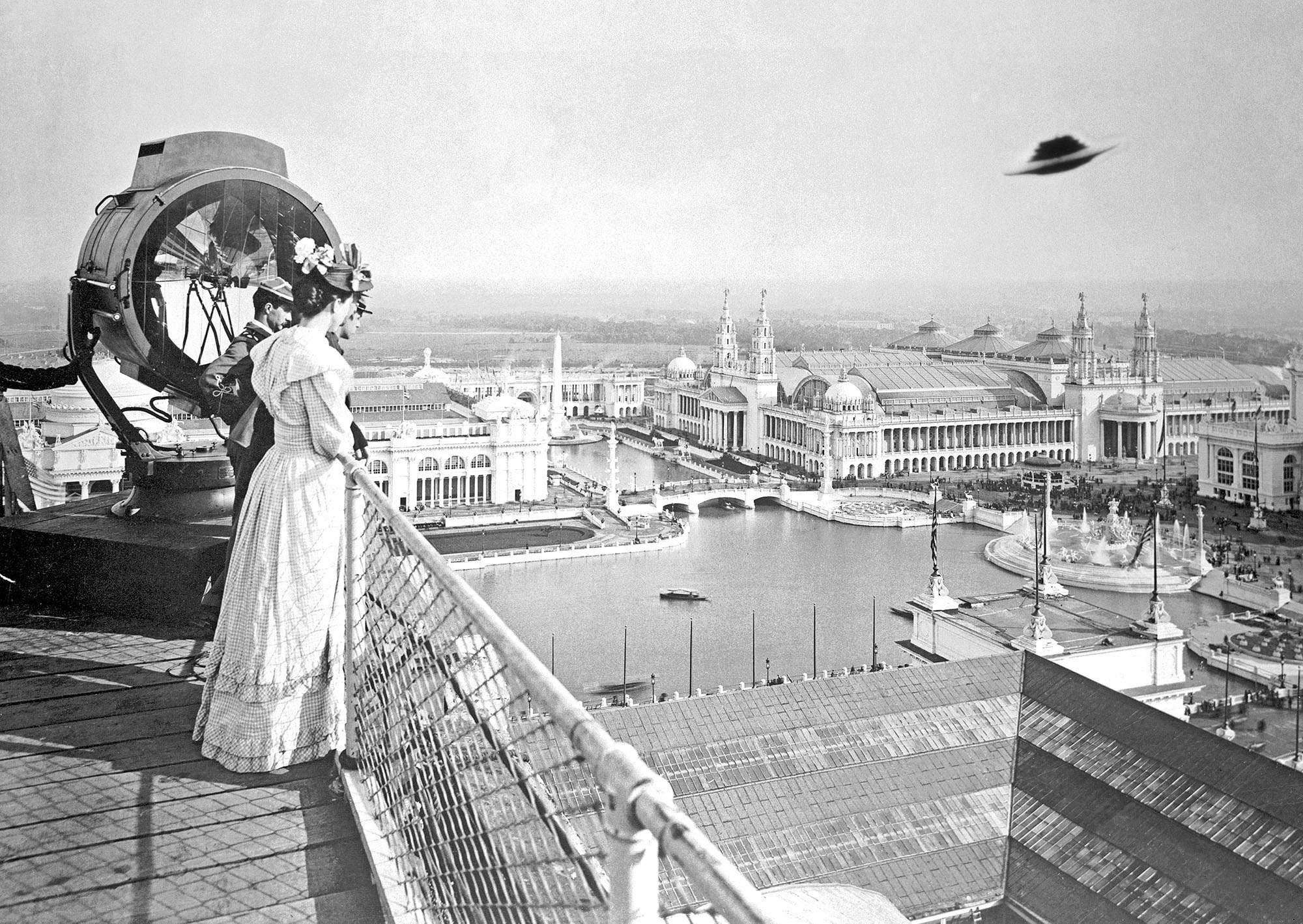
Of all the displeasures that the Trump Administration has brought upon the District of Columbia, the most peculiar was the dinky little fairgrounds thrown up on the National Mall this past July. Crafted from the finest styrofoam and vinyl that misdirected donations can buy, its design unmistakably evoked the otherworldly classical ensembles of the 1893 World’s Fair and its imitators. In some ways, the choice is intuitive. The World’s Columbian Exposition was an exuberant expression of American wealth, power, and identity that cultural creators have returned to with fascination again and again. Make America Great Again, right?
But on the other hand, how did a festival that lasted only six months lodge itself so deeply in the American psyche? Why did we rebuild it in miniature on the National Mall? Why has it become a feature of more than one conspiracy theory about a suppressed glorious past? Why is its discernment invoked on every can of Pabst Blue Ribbon? Have we always been thinking about this plaster pop-up advertisement for American majesty?
The answer to all of these questions is… stranger than I had thought. Whether thinking back to 1893 or 1993, what draws us to an event, story, or image depends less on the context of the events than the context we inhabit. As a result, we interpret—or reimagine—the past differently from our predecessors. And I think the lingering memory of the World’s Columbian Exposition shows how it’s from these reimaginings, not neutral facts, that we reshape the world.
A New and Improved Jerusalem
One aspect of the fair that no historian will dispute is that, like the dinosaurs of Jurassic Park (1993), it blew people’s minds. Raves about the Exposition had begun even before it opened in May 1893 and continued well past its closure in October of that same year. Articles, telegrams, and diaries all testified to its wonder. For years after, both licensed and bootleg merchandise sold well, cluttering parlors into the new century.
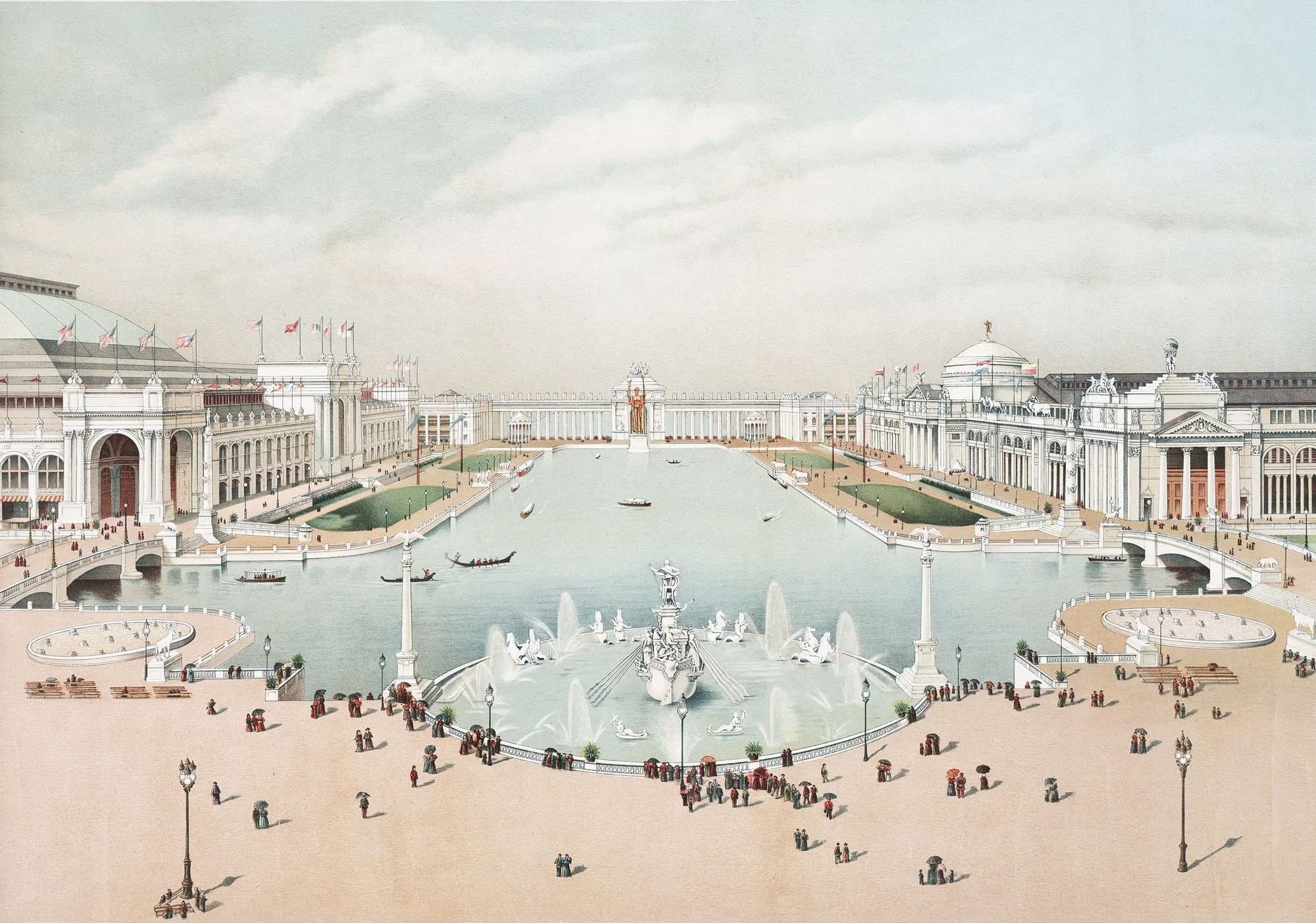
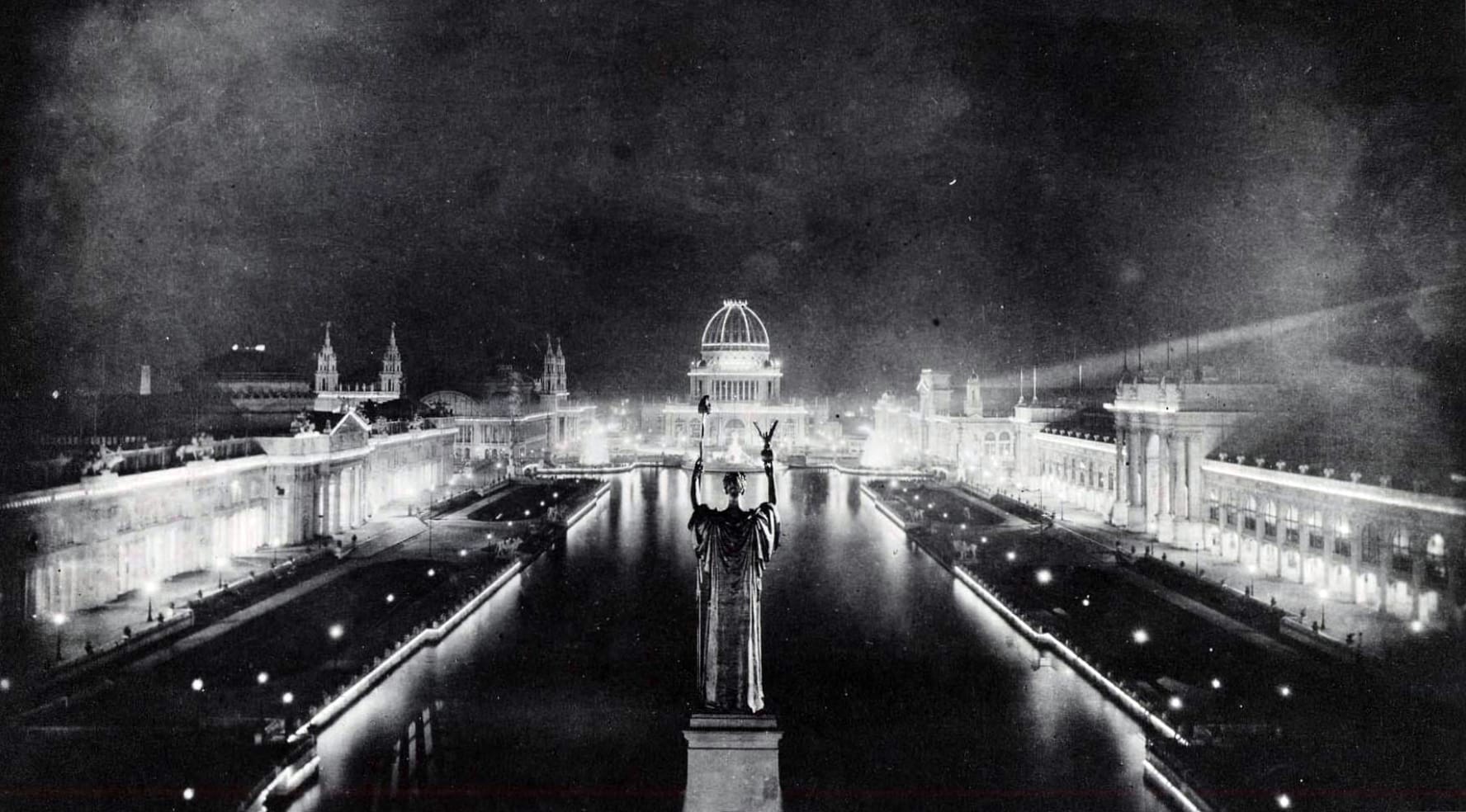
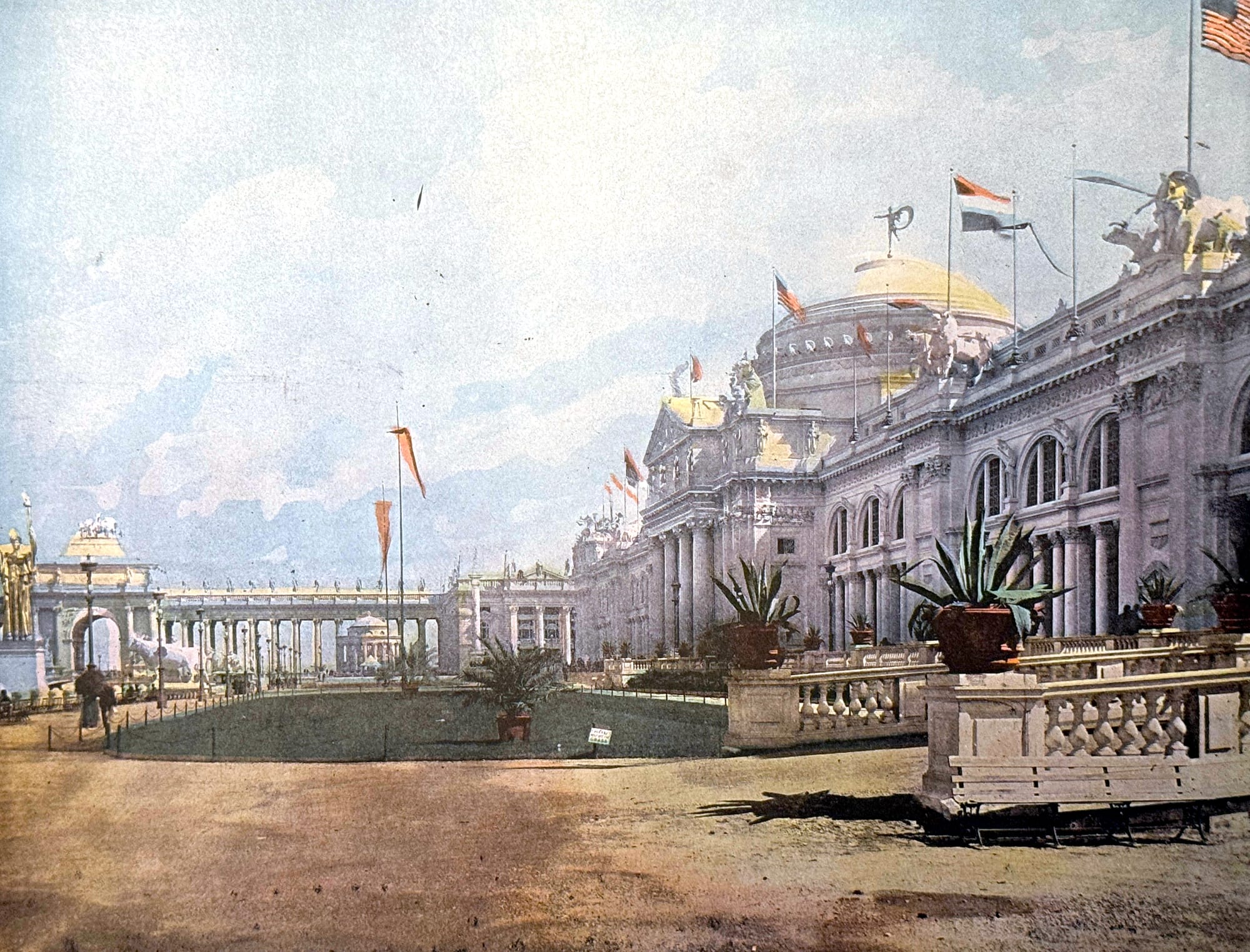
Writers of all stripes have catalogued the diversity of its appeal. For a population that had only just become majority urban, Chicago was an attraction in and of itself. Down in Hyde Park, the glass-roofed exhibit halls offered unbeatable publicity to manufacturers in an advertising environment of catalogues and newsprint. Over at the fair’s Midway, visitors delighted in its carnival attractions while its ethnographic displays shook assumptions about humanity. More than any of that, however, what lingered longer in people’s memory was the central complex of the fair. Known officially as the “Court of Honor,” and colloquially as the “White City,” it was an ensemble of monumental plaster facades that shone in the daytime and glowed after dark in a lavish display of Westinghouse electric light—still radiant with the shock of the new. Hundreds of organizations held their annual meetings behind its facades and nearly a third of all Americans visited.
Even the White City had its dark side.
It is not possible to trace every path that crossed in the White City. Some people were wowed and went home with the merch. Others were transformed. One such pilgrim was a journalist named Charles Mulford Robinson. In the 1897 official history the fair, he described the experience of entering the Court of Honor as something like an ego death:
The faculties were all alert; he forgot himself or he felt the limits of his own personality slipping away, extending widely, boundlessly, until the whole scene was in his own soul. That was the first, unanalyzed impression of the Fair; not the impression merely of the artist, the architect, or the poet, but of the everyday person, sounding infinite depths whose existence he never had known before.
He was far from alone in seeing the otherworldly in the design. In 1895, Frances Hogson Burnett, better known as the author of The Secret Garden, published a children’s parable, Two Little Pilgrims’ Progress, A Story of the City Beautiful. The short book follows two orphan children as they visit the fair while reading the 17th century Christian allegory Pilgrim’s Progress. In Burnett’s retelling, the spiritual journey is a physical one. The Celestial City that serves as Pilgrim’s aim in the fable, it turns out, was right there on the shores of Lake Michigan, reached for reasonable fare. Contemporary reviews of the book were mixed. None that I have found, however, objected to the comparison she made between this for-profit festival and actual literal Heaven.
Here’s another question. How much do you think about the Barcelona Summer Olympics? Woodstock ’94? Michael Jackson’s halftime show at Super Bowl XXVII?
Each of these brief events from roughly thirty years ago was deeply influential in its own time and on the industries they were part of. Yet I think it’s safe to say that they don’t hold our memory as well as media from 1993 like Whitney Houston’s rendition of I Will Always Love You or Stephen Ambrose’s A Band of Brothers. Events are definitionally less tangible and less accessible. The memory itself persists more in more the fragments of souvenirs. The historian David Burg counted over a dozen novels featured the Fair as a setting or even plot device over the following decades. Some reveled in its heyday; others frolicked in its ruins. In most cases, it was a setting or even a plot device, not the character that Burnett made it.
Colorized engraving from The Book of the Fair, by H. H. Bancroft, 1893
On the other side of the First World War I, the only people who seem particularly interested in the fair are urban planners. Seeing it as the spark for their movement, they approached it with historical, rather than immediate, reverence. Like the general public, their eyes were focused on the unfolding of modernity. As charted by economist Robert Gordon, the technology that had seemed magical in 1893 grew increasingly mundane. Its aesthetics, on the other hand, looked quainter with every year. Not only was there no jazz at the Columbian Exposition, there wasn’t even ragtime. When Chicago again hosted a World’s Fair in 1933, it invoked its predecessor primarily to emphasize just how far they had come in two generations.
Perhaps the clearest illustration of the Exposition’s faded mystique is its absence in the artistic medium that dominated the 20th century. From the establishment of the first studio in Hollywood in 1912 until 2017, only a single major motion picture covered the Fair—and even then, it dramatizes the Midway, not the White City. It’s a biopic of skimpresario Florenz Ziegfeld featuring Myrna Loy as Billie Burke, who herself was about to achieve immortality for introducing the world to another fantasy city—this one, Emerald.
Honestly, I was surprised at how thin the fair’s top-line cultural impact was for most of the 20th century. Not that I did a truly exhaustive search, but outside of Chicago it was a topic for the history books and apologetic statements by urban planners, especially when compared to the city’s dark side. Only PBR, it seems, held to the faith.
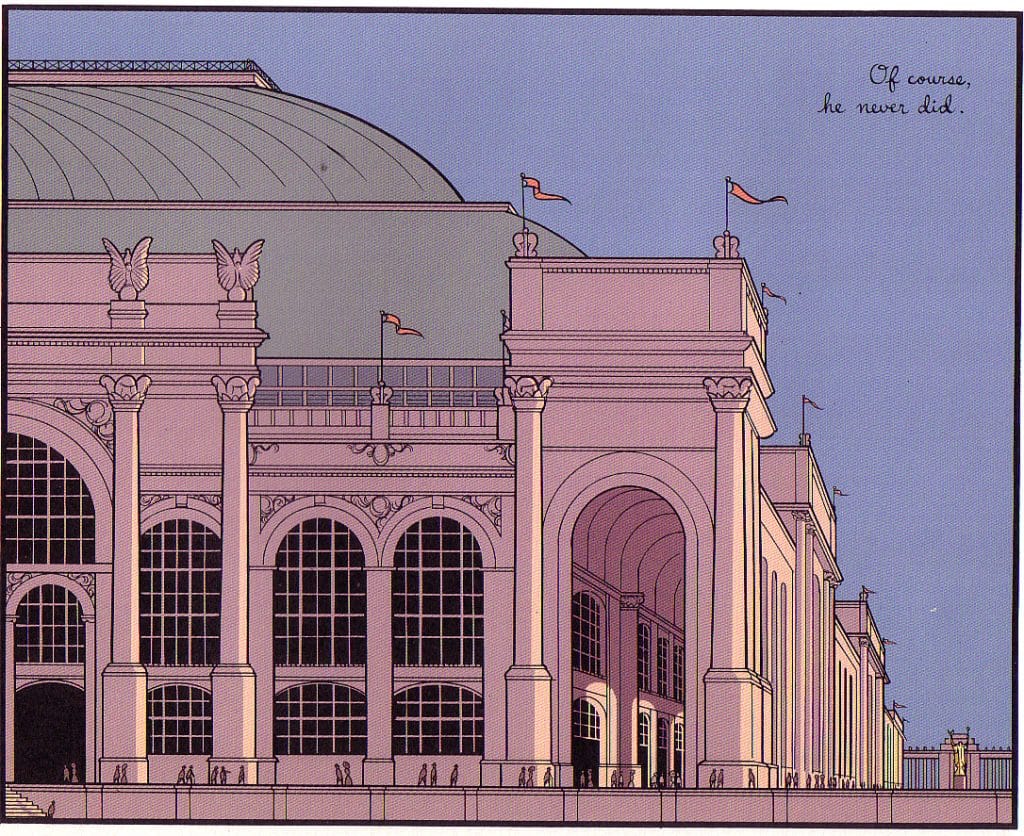
Frame from Chris Ware’s Jimmy Corrigan, the Smartest Kid on Earth
The dream of the 90s was the dream of the 90s
Things changed in the 1990s. The centennial of the Fair in 1993 summoned a host of books, local TV documentaries, and exhibits.
Still, these might not have added up to much, if a cartoonist named Chris Ware hadn’t broken his legs. Unable to walk for weeks, he read up on Chicago’s history and began to incorporate some of this background into the strip he ran in the local alt weekly (what could be more 90s than that?). Definitively published in 2000, Jimmy Corrigan, the Smartest Kid on Earth, features multiple sequences set at the fair. More so than almost any work since Burnett’s fable, it shows the White City as a space of unmatched wonder. The ornate structures fill page after panel and from every angle. Ware’s style draws heavily from severe technical drawing and slick advertisements. Yet rather than dulling the grandeur of the Roman designs, it makes them look Platonic—celestial even.
Ultimately, though, it looks like the revival of interest in the World’s Fair was actually the work of the Devil: 2003’s The Devil in the White City. Hanging 300 weeks on the New York Times bestseller list, Erik Larson’s narrative nonfiction book revived not only the magic of the Court of Honor, but also the motif from 19th-century works that the rest of Chicago was a place of lethal danger. The moment by Lake Michigan had an alluring ambiguity, like CK One.
Others saw it too. Novels, movies, shows, video games, memes: every medium and every genre has found its way to the Court of Honor since then. It been a setting for both Thomas Pynchon and the Marvel Cinematic Universe, it was namechecked by Sufjan Stevens, and it inspired the richly disturbing first person shooter BioShock Infinite. Of all the media that has riffed on Fair since hipsters started drinking PBR in Williamsburg, this game best tackles the themes that historians had been uncovering beneath the great plaster facades: Christian nationalism, racism, and patriarchy—all on the eve of Ferguson and Gamergate, organic cultural events that, like the Chicago Fair, continue to shape our culture even if they aren’t on our minds.
In-game advertisement for the floating city of Columbia in BioShock Infinite.
One advantage the game had over any of the novels about it was that it is a visual medium. Architecture photographs better than it reads. So perhaps it’s not a surprise that we also see a simultaneous revival of wonder around the fair on the basis of photographs alone. The internet made sharing image across the globe incomparably easy. With this came a collapse in context. A scan posted by the Art Institute of Chicago with academic reserve might get shared on Reddit with Millennial amazeballs, and then after six other reshares, appear on the Facebook feed of someone who began to wonder if our dysfunctional society really built all that grandeur for a single summer before even the automobile.
By 2016 at least, an the skepticism had hybridized with Russian “phantom time” theories: it like so many other grand 19th Century buildings was, in fact, the ruins of a superior lost airborne Tartarian civilization, destroyed in a great flood that left mud all over the streets. Don’t believe it? Then why is there mud all over the streets in these photos I found on Telegram? I bet you really think that guy lit the Olympic cauldron in Barcelona with an arrow.
As seen in the 1993 documentary series “The X-Files.”
You are part of the creative process
But as I said at the beginning, I think there is a surprising throughline from Burnett to Larson to u/TengristMulder93, which is… imagination. Both fiction and nonfiction require re-interpreting the bare existence of the Court of Honor, a space that most interpreters did not visit. When trying to re-present historical events, we must undertake process that is inherently imaginative, if not creative in its own right. Both conspiracists and historians of imperialism like Robert Rydell must dig beneath the White City to find a deeper meaning. Others like Burnett or the designer of that sad little Great Fair, architect Nicolas Charbonneau, need to color well outside those lines to get their point across.
The difference, then, is what each of these creators brought to the Fair. Ware built his depression-fueled vision of the White City off of extensive research in both secondary and primary historical sources. Those, in turn were built off of imaginative processes that were disciplined by historical methods: theory, the archive, and a consensus that the centuries between the fall of Rome and the construction of Monadnock Building actually happened.
In contrast, for believers in the Mudflood or those yearning to RETVRN, the historical context is of negative value. For the former group, their deep distrust in the institutions that provide provenance means they are free to read between the lines at a level a historian can only dream of. And once that skepticism has generated has generated a theory, it enables more, richer readings, and on and on until you conclude that H. H. Richardson is a composite character invented by the Preceptors of the Hollow Earth. In that way, Tartaria is an unmistakable a product of another invention released in ’93: the World Wide Web.
For the more learned reactionaries who want to reheat the White City (and the National Mall is just the beginning), the images of the fair are likewise a pinboard for their own imagining. While utterly fantastical, the buildings are nevertheless just familiar enough. The spaces are as bare of street filth as they are flush with the kind of ornament that to many seems less possible in 2026 than space travel did in 1893.
So, the minds behind statue avatars on x dot com revel in the capital-o Order and capital-b Beauty of the images, without much concern the underlying reality: the photos show not a city, but a temporary theme park. That is not the point; like Burnett or Charles Mulford Robinson, they believe that the grand halls could be how our cities look. Whether they are willing to develop the expertise and create a social movement like visitors to the fair did is a different story. This past summer’s styrene Midway wasn’t promising.
Tuscan column printed on to a vinyl tent at the Great American State Fair.
As an architect, I get it. Stripping context from a reference is often the beginning of aesthetic innovation. Proof is right there in the White City, where motifs had been borrowed from huts to temples to churches to palaces and last of all to grand light filled halls that helped sell sewing machines. As Fair designer Henry Van Brunt described the design team’s objectives in 1892:
It was considered that a series of pure classic models, in each case contrasting in character according to the personal equation of the architect… would present to the profession here an object-lesson so impressive of the practical value of architectural scholarship and of strict subordination to the formulas of the schools… This is not architecture in its highest sense, but rather a scenic display of architecture.
In other words, the White City was a creative act of deracination that in turn was meant to spur the imaginations of others. Sampling European opulence to the rhythm of American consumerism produced a powerful eyeworm. It was an advertisement for a certain kind of architecture, a certain approach to city making, and a certain way of organizing labor. Just like influencers cultivate interaction and imitation, Burnham’s boys created participatory spectacle… and it worked. You and I are still thinking about it now.
So maybe the more revealing question is: why did people stop thinking about it?
In my opinion—and this is just my interpretation—is context. With a new style of architecture debuting at each subsequent fair, even those who experienced the Court of Honor directly brought that sense of obsolescence to their own memories of the Fair. For those who only encountered it secondhand, they did so within the context of narrativized and constructed history. If they saw images, they found them on grandma’s shelves or on the right column of their AP US textbook.
This presents a challenge to those, like historians, who aim to convey what exactly the Columbian Exposition was and meant. To provide context—to say nothing of critique—is to get in the way of the fundamental purpose of the great White City on the shores of Lake Michigan: to invite people to imagine what the world could be.
I still think it’s possible. But on the other hand, historians can’t even agree on how important the Fair actually was. I will talk about that in a future newsletter.
The Great Ziegfeld, dir. Robert Z. Leonard. (Metro-Goldwyn-Mayer, 1936).
Jurassic Park, dir. Steven Spielberg (Universal Pictures, 1993).
The Wizard of Oz, dir. Victor Fleming et. al. (Metro-Goldwyn-Mayer, 1939).
Ambrose, Stephen E. Band of Brothers: E Company, 506th Regiment, 101st Airborne, from Normandy to Hitler’s Eagle’s Nest. New York: Simon & Schuster, 1992.
Ross, Rebecca. “Picturing the Profession: The View from Above and the Civic Imaginary in Burnham’s Plans.” Journal of Planning History 12, no. 3 (2013), 269-281. https://doi.org/10.1177/1538513213481762
Rydell, Robert. All the World’s a Fair: Visions of Empire and American International Exhibitions, 1876–1916. Chicago: University of Chicago Press, 1984.
Schuyler, David. “Frederick Law Olmsted and the World’s Columbian Exposition.” Journal of Planning History 15, no. 1 (2016): 3-28.
Selzer, Adam. H. H. Holmes: The True History of the White City Devil. New York Skyhorse Publishing, 2019.
Stevens, Sufjan. “Come On! Feel the Illinoise! (Part I: The World’s Columbian Exposition).” Track 4 on Illinois.
Taylor, Dorceta. The Environment and the People in American Cities, 1600s-1900s: Disorder, Inequality and Social Change. Durham: Duke University Press, 2009.
Ware, Chris. Jimmy Corrigan, the Smartest Kid on Earth. New York: Pantheon Books, 2000.
Wilson, William H. The City Beautiful Movement. Baltimore: Johns Hopkins University Press, 1994.
Van Brunt, Henry. “Architecture at the World’s Columbian Exposition.” The Century Magazine 44, no. 1 (May 1892) p. 81-99.
There is a huge amount of work on the Fair. If you’re interested, this website has compiled an extensive bibliography and indexes of all the other media you can consume with or without context.
And why would you remember that old Fair, when didn’t have real innovation:
Sept. 22 (UPI) — A former U.S. Postal Service worker has been indicted forallegedly throwing away about 300 mail-in ballots earlier this year in Utah.
The U.S. Department of Justice unsealed the indictment Tuesday as Damon Matai Seei, 34, of Payson, Utah, appeared for his arraignment at the Orrin G. Hatch U.S. Courthouse in Salt Lake City.
Seei was indicted by a federal grand jury on Wednesday. He faces charges of unlawful secretion, destruction and delay of mail for allegedly throwing the ballots into a dumpster in a church parking lot.
Justice Department officials alleged in a detention memo that Seei said in an interview that he threw away the ballots and other mail on June 3 to “lighten his workload.” He said in a written statement that he felt “overwhelmed” that day and decided to “get rid of advertisement mail.”
Seei said he had no political agenda and didn’t mean to throw away ballots, the memo said, but that he made a “poor decision” out of “frustration” and “laziness.” The ballots were to be delivered to Eagle Mountain, Utah, residents to allow them to vote in the June 23 primary election.
“When American voters lawfully cast their vote, they should feel confident that it is counted,” said acting Deputy Attorney General Trent McCotter in a statement. “Allegedly throwing away hundreds of ballots is a serious federal crime that undermines the integrity of our elections. Ballot integrity is not a partisan issue.”
Seei’s next court appearance is set for Nov. 30.
The indictment comes as U.S. President Donald Trump has, without evidence, alleged an epidemic of voter fraud, especially in mail-in voting. Last week, the U.S. Supreme Court rejected the administration’s plans to limit mail-in voting for the November midterm elections.
Sept. 22 (UPI) — U.S. Treasury Secretary Scott Bessent said Tuesday that the Trump administration is looking into whether a diesel export ban would help surging diesel prices in the United States.
“We’re examining whether it’s feasible in terms of the overall refining capacity and whether a full or partial ban would work,” Bessent said at a meeting between U.S. President Donald Trump and Ukrainian President Volodymyr Zelensky at the United Nations in New York City.
Asked if he would endorse a ban, which other Republicans have called for, Trump said Tuesday that he has called for the measure as well.
“I said let’s not send out the diesel,” he said. “We make a lot of diesel.”
The United States is experiencing record high prices for diesel, with the fuel’s price soaring to an average of $6.53 per gallon Monday, according to AAA. U.S. refiners have escalated diesel exports as refineries in Russia and the Middle East deal with attacks and transportation issuescontinue.
Trump said the decision on a ban would be “fast, one way or another.”
Economists and energy experts said that a diesel export ban would could lower U.S. prices in the short term but would eventually backfire and lead to higher prices globally, including in the United States, Axios reported.
Sen. Chuck Grassley, R-Iowa, is one of the Republican lawmakers calling for a diesel export ban as prices climb and the November midterm elections approach. Others, including Sen. John Cornyn, R-Texas, called it a “gimmick.”
Mike Sommers, American Petroleum Institute CEO, said a ban would “only compound the problem” and eventually hurt consumers.
“The answer is more supply and more flexibility — not new restrictions that risk making a difficult situation worse,” Sommers said, Axios reported.
I was recently invited to brief a group of Congressional members and staff on the state of open-weight models in the lens of U.S.-China competition. I’m sharing my prepared remarks as a state of the union on open models that is accessible to a broader audience.
Interconnects AI is a reader-supported publication. Consider becoming a subscriber.
Recap: What is an open source v. open-weight vs. closed model?
Open language models are AI models where their weights are publicly available for inspection or downstream use. These are most often contrasted to so-called “closed” AI models. Closed models offer access only through Application Programming Interfaces (APIs) that developers can use to directly query a model, like GPT-4 or Claude Opus 4.5, or through products, like ChatGPT and Claude Code.
Open language models primarily are bucketed into two categories, open-weight and open-source models. Open-weight models are the most common form, such as popular models like Meta’s Llama, Alibaba’s Qwen, Google’s Gemma, or DeepSeek’s models. These models are governed by licenses, governing documents dictating what is allowed with downstream use, and are often accompanied by inference code in libraries such as Transformers, VLLM, SGLANG, etc. Since about April 2025, Chinese AI companies have been the clear leader in open-weight models.
True “open-source” models are similar to these, as they include the weights, licenses, and inference code, but they also include the complete information needed to reproduce the model – the training code and training data. The most prominent open-source models have been built in the United States, led recently by the Allen Institute for AI’s Olmo models that I helped build in my recent 2.5 years there. The other prominent open-source models are also built by American non-profit organizations, including OpenAthena’s Marin models and EleutherAI’s Pythia models.
Open-weight, open-source, and every other label for a model – including closed models primarily offered via an API – exist on a spectrum. For example, Nvidia’s Nemotron models are far more open than most open-weight models, releasing large quantities of their training data under permissive licenses, but they’re not fully open-source because they do not release all of the data. Closed models also exist on a spectrum based on what information the API reveals and the terms of use.
The state of competition between American and Chinese open-weight models (unit economics, technical capabilities, etc.)
We are living in a world where GLM-5.2 and Kimi K3, some of the latest, leading Chinese models, have enacted a step change in the commercial viability of open models — crossing a similar threshold in agentic capabilities that Anthropic’s Claude Code crossed in December of 2025.
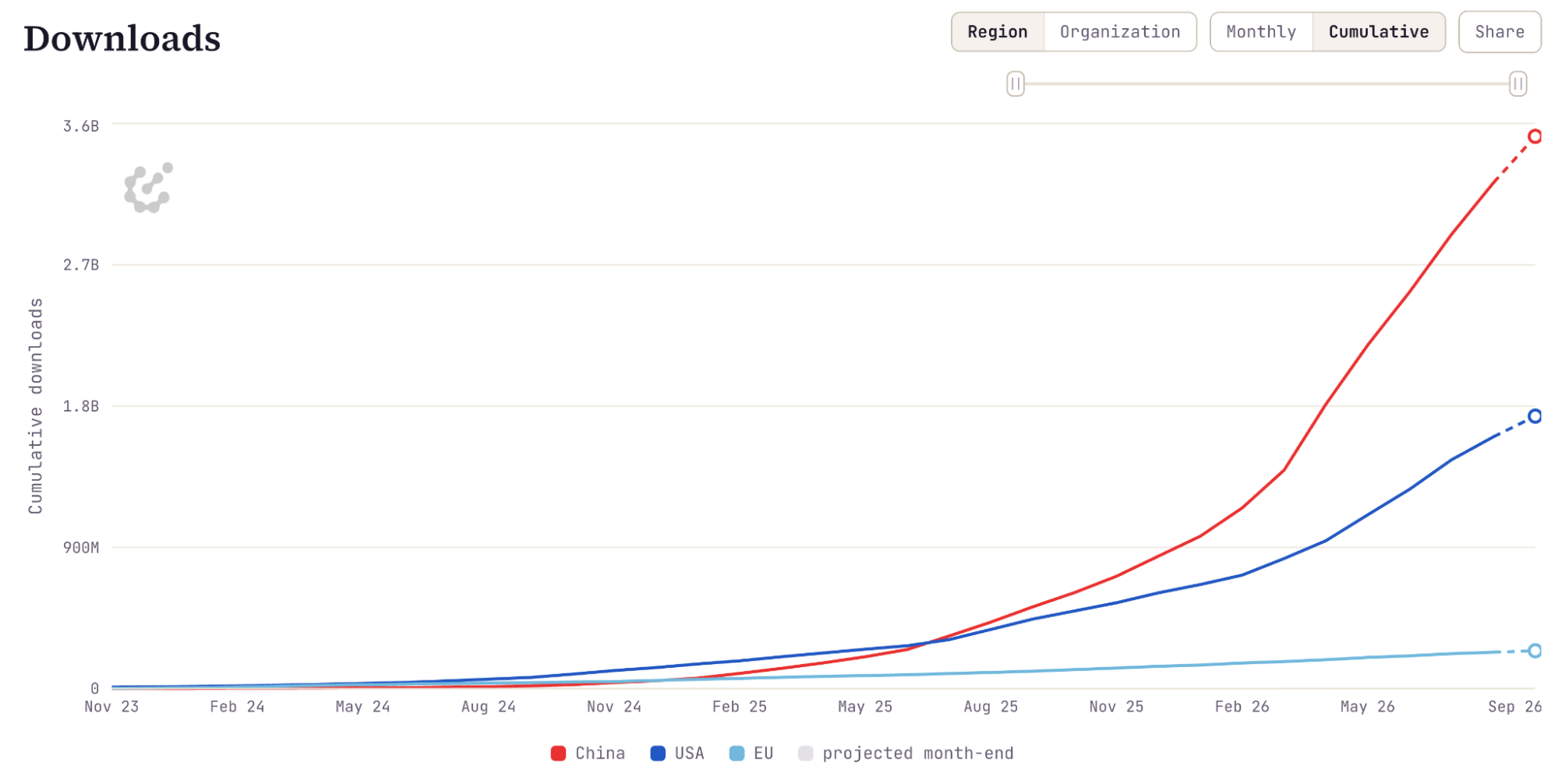
America was the early leader in open language models, primarily through Meta’s Llama models, which were used extensively across research and commercial tasks. Chinese open-weight models surpassed American open-weight models in these two key areas about 18 months ago. The simple metric showing this is Hugging Face Downloads, where China took the lead in July of 2025 primarily through the success of Alibaba’s Qwen models. I personally maintain tools to track this data, and since I first published the American Truly Open Models (ATOM) Project in August of 2025, China’s download lead has grown to about 1.6B – with a total of 3.2B downloads, twice that of America’s total.
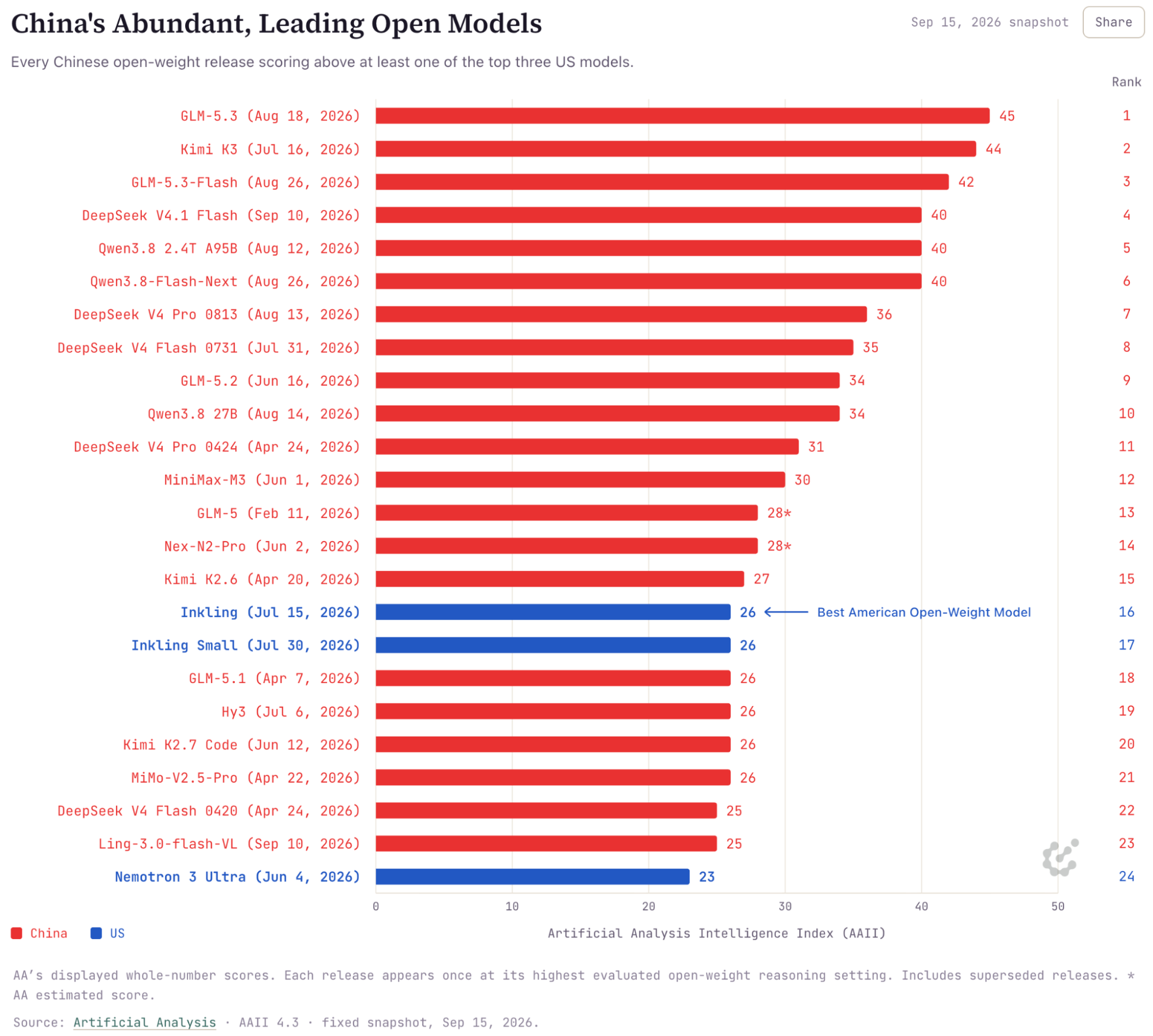
On popular capabilities benchmarks, such as the Artificial Analysis Intelligence Index (AAII), the Chinese open-weight models have a clear lead over American counterparts. The top three Chinese models as of writing this on September 14, 2026 are Z.ai’s GLM-5.3 and GLM-5.3-Flash and Moonshot AI’s Kimi K3 with scores of 45, 42, and 44 respectively. By comparison, the leading American models are Thinking Machines’ Inkling and Inkling Small, both with a score of 26, and Nvidia’s Nemotron 3 Ultra, with a score of 23. The top American models were released in June and July of 2026, and are updated less frequently than their Chinese counterparts. For example, Chinese labs released models with scores above these American models 2-6 months before the American companies got there (e.g. GLM-5 or DeepSeek V4 Pro). There is a trend of more American companies releasing models, including names like Arcee AI, Poolside and IBM, but they are not rapidly closing this performance gap. Other benchmarks tell a similar story.
The top American open models on the Artificial Analysis Index are behind 15 other Chinese made models.
Together, Chinese open-weight models are approximately 2-5 months behind the closed American frontier, with the open-weight American models being approximately 6-9 months behind the likes of OpenAI and Anthropic. The Chinese labs are closest in tasks with clear user demand, such as agentic coding, and further behind on more open-ended scientific tasks, such as physics or biology.
The reasons why Chinese labs can produce these strong models, despite having fewer resources than American counterparts, is still an open debate and heavily influenced by different work cultures, but is also influenced by a few key technical factors. The Chinese labs release their models faster and focus on a slightly narrower distribution of tasks, flattering them slightly on public benchmarks. Releasing faster helps them score higher because all the labs are making consistent progress, so once you “finish” a model to be released, it is a snapshot of performance at that given time — labs where that time is later tend to score higher. Still, the models built by the Chinese labs are genuinely strong and represent real competition to the American industry. This competition will not decrease meaningfully as the closed labs patch vulnerabilities in their API offerings which enable distillation.
Distillation is most impactful in new domains and does not make it trivial to create a universally strong final model. I estimate that if distillation was fully prevented, e.g. with know-your-customer (KYC) tools at Anthropic and OpenAI, the gap from the strongest American models to Chinese open-weight models would only increase by 1-2 months.
For example, the Chinese labs are rapidly changing their posture towards paying for training data in 2026. Earlier in the year, the top Chinese labs including Moonshot AI and Z.ai had a strong preference towards building data workflows in-house, but by the summer they had begun to buy the cutting edge data – challenging RL environments for agentic tasks – from both established American companies and new Chinese startups.
With the advance of open weight models in China towards the frontier of capabilities, and the recent documentation of growing risks around frontier models in areas such as cybersecurity (e.g. the OpenAI-HuggingFace incident), there’s growing regulatory uncertainty on how continued releases can enable a safer ecosystem?
A structural challenge in open-weight models is that there are few effective methods for stopping pieces of open software from reaching bad actors. If an attempt was made to restrict access to the strongest open-weight models from China because they amplify risks, the parties who would be set back are American businesses. We have an example of this – HuggingFace used a Chinese open-weight model to understand the cyberattack because closed models would not answer their requests. Thus, managing the risks of open-weight models often comes down to ecosystem preparation.
Open-weight models are becoming an essential tool for AI diffusion, and the best path to get ahead of these risks and unbalanced relationships where American companies rely on models built in China is to continue to enable investment in open models in the US. Ownership of open models allows better coordination and preparation of risks that are global in their nature while accelerating diffusion of AI services throughout the domestic economy.
The state of open model adoption: How is open-source being used by academia, businesses, and other countries?
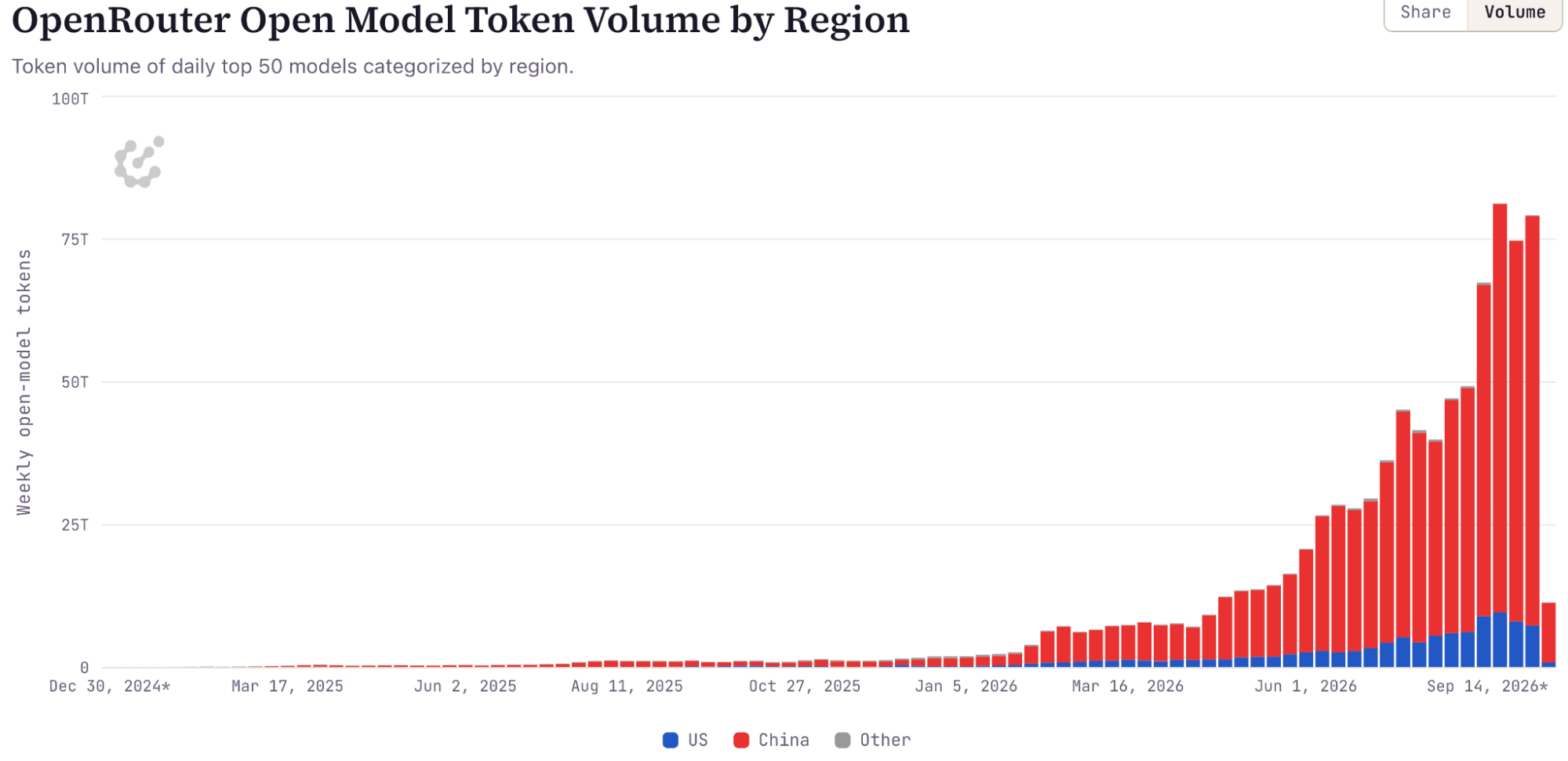
Open-weight language models have grown substantially in general interest and economic viability in 2026, allowing early glimpses of more direct ways to compare adoption of models from the US, China, or elsewhere on top of Hugging Face metrics. One example is OpenRouter usage. OpenRouter is a popular LLM inference platform that supplies a single interface to switch between models, open and closed, from the US and China. This platform is primarily known for trying different open-weight models. The platform has shared usage data for the top models since Jan. 1, 2025, and shown growth in usage from ~1T tokens processed from open models in a week of September 2025 to ~80T tokens per week today. In that time, Chinese models have grown from ~70% market share to over 80% of usage. Other platforms that are designed to commercialize open models show similar data, such as the open-source coding agent OpenCode, which shows an inference volume of ~95% or higher with Chinese models.
These open platforms are the best approximation of open model usage we have – a large proportion of open model usage is on platforms that do not disclose per-model breakdowns, such as Together AI or Fireworks AI, and in private deployments for enterprise applications.
Many prominent technology companies and startups have been building on Chinese open-weight models for their AI features, such as Harvey, the legal agent, Cursor, the coding agent, and DoorDash’s use of Kimi models, Airbnb’s use of Qwen, or Perplexity’s use of DeepSeek. These prominent companies are the tip of the iceberg, where a large swath of younger Silicon Valley startups are building on Chinese models in order to have low-cost, flexible options. There is a growing trend of American startups and companies entering enterprise agreements with Chinese model labs in order to get permission to use their models in their products – a new form of cross-border technology collaboration I have not witnessed in my career.
The foundation of innovation on Chinese models extends further into the AI ecosystem. To a first order approximation, most of academic research is conducted on Alibaba’s Qwen family of models. Having met multiple members of the Qwen leadership team during my trip to China, they are very invested in and intentional about this type of adoption, which will not be easy to claw back to American models.
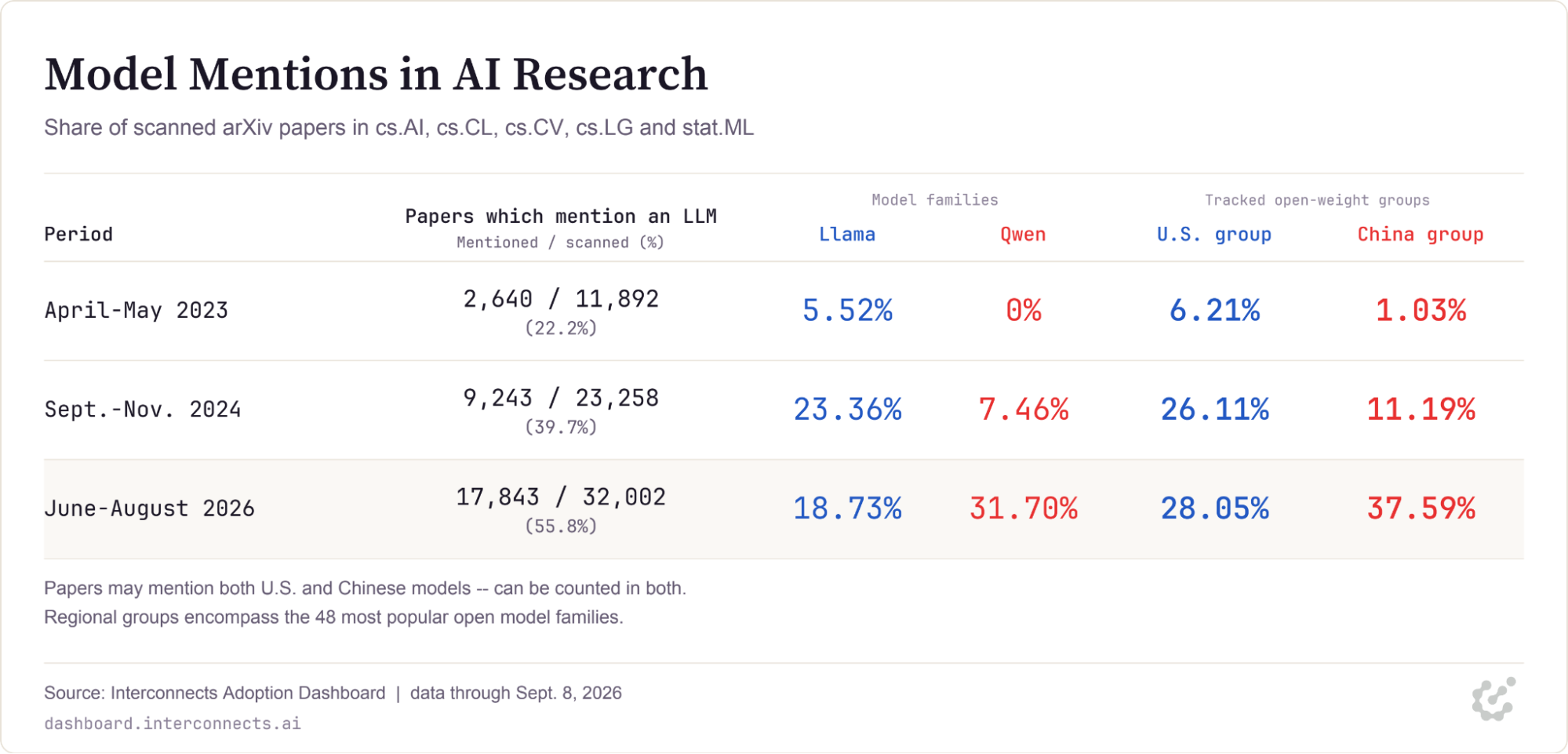
To quantify the adoption of open models across academia, I scanned every paper in the 5 most popular ML categories of arXiv (cs.AI, cs.CL, cs.CV, cs.LG, stat.ML), the preprint platform popular in AI research. The results clearly track my understanding of the evolving leadership in AI research, showing LLMs becoming a foundational layer of ML research – mentions of any open model were 2% in January of 2023 and 50% in September of 2026 – and the leading role shift from the U.S. to China in the same time period.
For example, in April to May of 2023, a few months after Meta’s original Llama (a backronym, Large Language Model Meta AI, first released in Feb. of 2023), about 2,600 of 12,000 new AI/ML papers on arXiv mentioned at least one prominent open model family. Of all those scanned papers, ~5.5% mentioned Llama and ~1% mentioned a Chinese model. In the fall of 2024, during Llama’s peak, about 23% of papers mentioned Llama with about 7.5% mentioning Qwen, the most direct Chinese competition. Today, Llama has lost its lead in academia, being mentioned in about 21% of papers still, which is remarkable longevity, but Qwen’s share has risen to 30% of papers. Overall, any Chinese open weight model is mentioned in over 40% of papers, over the U.S.’s 30%, with China’s share continuing to grow.
This shows that we clearly have a lot of work to do in order to re-establish the U.S. as the home of AI research in the era of open-weight language models. There are signs of hope.
In our research, we find that American models of comparable capabilities-to-size regions to their Chinese counterparts get adopted at disproportionate rates. In the last year we’ve seen OpenAI’s first open-weight models since ChatGPT, gpt-oss, become one of the most adopted open-weight models of all time. Since then, Google’s Gemma 4 models have been some of the only ones ever to show similar adoption numbers to Qwen’s most popular small models, and Nvidia’s Nemotron models have modest adoption despite numerous more capable models at the same size point.
The story of open models in 2026 is one of establishing economic relevance. This is the convergence of many stories across the AI ecosystem, summarized as:
The capabilities gap from open to closed models available to users has been decreasing over the last 3 years. This varies by task, but can be estimated as a 2-5 month gap in capabilities. With capabilities overall progressing so fast, this has seen open-weight AI models unlock substantial markets in 2026 and points to more inflection points in the near future.
Open model usage is exploding in high-value industries (e.g. software engineering, legal services, financial services), indicating an emergence of an alternative ecosystem to the best closed models. Platforms offering inference primarily on open models, from Together, OpenRouter, Fireworks, Baseten, etc., are seeing incredible growth as the first winners of an open model post-training economy (other layers include finetuning APIs such as Thinking Machines’ Tinker). This is combined with numerous anecdotes from technical staff in the AI industry that uses open-weight models such as GLM-5.3 as an alternative to Claude or GPT due to a combination of speed, lower prices, customizable offerings, and privacy.
Chinese AI companies are the clear leaders in open weight models. Relative to 2025, where Chinese models like DeepSeek R1 shook the AI world with surprise, the American AI labs have been recovering in their positions with open-weight models, but despite more substantial investment in the US, the Chinese labs regularly are producing notably stronger models adored by many types of users.
Distillation of American AI models by Chinese labs does not explain the entire story of their success. Distillation is an industry standard technique of training another AI model on the outputs from a usually stronger model. The technique is most prevalent in the Chinese AI industry, which has used basic exploits to extract reasoning traces and additional data from American companies’ products that are not fully secured. The best estimates are that distillation helps reduce the performance gap of Chinese companies relative to the American frontier by 1-2 months.
Chinese models, particularly Alibaba’s Qwen family, are established as a foundational layer of research and development across academia and local model users. In recent months, Chinese open weight models were mentioned in 38% of AI papers, above the U.S.’s 28% – and the Chinese share is growing much faster than its American counterparts. This, along with other political factors and the closed nature of leading American AI companies, is contributing to an accelerated decline in America’s lead as the preeminent AI research hub in the world.
Open weight models are entering the capability levels where new risks, e.g. cybersecurity, can be enabled by numerous open-weight models being available, necessitating an ecosystem level response in preparation. This new era of risks is also enabling a period of political uncertainty, where there is regulatory attention on the strongest AI models, but massive uncertainty on how policy would be legally enacted. At the same time, many researchers and engineers rely on open models due to more permissive safeguards, where the closed models such as Claude and GPT often refuse critical cybersecurity defensive work or biology research.
In 2026 the Chinese labs are clearly maintaining their status as the leaders of the open-weight AI ecosystem. This comes as open-weight models have passed an inflection point in economic viability and in the face of increased activity from American labs as model competition. The leading Chinese labs do not appear to be meaningfully challenged, as they expand their enterprise and research adoption globally.
This landscape of open models comes at a crucial time in the broader AI ecosystem. We’re seeing OpenAI and Anthropic take massive steps forward with their latest public models, and at the same time call for coordinated care on how we manage the next stage of AI progress. What is happening in the confines of a few AI labs today, especially with extreme talent and compute density, is a precursor to what will soon emerge in the open model ecosystem. Open models are going to be the substrate for everyone else in the world outside of the few true frontier AI labs, to harness an acceleration in software engineering and other computational practices. This represents a substantial source of soft power, influence, and potential for the organizations that enable this broad access to transformative intelligence.
With this future coming soon, we need to collectively stay humble about the exact path open models will take. There are a lot of unknowns with open models – e.g. we don’t have good data on how they’re used in countries other than the U.S. and China. With the distribution of ML training expertise being broad, i.e. tens of organizations and thousands of people that are within a year of the frontier of capabilities, it is a matter of when, not if, open models cross the performance thresholds that enable new workflows. The collective approach should be to understand how to use this broadly accessible, open intelligence for good while proactively mitigating the potential harms.
Thank you to Florian Brand and Kevin Xu for feedback and/or suggestions for this work. For more research informing this post, see the open-source AI reading list.
Donald Trump will meet with the Chinese president Xi Jinping later today, ahead of a three-day visit that will undoubtedly see artificial intelligence (AI) high on the agenda.
António Guterres, the UN secretary general, has called on the two countries to establish a dialogue on AI similar to the communication between the US and the Soviet Union during the cold war.
“Governments with the greatest AI capabilities have the greatest responsibilities to humanity, to establish channels for dialogue, transparency, trust and cooperation,” Guterres said.
Tech executives including Jeff Bezos of Amazon, Sundar Pichai of Alphabet, Sam Altman of OpenAI, Tim Cook of Apple, Elon Musk of Tesla, Mark Zuckerberg of Meta and Jensen Huang of Nvidia will reportedly attend a state dinner at the White House on Thursday evening.
It comes as two leading progressive US lawmakers, senator Bernie Sanders and representative Greg Casar, were due to unveil legislation later today that would ban artificial superintelligence and create a federal agency to oversee advanced AI.
The bill, provided first to the Associated Press, would also pause advanced AI development until guidelines are implemented while creating the Department of Artificial Intelligence. Multiple employees at leading AI companies are endorsing the bill.
“It doesn’t take a genius to say, ‘slow it down,’” Sanders said in an interview with AP. “Do we really want to develop a super intelligence that when it becomes smarter than human beings could act independently of human control? I don’t think we do.”
Congress has so far done little to rein in the AI industry even as some of its most prominent leaders warn about potentially catastrophic risks.
Xi departed Beijing on Wednesday, state media said, heading to Joint Base Andrews, Maryland, where he will be met by Trump on the tarmac.
“President Xi Jinping left Beijing by special plane for a state visit to the United States” accompanied by his wife Peng Liyuan, his right-hand man Cai Qi, and foreign minister Wang Yi, among others, state broadcaster CCTV said.
In other developments:
Speaking at the UN general assembly, Donald Trump re-issued his threat to “annihilate” Iran and “drive them into Hell” if the regime didn’t capitulate and make a deal.” He also said he was “working closely with the leaders of Russia and Ukraine” to end the disastrous war, defended his administration’s actions in Latin America – including the midnight raid to arrest former Venezuelan president Nicólas Maduro, defended his drone strikes on boats in the Caribbean and the Pacific, accused Mexico of being effectively controlled by the cartels, and said it was “unacceptable” for the US to share a border with a nation under such conditions, pointed to regime change in Cuba and said he would reject any calls for a “globalist scheme” to control artificial intelligence.
Shortly after his UN address, Trump signed a Greenland deal, which Greenland’s prime minister Jens-Frederick Nielsen said “underlines the importance of the Nato alliance.” In tricky, carefully worded paragraphs, she said the agreement “recognises the US defining historical and ongoing contributions to the security and defence of Greenland,” but it also “respects the sovereignty and the territorial integrity of the Kingdom of Denmark, as well as Greenland’s right to self-determination.”
Trump told a CNN reporter at the UN general assembly on Tuesday that he was “surprised” the outlet was covering him, saying it ‘shouldn’t be here’ after he banned the network alongside Politico and MS Now from the White House on Friday.
At a joint press conference on Tuesday, vice-president JD Vance and Mehmet Oz, administrator of the Centers for Medicare and Medicaid Services, announced that the federal government was removing 760,000 enrollees from Affordable Care Act insurance marketplaces.
Sept. 23 (UPI) — The University of California, San Francisco School of Medicine discriminates against White and Asian applicants in favor of their Black and Hispanic counterparts, the Justice Department said amid the Trump administration’s efforts to eradicate diversity, equity and inclusion policies at institutions of higher learning.
The Justice Department has launched investigations into some of the nation’s leading medical and law schools to determine compliance with a 2023 U.S. Supreme Court decision that restricted race-conscious admissions practices.
In its findings released Tuesday concerning UCSF Medical School, federal lawyers alleged that prompting applicants to identify their race in the first two stages of the application process resulted in Black and Hispanic applicants being invited to the third and final interview stage at higher rates than White and Asian applicants with better MCAT scores and undergraduate grade point averages.
The report states that this was the case for the 2023 through 2025 incoming classes. During this period, UCSF Medical School was 4.6 times more likely to admit Hispanic applicants and 12.6 times more likely to admit Black applicants compared to White applicants with the same MCAT score, GPA and socioeconomic characteristics.
“Unfortunately, at UCSF Medical School, MCAT scores and undergraduate GPAs have taken a backseat to race,” Assistant Attorney General Harmeet Dhillon of the Justice Department’s Civil Rights Division said in a statement.
“Aspiring doctors should be admitted based on their qualifications. The Supreme Court has spoken clearly — federally funded medical schools may not admit students based on misguided and illegal notions of diversity.”
UPI has asked UCSF Medical School for comment.
Trump, who ran on removing left-leaning ideology from public and private spaces, has been targeting universities, many of which are some of the most celebrated in the nation, over alleged DEI hiring and admissions policies.
On Jan. 21, 2025, Trump’s second day back in office, the president signed an executive order directing the attorney general to issue guidance to federally funded educational institutions on how to comply with the Supreme Court’s 2023 ruling concerning race-conscious admissions practices at Harvard University and the University of North Carolina.
On March 30, the Justice Department informed UCSF Medical School of its investigation, requesting admissions data and other documents related to its admissions policies and practices.
The Justice Department has announced similar findings concerning other schools, including the University of California, San Diego School of Medicine, Yale University’s medical school, University of California, Berkeley School of Law and several others.
It is calling on UCSF Medical School to contact it by Oct. 2 to enter discussions on implementing a voluntary resolution agreement to ensure its compliance with the Supreme Court ruling.
Scenes from the 81st U.N. General Assembly
President Donald Trump speaks at the United Nations General Assembly at U.N. Headquarters in New York City on September 22, 2026. Photo by John Angelillo/UPI | License Photo
Andy Burnham calls out Russia as a hostile actor in misinformation war during UN address – video
New UK agency to fight ‘information warfare’ from likes of Russia, Burnham tells UN
PM aims to ‘stem poisonous tide’ of disinformation and deepfakes with National Centre for Information Defence
Security chiefs will set up a new national centre to tackle disinformation and deepfakes from hostile states such as Russia, Andy Burnham has announced, saying the government had a duty to “stem the poisonous tide” from damaging British interests.
The National Centre for Information Defence will “detect, attribute and disrupt” information attacks by foreign powers, many of which are enabled by AI, bringing together the intelligence agencies, law enforcement and social media companies.
It will be tasked with making sure the UK has the defensive capability necessary to combat information warfare and build national resilience by helping communities to identify and combat disinformation, preventing a “distorted and untrue” narrative about the UK.
Burnham said the country would have to go into the next decade “eyes wide open” about “insidious” campaigns, many of which had been orchestrated by Russia, which “twisted” what people at home felt about their own country and community.
In eye-catching remarks, the prime minister suggested that Britons who were struggling with the cost of living and young people not in education, training or employment may be particularly susceptible to foreign influence online, underlining how inequality further undermined society.
In his speech to the UN in New York on Tuesday night, Burnham said: “We’re talking about an insidious campaign that reaches into people’s homes and twists what they feel about their own country and community – creating a narrative of decline, stoking division and sowing despair.
“On top of that, we have seen cyber-attacks on our companies and institutions. We know that AI will multiply the threat. We have tiptoed around this for too long. Over the last decade we have given too much ground to those who want to run a negative, corrosive narrative about life in Britain, which bears no resemblance to reality. Well, no more.
“We are going to face the new decade in a different way – with our eyes wide open. We are going to be much prouder in standing up for our values and the rule of law. And we are going to help our people to strengthen their resilience – because, faced with this information warfare, security starts in every home.”
Burnham’s speech came after Donald Trump – during a press conference at the UN with Ukraine’s president Volodymyr Zelenskyy – said that Keir Starmer’s rhetoric had been “too tough” towards Moscow and that London “needs to be a little bit careful”.
Downing Street pushed back on the US president’s remarks, saying that every UK prime minister – up to and including Burnham – had been consistent in the view that Russia’s threats, whether hybrid attacks or rhetoric, were “egregious and unacceptable”.
“The UK is united with our allies on the importance of defending ourselves, and Russia’s aggression will not deter us from supporting Ukraine,” the prime minister’s official spokesperson added.
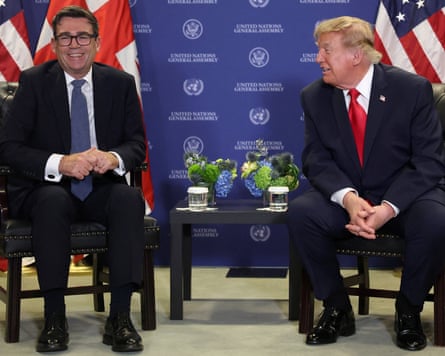
Downing Street pushed back on comments by Donald Trump, who met Andy Burnham on Tuesday, that previous UK government rhetoric had been ‘too tough’ towards Moscow. Photograph: Toby Melville/Pool Reuters/AP
In his speech, Burnham singled out Russia, saying the Kremlin spent around £1.3bn each year on manipulating information.
“Russian agencies have used every means at their disposal to spread lies and disinformation and prey on people’s fears. They’ve used bots and fake websites. Falsified newspaper articles,” he said.
“Forged the branding of 28 British organisations – including universities and the BBC. They’ve amplified far-right narratives. And we have evidence that they tried to interfere with the 2019 general election.
“We also know that they have tried to stoke tensions and unrest in the wake of horrific events. The idea that anyone would try to use such things to their advantage is just repulsive – but it is what they do.”
The prime minister suggested that certain groups of people who felt their own lives were not improving may be more vulnerable to disinformation and deepfakes.
“If you’re struggling with the cost of living and your life is not improving – or if you’re a young person not in employment, education or training – then you are going to be much more vulnerable to this kind of influence,” he said.
“So part of the challenge is to lift our people up and create the opportunities they need. When inequalities grow too wide, our societies are at greater risk. So we will work to make life more affordable. And we will put in place the architecture we need to stem this poisonous tide.”
The UK plans to share its experience of being on the receiving end of information attack with other countries, and has already supported Moldova, for example, to protect its elections from Russian interference.
“As more elections approach across Europe, more nations are grappling with these issues – some for the first time. So we’re ready to share our understanding of how these actors work, and how we can respond – because this is vital for our collective security and resilience,” Burnham added.
Emily Thornberry, the chair of the foreign affairs select committee, said: “I’m absolutely delighted the prime minister has announced a new centre to tackle the threat of disinformation, which was the major recommendation of the foreign affairs committee’s March 2026 disinformation diplomacy report.
“For too long, the approach of successive governments to disinformation has been disjointed and without organisation, allowing states like Russia to amplify lies about this country, to sow division and stoke tensions. This new National Centre for Information Defence is an opportunity to finally take on this very serious threat.”
Six-year-old breaks women’s world Rubik’s Cube record – video
Six-year-old Lian Yunzhi broke the women’s 3×3 average world record twice at two World Cube Association-certified competitions in Wuhan and Guangzhou, according to state broadcaster CCTV on Monday. She posted averages of 4.52 and 4.27 seconds, after solving the Rubik’s Cube five times. She is the first female speedcuber to average less than 4.5 seconds.
Intel ships programmable SHAVE cores inside its NPUs, but the public stack
exposes only graph-level programming. npunlock reconstructs the missing path
from custom C code to a runnable NPU kernel.
The current implementation has been verified on Windows x64 with Meteor Lake /
NPU3720.
Latest breakthrough — 2026-09-23: One native graph can execute independent FP32-unary and FP16-binary custom branches; explicit ACT-group preflight handles the compiler’s branch reordering. Evidence and limits.
Quick example
This complete FP32 GELU example embeds the C kernel in Python, places it in an
NPU graph, and checks the result against NumPy. The bundled npunlock/npu3720_kernel.h target header supplies the NPU3720 invocation and
tensor-address helpers. The tested MoviTools toolchain makes most conventional libm functions available to kernels without including <math.h>; this
example calls tanhf directly. See the mlibm.a symbol inventory for the observed candidates.
importnumpyasnpimportnpunlockasnpunpu.configure(movi_dll_dir=r"C:pathtoMVC_DEPEND")
gelu_c: bytes=b"""#define MLIBM_DEFINE_LINK_COMPAT 1#include <npunlock/npu3720_kernel.h>void controlled_act(unsigned layerParams) { act_abi_invocation invocation; ACT_ABI_LOAD_INVOCATION32_OR_RETURN(layerParams, invocation); const float *in = ACT_ABI_INPUT_PTR32(const float, invocation, 0u); float *out = ACT_ABI_OUTPUT_PTR32(float, invocation, 1u); const float SQRT_2_DIV_PI = 0.7978845608028654f; for (unsigned i = 0; i < invocation.element_count; ++i) { float x = in[i]; float w = x + 0.044715f * x * x * x; w = tanhf(w * SQRT_2_DIV_PI); out[i] = 0.5f * x * (1.0f + w); }}"""N=2048x=npu.input("x", shape=(1, N), dtype="f32")
y=npu.custom(
x,
source=gelu_c,
carrier="Abs",
_name="y",
)
program=npu.compile(npu.Graph(inputs=[x], outputs=[y], name="gelu_f32_example"))
input_value=np.linspace(-4, 4, N, dtype=np.float32).reshape(1, -1)
output=program.run({"x": input_value})["y"]
reference=0.5*input_value* (
1.0+np.tanh(
np.sqrt(2.0/np.pi)
* (input_value+0.044715*input_value**3)
)
)
print(f"maximum absolute error: {np.max(np.abs(output-reference)):g}")
Intel’s normal NPU software accepts graphs made from operations its compiler
supports; it does not expose a public workflow for supplying a C implementation
for an operation. The NPU’s ACT-SHAVE processors are programmable and run
software kernels. npunlock makes those processors usable for compatible
custom graph operations while retaining Intel’s compiler and driver for the
surrounding graph and hardware execution.
Requirements
Windows x64
Meteor Lake / Intel NPU3720
an installed Intel NPU driver for the device
Python 3.10 or newer
CMake 3.24 or newer and an installed MSVC toolchain for source installation
the extracted MoviTools MVC_DEPEND toolchain for custom C compilation
OpenVINO is not required as a runtime, Python package, or compiler frontend. npunlock does emit OpenVINO-format IR for the installed Intel driver.
Install
npunlock is currently installed from a source checkout:
python -m pip install .
The build bundles npunlock.dll and npunlock_worker.exe inside the Python
package, so normal Python use does not require a separate native path.
Get MoviTools
Custom C compilation uses Intel/Movidius MoviTools, which npunlock does not
redistribute or download.
A MoviTools package verified to work was found in a legacy Lenovo driver pack. See Getting MoviTools for the official download,
hash, extraction command, and expected layout.
Extract the MVC_DEPEND payload from Lenovo’s older
Intel NPU driver package 31.0.100.1688, but remember, DO NOT install or downgrade to
that driver. All we need is the bundled MoviTools.
Run an example
Point npunlock at the extracted MVC_DEPEND root and run GELU:
The example runs on the NPU and reports its maximum error against a NumPy
reference.
What currently works
compile user-written C into ACT-SHAVE machine code
run custom kernels inside Intel NPU graphs
static dense FP16 unary and two-input custom kernels
a verified unary FP32 path
one graph containing independent FP32-unary and FP16-binary custom branches
nonlinear math such as GELU and tanhf
reusable NumPy-compatible host/NPU shared input and output buffers
Python, CLI, and native C APIs
Current limitations
Support is experimental and currently limited to Windows x64, Meteor Lake /
NPU3720, static shapes, compatible ACT carriers, and known tensor layouts.
Connected mixed-precision conversion groups are not yet patch-discoverable;
the verified mixed-precision example uses independent branches. Other NPU
generations have not been verified. See Current limitations for the full compatibility boundary.
Help test Linux and newer NPUs
Have an NPU3720 Linux system or a newer Intel NPU? Contributions are welcome.
Two routes look especially promising but remain untested:
a patched NPU3720 graph produced on Windows may run on Linux because the NPU
firmware executes the custom machine code; building SHAVE code on Linux would
additionally require a way to load the Windows MoviTools DLLs;
newer NPUs may execute the existing 3720xx SHAVE image, or an older OEM
driver package for that generation may provide matching MoviTools components.
Both need hardware validation, driver/firmware version records, and output
comparison against a host oracle. If you can test either path, feedback, failure
reports, and code contributions are welcome. See Porting to Linux and newer NPUs for the hypotheses, caveats,
and a suggested test plan.
Documentation
Getting MoviTools — obtain the compiler toolchain without installing the legacy driver
Python API — construct, compile, and execute graphs from Python
A note on AI use: I did use AI while building this project–for scaffolding, repetitive implementation work, converting my reverse-engineered results into organized documentation, and fixing my English. The reverse engineering, experiments, debugging, and technical conclusions came from hands-on work. If that doesn’t bother you, there’s a pretty deep and surprisingly satisfying rabbit hole ahead.
License
npunlock is licensed under the Apache License 2.0. MoviTools and
the Intel/Movidius libraries are external proprietary dependencies and are not
covered or redistributed by this repository.