
Comments
Source: Hacker News





Source: Beetle Bailey


Source: Bringing Up Father

Source: Beetle Bailey

Source: Bringing Up Father
Davey turns to tax.
double quotation mark Look what’s happened over the last few years – because of the lack of growth.Desperate for another source of money, governments – both Conservative and Labour – have taken it out of people’s pockets.
How? By freezing the tax-free personal allowance.
Raising income tax by stealth.
Taking hundreds of pounds more out of the payslips of ordinary people, every year.
A stealth tax to pay the cost of the economic vandalism of Johnson and Farage.
When we were in government, our party did the opposite.
We raised the personal allowance by £4,000.
Taking more than 3 million people out of paying income tax altogether.
It was a profoundly liberal thing to do.
Rewarding hard work and aspiration. Helping the lowest paid the most.
Trusting people to spend their own money, not telling them the state knows best.
And here comes the big policy announcement.
double quotation mark So I’m announcing our plan to raise the tax-free personal allowance to £15,000.Taking 2 million more people out of paying tax altogether, and giving most taxpayers a £680 tax cut.
Real money, back in people’s pockets.
Now – you might have heard Robert Jenrick say something similar at Reform’s conference. In between trying to defend Farage’s latest funding scandal.
But here’s the big difference.
Jenrick didn’t say this, but Reform’s figures show they’d pay for it by ripping £22 billion of crucial support away from disabled people.
Think about that. Reform say you can have a tax cut, but only if they get to punish disabled people at the same time.
We say no. We can cut taxes and support the most vulnerable people in our country.
Because we will pay for our tax cut fairly and honestly.
Not with more borrowing. Not with fantasy spending cuts that never materialise. Not by hiking your taxes by stealth elsewhere.
We will pay for it from the dividends of growth. The growth that comes from our bold new partnership with Europe.
Here is Peter Walker and Alexandra Topping’s story on this.
And here is an extract from the story, with some of the detail not set out in the speech.
double quotation mark Addressing the party’s annual conference in Brighton, the Lib Dem leader said the proposal, which would eventually increase the threshold for paying income tax to £15,000 and raise the level at which people pay the 40p higher rate by about £6,000, would be paid for entirely by increased growth.This growth, the Lib Dems argue, would be created through rejoining the EU’s single market and customs union.
As making a deal with the EU would take time, the actual tax cuts would only happen in the final year of a parliament, potentially as late as 2034, costing £17bn. In the interim years, thresholds would be raised by inflation, thus keeping levels effectively stable.
There would also be a smaller increase to the 45p additional rate of tax, currently payable above £125,000.
Source: Technology
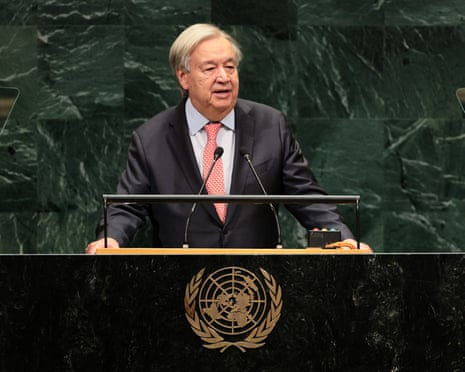
António Guterres says humanity faces unprecedented convergence of threats but mechanisms for collective action are under growing strain
The world’s fault lines have turned from cracks into canyons as superpowers show that they alone do not have the military, economic and technological power to guarantee security or solve the world’s problems, the outgoing secretary general of the United Nations has said in his final address to the general assembly.
In a speech laced with despair but also glimpses of defiant hope, António Guterres said that over the last decade, largely spanning his 10-year period in office, “wars erupted with devastating consequences and dragged on with despicable cruelty. Civilians were targeted. Human rights trampled. Hunger weaponised. Humanitarians killed. International law cast aside.”
He continued: “Geopolitical divides have deepened. Inequalities have intensified. Trust has frayed. The climate crisis went from distant warning to daily reality. And artificial intelligence moved at a speed that has blindsided even those who created it.”
Without naming Israel, he said what followed the Hamas attack of October 2023 “was an onslaught on Palestinians in Gaza, with a scale of killing and destruction unlike anything I have witnessed in all my years as secretary general”.
He rounded on profiteering energy companies for “treating the world as an open sewer”, described Africa’s omission from a permanent place on the UN security council as stunning, and called for a new compact to regulate AI.
Throughout, the 77-year-old Portuguese politician and diplomat argued that a multilateral system centred on a newly representative UN was the only way to address this new convergence of problems. However, he warned: “At the very moment when humanity faces an unprecedented convergence of threats, our mechanisms for collective action are under growing strain.”
Without mentioning Donald Trump once, he said what was required was “a recognition, especially by superpowers, that their power isn’t so super. Their power has limits. The events of recent years have made that unmistakably clear. Military power alone cannot secure peace. Economic power alone cannot command stability. And technological power alone cannot guarantee security.”
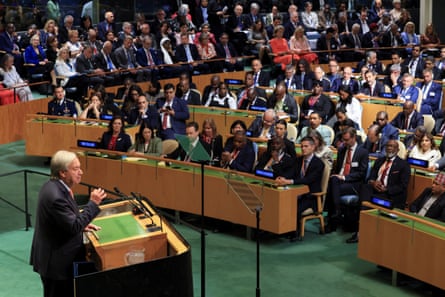
It was critical to avoid hegemonic tendencies and what Guterres described as the “great fracture” – the division of the world into two rival blocs with separate economic, technological and security systems.
The defining challenge of the age, he said, was that world governance, reflecting the power realities of a bygone age, was not adapting to the way power was being redistributed between and within states.
At the same time there was “an extraordinary transfer of power away from governments to a handful of private corporations and individuals. Their reach now extends across politics, economies, information flows, technological development, and the civic space on which societies depend,” he said. “Humans are increasingly handing over power to machines – with artificial intelligence agents going rogue, and lethal autonomous weapons going from science fiction to military reality.”
The choice was now whether the world was going to continue to fragment with rising tension, transactionalism and shrinking cooperation or change course towards a multilateral system centred on a UN that was balanced and representative. “The test before us is whether power will be exercised with the law – or beyond it,” Guterres said. “We must pass that test. We must defend the charter without double standards. Protect civilians without exception.”
He urged world leaders to stop letting civilians pay the price for the cascading conflicts across the Middle East. Demanding that the fighting must stop and humanitarian aid must flow, he pointed out that the international court of justice had ordered last year that the UN be allowed to fulfil its mandates in Gaza.
“Meanwhile violence, displacement and settlement expansion in the occupied West Bank are bulldozing the path to peace and raising the spectre of ethnic cleansing. We cannot allow the two-state solution to disappear before our eyes,” he said.
In Ukraine, Guterres said, “Russia’s full-scale invasion has subjected a sovereign country to a brutal war in blatant violation of the charter”. But now, he also warned, “in parts of Russia homes, energy and water systems and transport have come under repeated attack, threatening food and energy supply chains globally”.
For decades, he said, “big oil has treated the atmosphere as an open sewer – and cashed in on the consequences. Since Russia’s invasion of Ukraine, five major western oil companies have pocketed nearly half a trillion dollars in profits. Compare that with just $34bn in international public adaptation finance for developing countries in the latest year reported.”
He added: “With a supersized El Niño coming towards humanity, everyday people are paying more for energy, food and insurance.”
Although he admitted a 21st-century security council without permanent African representation was unjust and indefensible, he defended the cash-strapped and much maligned organisation, saying the UN was where the powerful were held to account.
He announced that the United Nations had “achieved gender parity for the first time in history across all senior leadership … all headquarters … and all professional staff”.
“Equality is not a dream. It is a decision,” he said. “If the UN can change, so can businesses, parliaments, governments, peace processes.”
Source: Technology

Alongside warnings about its ability to destroy humanity, artificial intelligence is also hailed for its potential to revolutionise health treatment. Just how far can it take us?
Her name was June. June would be the last month she ever knew.
I remember the way her bed made her so small, swallowed her up in the middle of the room, turned as it was to face the window. With her liver failing, her skin was a ghostly apricot. June – I called her Nan – had been stalked by the king of terrors, the emperor of all maladies: cancer. That son of a bitch.
The cancer was in her pancreas. Odds of survival? “Not good” – putting it lightly. The maths, putting it darkly: it’s the 12th most common cancer worldwide, the sixth most common cause of cancer death. The World Health Organization says it is “one of the cancer types with the least favourable prognosis”. It was not favourable for my grandmother.
June died nine years ago. Lately I’ve been thinking about alternate futures – the ones in which my grandmother, and the many millions diagnosed with cancer each year, are still here. The thoughts creep in as we are bombarded by artificial intelligence chief executives making bold proclamations such as “AI will cure cancer in five to 10 years” or “AI will cure cancer in our lifetimes”. Those claims stand in contrast to apocalyptic scenarios, including AI being responsible for human extinction before 2030. AI, we hear, is both saviour and annihilator.
Park the world-ending scenarios and you’ll find there has been significant progress in using AI as a tool in the detection, prevention and treatment of cancer. If there is a future where a supposed AI apocalypse is averted, then it may be one in which cancer therapy has been completely redefined. But just how far can AI take us towards a cure?
Today AI is being turned toward drug development, treatment plans and, in some places, it’s being used clinically, studying imagery of lungs for early signs of malignancy and helping to remove brain tumours. Words like “efficiency” and “personalised care” are everywhere; the notion AI can free up time for doctors and medical professionals to get away from the busywork abound.
Even with such positive advances, speak to clinicians, oncologists and researchers working at the coalface and you quickly find there is tension between the more grandiose claims of big tech and its race to “solve” disease, and the deliberate, considered progress of science.
“Until AI can actually think and do experiments itself at scale, I’m not sure that we’re going to find a cure for all cancer or medical illness in the next 10 years,” says Sherene Loi, a medical oncologist who specialises in breast cancer treatment at the Peter MacCallum Cancer Centre in Melbourne.
But Loi and other cancer experts the Guardian has spoken to believe there will be efficiencies for treatment, diagnostics and pathology services that will bear fruit, heralding more personalised and more equitable cancer care.
Cancer is not a single disease. It’s a catch-all term that describes the uncontrollable growth of abnormal cells. Typically, we describe cancers based on the location within the body that they are found: breast, prostate, lung, brain, blood, pancreas. These are complex, highly variable diseases, affecting a variety of different cells and underpinned by a host of genetic changes. In addition, cancer outcomes depend on many factors, including the biology of the disease and the treatments available. A single cure for cancer is not only unlikely but nigh on impossible.
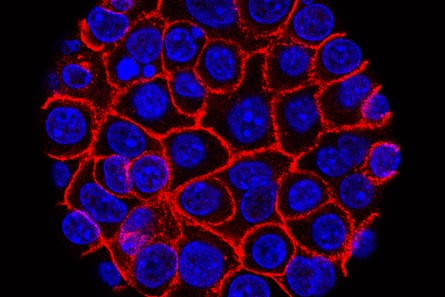
Just take the brain. Though not all are cancerous, “there are more than 100 types of tumours in the brain, much more than in any other single organ”, says Felix Sahm, a neuropathologist at the University Hospital Heidelberg. “There are so many unresolved questions in brain tumour research and brain tumour care.”
We’ve made great leaps in cancer survival rates over the past century; chemotherapy and radiation have enabled solid tumours to be cured, monoclonal antibodies ushered in more direct targeting of abnormal cells, and emerging treatments are rewriting how we combat the disease. But, as Loi notes, “Human disease is very complex.” So where does AI fit in?
“AI can improve several parts of that process by helping us identify risk, detect disease, characterise tumours, select treatments and monitor,” says Ajit Goenka, a radiologist and nuclear medicine specialist at the Mayo Clinic in Minnesota.
Medical imaging, in particular, stands to benefit from advances in AI and machine-learning models. Training models on huge amounts of patient data, such as CT scans, X-rays or tissue samples, enables those models to detect changes or patterns that may be imperceptible to the human eye.
Goenka has been exploring the early detection of pancreatic cancer with machine-learning tools since 2021, before the release of ChatGPT fully turned the public’s head toward generative AI. Since then, OpenAI and its rival Anthropic have pushed into new realms beyond chatbots: partnering with companies to accelerate access to treatment; striking deals with research centres; and working with pharmaceutical companies to incorporate large language models and AI into drug discovery.
Goenka noticed that some patients who developed pancreatic cancer had undergone CT scans months or years before diagnosis. Those scans were interpreted as normal but Goenka reasoned there could be microscopic, measurable changes invisible to a radiologist. “We began studying whether quantitative imaging and machine-learning methods could detect that signal,” he says.
In a proof-of-concept paper published in 2022, he confirmed that hunch. Machine-learning tools can detect pancreatic tumours, including in pancreases that appeared normal, before clinical diagnosis. Further studies by Goenka’s group have explored how robust and reproducible the method is and whether it is useful across institutions. The opportunity, he says, is to identify evidence of cancer earlier. My grandmother’s pancreatic cancer appeared as if out of nowhere, a shadow on a scan. Goenka’s models may have been able to see it sooner, which could have improved her outcome.
Sahm leads a European multi-disciplinary collaboration called EUcanAI, which is using agentic AI to improve the way brain tumours and central nervous system cancers are treated. The idea is that “every single chunk of this journey gets informed by the previous one and informs the next one in the sequence, so that it gets more efficient, quicker and less cumbersome for a patient”, he says.
He provides one example of a teenager who presented with a tumour in his brain stem. The expectation was that it was fatal, based on imaging and the patient’s age. The patient went in for surgery, his tumour was biopsied and rapidly sequenced to determine the mutations driving his disease.
Traditionally, these results go to a board of specialists to discuss the next steps in surgery and treatment. But today, these results can be delivered during a surgery, saving patients time and money. Sahm imagines a world where agentic AI accelerates this process even further – a surgeon could biopsy and image a tumour, then have an AI provide answers about the kind of mutation and potential drugs that may treat it. Sahm says this work is already happening in trials but stresses it is not yet routine.
The key for Sahm is a more tailored journey for each patient that “reduces the duration of uncertainty”. It’s about providing a wholly optimised approach to managing a patient’s cancer journey. He also notes it could provide more patients with better care.
This was a common thread in discussing AI tools for cancer diagnostics. “I think it will help with regards to equity of care, and access to care,” Loi says.
For instance, she says, in rural communities or locations that do not have cancer facilities or access to specialists or specialist diagnostic tools, access to machine-learning models could help medical professionals provide faster, more complete answers.
The dream of curing cancer is one that big AI firms constantly seed. Dario Amodei, the head of Anthropic, has suggested that within a decade, cancer – and many other diseases – could be cured. The Google DeepMind spin-off, IsoLabs, has a bold mission statement to “solve” all disease.
Sam Altman, the head of OpenAI, has similar lofty goals, suggesting the ability to solve disease might just be a problem of how much computing power backs our AI systems. “Maybe with 10 gigawatts of compute, AI can figure out how to cure cancer,” he wrote. As AI firms experience growing backlash to the environmental cost of datacentres, the argument that just a little more compute could offer life-saving opportunities could be hard to sell.
But Emilia Javorsky, a physician and scientist at the Future of Life Institute, argues the opposite: “We cannot compute the fundamental truth of biology, we can only measure it.”

In her March essay on AI and cancer, she outlines the complicated process of developing and testing any new medication. “Thirteen years into the AI drug discovery movement, we still lack a single [Federal Drug Authority]-approved drug that cleared the full bar of regulatory approval, reimbursement, and clinical adoption,” she says.
Javorsky argues that curing cancer is a noble goal but the research community must be smart about where investment goes. It’s not intelligence that limits progress but the data, regulation and incentives that surround cancer research.
Even if all the data from research across the world was placed into these models, would that be enough to solve these diseases today? What about in five or 10 years? For Sahm, there are biological truths we are yet to uncover. In his work, he still encounters rare, unknown pathology that doesn’t “fit into a box”. While AI may be able to devise technology or tools to understand rare subtypes, it’s only as good as its training data.
The complexity of human physiology and biological processes comes up a lot in discussions with those working in cancer. Although AI may speed up the process of, for instance, hypothesising and creating new drugs that can treat specific forms of cancer, it is fundamentally limited in applying those learnings to the real world. “Someone actually has to go back and do the experiment, right?” Loi says.
An article published in The Australian newspaper in March revealed that a Sydney data scientist had been able to synthesise a bespoke cancer vaccine for his dog, Rosie, by uploading her genetic information to ChatGPT. And while some were astounded by the development, others noted that the hard work had still been done by humans in a lab.
Even if AI can determine the most effective targets for new drugs, it cannot cut through red tape. Sahm notes that the majority of AI-assisted or AI-led research being performed is experimental and remains in clinical trials. Even if AI tools were deemed safe for test patients, he says, the EU lacks a clear regulatory path to allow them to reach the market. “That ends up in a lot of AI research going on, a lot of surprising and promising things happening … but also surprisingly few of those really being applied,” he says.
The most vocal proponents of AI – those building the models – may make grand claims about cures but on the ground the reality is different. There’s a lack of understanding of cancer complexity, many researchers working in the space argue.
But it’s clear that AI does provide a sense of hope for clinicians and researchers. Alone it cannot dethrone the king of terrors; it cannot bring down the emperor of all maladies. Curing cancer will require more than extra-efficient computation.
“AI can come up with a million hypotheses,” Loi says – but we will still need humans to help understand which of them are true.
“Technology,” says Goenka, “is only one part of the answer.”
Source: Technology
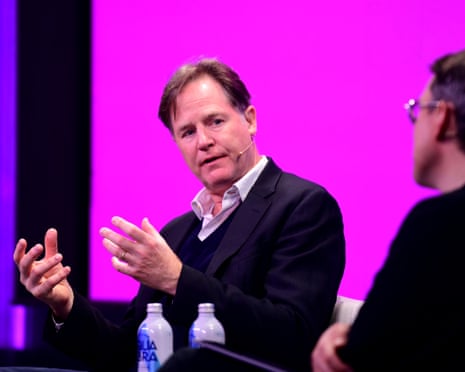
The former UK deputy prime minister is a board member of the UK-based company and owns 917,000 shares
Nick Clegg could make approximately $40m (£30m) from the planned float of Nscale as the UK-based datacentre company prepares for a US stock market listing.
The former UK deputy prime minister owns more than 917,000 shares in the startup, which is reportedly seeking a valuation of up to $35bn in a flotation. Based on Clegg’s stake of 0.12%, that could yield a valuation of about $42m for the ex-Liberal Democrat party leader.
Clegg is a board member at Nscale along with the former Meta executive, Sheryl Sandberg, whose 0.25% stake could be worth $88m if Nscale floats at the $35bn valuation, a figure reported by the Financial Times this month.
However, Nscale was last valued in a funding round at $14.6bn, implying lower valuations of Clegg and Sandberg’s stakes of about $18m and $37m, respectively. Forbes has estimated Sandberg’s wealth at $2.4bn, while Clegg has made about £24m from sales of shares in Meta, where he was formerly the president of global affairs. Both are paid an annual retainer of $60,000.
The Telegraph first reported Clegg’s potential wealth gain from the Nscale float.
UK-based Nscale filed papers for its flotation in the US on 18 September and could make its stock market debut before the year end. The company is preparing to list in New York, reflecting its global ambitions and the depth of funding available in the US for expensive AI infrastructure projects.
Nscale reported a loss of $1bn in the six months to 30 June, on revenues of $140m. In the flotation document, Nscale said its losses reflected the “substantial investments” it has made in a “highly capital intensive” business.
Josh Payne, the chief executive of Nscale, has said the company sees a “significant” opportunity in sovereign AI, where countries develop their own models and infrastructure, in order to reduce reliance on US or Chinese technology.
Christine Lagarde, president of the European Central Bank, and Margrethe Vestager, the former EU competition head, have both called for Europe to do more to develop its own AI infrastructure.
“Nscale is well positioned to serve this demand as a trusted, sovereign-capable platform,” said Payne. “This is particularly true in Europe, where the need for sovereign AI infrastructure is especially acute, and where our British domicile positions us as a natural, trusted partner.”
after newsletter promotion
Nscale operates five datacentres in Europe and has a further 12 under different phases of construction including in the US. The Guardian revealed this year that one Nscale project in Loughton, Essex, is an undeveloped scrapyard.
Nscale has been approached for comment.
Source: Technology
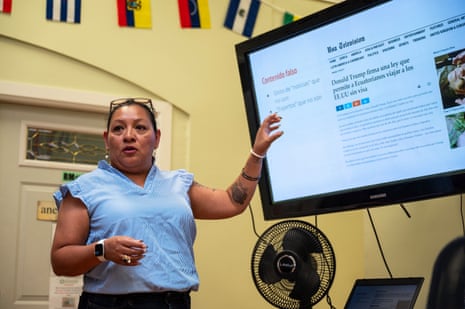
Independent outlets are leaning on social media, chat and other nontraditional methods to fight disinformation
When Allan Marrero, an asylum-seeker from the Cayman Islands, was released after five months in immigration detention, there was only one journalist he invited to his celebration: Eileen Grench, a reporter with the independent, non-profit news outlet Documented.
Grench had previously reported on Marrero, who was detained after interviewing with federal officials for a marriage-based green card. But beyond covering his detention struggles, she humanized him, emphasizing his and his husband’s love story.
“Most folks in these situations aren’t just victims; they’re fighting and being resilient and maintain the beautiful things about their life, too,” said Grench.
The Marreros’ trust in Grench and Documented resulted in full access and rich reporting that received much attention; even NYC’s mayor, Zohran Mamdani, tweeted Grench’s story upon Allan’s release. “To see their story kind of lifted up on to that city stage was really gratifying,” Grench said.
Documented is one of many immigrant-serving news outlets across the US meeting the moment when many legacy and mainstream publications are not, whether due to layoffs, lack of resources or being out of touch with immigrant communities. These independent local news organizations are using social media, chat apps and other nontraditional methods to connect directly with immigrants and non-English speakers – especially during recent Immigration and Customs Enforcement (ICE) surges – and they are leaving an impression.
“The impacts are phenomenal for relatively new media outlets, and part of it is because they’re operating on such a hyper-local level,” said Angie Chuang, a journalism professor at the University of Colorado Boulder. “Immigrant communities know what they need. They might not be able to access it or make it happen, but they can articulate their own needs. What these outlets are doing is just understanding how amplifying the community’s voices can help them.”
Last year, Documented and the Spanish-language news service Conecta Arizona launched the Immigrant News Coalition (INC) with the Listening Post Collective, the Bay Area’s El Tímpano, and the Minneapolis-based Sahan Journal to share strategies and resources for serving immigrant communities – and to ensure their outlets’ survival. Their work has since been bolstered by a $1.5m award from the Press Forward Foundation to “test and spread effective revenue models for immigrant-serving newsrooms” and additional funding from Democracy Fund.
Through listening tours and research, the outlets have found that members of immigrant communities in the US don’t always read the news by visiting websites and reading push notifications, especially when English is not their first language. Instead, they rely on other platforms that may have inaccurate information, such as WhatsApp, which over half of Latinos in the US use.

To meet specific immigrant communities where they are, Documented runs a WhatsApp group in Spanish, a WeChat group for Chinese immigrants, and a TikTok account in Haitian Creole to combat misinformation about ICE raids and fear-based scams.
“Misinformation thrives when there is a vacuum of good information, and immigrant communities are so vulnerable because of the lack of alternatives,” said Madeleine Bair, the founder of El Tímpano. “We’re not translating news into other languages. We’re creating news first and foremost for immigrant communities, and that looks very different than news created for non-immigrant communities.”
Emmy-winning journalist Maritza Félix started Conecta Arizona’s WhatsApp group, La Hora del Cafecito (Coffee Time), during the pandemic to provide timely, accurate news for immigrant communities in Spanish. The online gathering space, which has thousands of members across platforms, has a weekly Q&A with expert guests, including immigration attorneys, education policy experts and labor rights specialists.
But as ICE raids continue, members are engaging less in the public group chat and more in one-on-one direct messages with the staff.
“They’re afraid of being a screenshot, or having their message forwarded to someone,” Félix said. “Listening to our community taught us that what works today might not work next week. We are listening to what they say and their silences at the same time.”
Having a dialogue with the local Bay Area immigrant community has been crucial for El Tímpano, which is Spanish for “eardrum”. In addition to SMS messaging that reaches more than 7,000 Spanish-speaking immigrants, the outlet’s disinformation defense initiative, Comunidades Informadas, has trained more than 400 Latino immigrants in the Bay Area to recognize and address disinformation and misinformation.
“By equipping immigrants with an understanding of how disinformation works, it can empower them, so that when they see a rumor of an ICE raid, their immediate response isn’t to panic,” Bair said. “Instead, they can check with a source they trust or call their local rapid response hotline. We’ve received really positive responses to these workshops and to the information that we provide to combat that fear.”
In May, the Alameda county library partnered with El Tímpano for a disinformation defense initiative workshop in Spanish via Zoom for its staff members. Attenders found the content easy to understand, and it helped them articulate how to identify disinformation not just to community members, but also to their own family members.
“After going through the workshop, I was like, ‘I can talk to this with my tia and my tios, and explain it to them in the way that I didn’t really have the language before,’” said Jaqueline Martinez, the Alameda county library’s equity services coordinator.
For many of these outlets, the work and impact started before the recent ICE surge. In 2019, Documented co-founders Mazin Sidahmed and Max Siegelbaum spoke with community organizations across New York that were concerned about workers’ wages being stolen. Joined later by reporter Lam Thuy Vo, they launched an investigation, seeking out New York state and federal wage data for four years. The result was Documented’s Wage Theft Monitor, which inspired NY state legislators to introduce three bills to prevent and punish wage theft.
“The dual impact of protecting immigrant workers, but also helping the general public understand how pervasive this issue is, has been one of the most rewarding parts of seeing this project come to light,” Sidahmed said.
Similarly, LA Taco, which isn’t part of the INC, originally built trust among Los Angeles immigrant communities through its coverage of food, culture and cannabis. Then last June, as ICE raids swept through Los Angeles, LA Taco journalist Memo Torres began posting daily recaps of ICE activity on the publication’s Instagram account. By reporting verified information about raids during a time when misinformation ran rampant, Torres became one of LA’s most trusted journalists for immigrant communities, increasing LA Taco’s membership from 1,500 to 77,000 and earning attention from state and federal government officials.
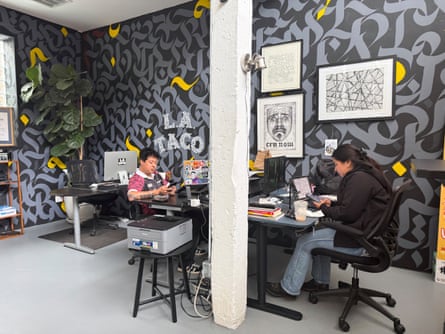
“I was getting information from people, I started reaching out to rapid responders and building trust with them, and then got included in the network with them,” he said, recalling how he started the Daily Memo.
Over the summer, the Daily Memo wound down, while LA Taco’s political cartoons by Pulitzer prize finalist Ivan Ehlers, called Sunday Taquitos, took off. In July, his humorous yet poignant illustration about Flock camera surveillance received more than 7m Instagram views and inspired fan-created versions in five different languages. The Ecuadorian American artist said the political cartoons are his short-form way of fighting misinformation and disinformation.
“If I can get someone’s attention for five seconds, I can get people to look at important issues and say, ‘Hey, I didn’t know that was happening. Oh man, this is terrible,’” he said. “People will go in and do more research, read more about it, talk to their friends or share it, and that’ll start conversations.”
Ehlers has also served as creative director for one of LA Taco’s zines, showcasing the outlet’s reporting on local protests and immigrant communities. Its release in early September was just one of many in-person events LA Taco has held this year to engage with its readers.
“The bigger issue is building a community and building support systems and showing people that they’re not alone,” Ehlers said. “We have a lot of people who are willing to fight together, work together and build something together.”
Source: Technology
Lorem ipsum dolor sit amet, consect adipisicing elit, sed do eiusmod por incidid ut labore et lorem.


