Preloader

Technology

Divide by depth for instant 3D

—

When I first started working on games, I used high level frameworks that would give you a Camera that just kind of worked. But as I learned more and wanted to apply more creative techniques, I struggled to even have the vocabulary to search for what I wanted to do, and only after writing lower level graphics code did I understand cameras are based around kind of really simple math.

In the excellent One Formula That Demystifies 3D Graphics (via @tsoding), we’re presented with the following:

(x, y, z)
x' = x/z
y' = y/z

In essence, if we say (y) is up and (z) is forward, 3D coordinates ((x, y, z)) can be projected into 2D coordinates ((x’, y’)) by dividing (x) and (y) by (z). For example, if we have a series of 3D points that only vary in depth, as depth increases, their projected positions get closer to vanishing point ((0,0)):

[begin{array}{c|c}
(x,y,z) & (x’,y’) \ hline
(2,1,2) & (1,0.5) \
(2,1,4) & (0.5,0.25) \
(2,1,8) & (0.25,0.125)
end{array}]

This can be demonstrated by a ball that moves and scales with depth as it orbits the camera’s up axis, offset along the (z) axis by forward:

  // slider:1 5
  const float forward = 2.0;

  vec3 camera_pos = vec3(sin(iTime), 0., cos(iTime) + forward);
  vec2 projected_pos = camera_pos.xy / camera_pos.z;
  float radius = 0.5 / camera_pos.z;

Using the same principle, we can even draw more sophisticated “geometry” in the same way!

  // slider: 2 5
  const float z = 2.5;
  float d = 0.0;
  for (int i = 0; i < 12; i++) {
    vec3 a = r * c[e[i].x] + fwd * z, b = r * c[e[i].y] + fwd * z;
    d = max(d, line(uv, a.xy / a.z, b.xy / b.z));
  }
  fragColor = iForeground * d;

Obviously, these are very constrained and naive examples that are largely impractical in all but the simplest scenarios. When we do any kind of 3D work, we typically need to involve things like the direction the camera’s pointing in, it’s position, it’s field of view, etc. While we could in theory hack those shaders to support these features, there is a way that’s less effort and more practical. It’s called the perspective projection matrix, and it’s the magic behind the mighty Camera.

Perspective Projection

There are a few ways to construct a perspective projection matrix, depending on your use case. Computer vision and graphics for example, have slightly different conventions for layout, which is why it’s hard to point to a single Wikipedia article and expect a universal form. That being said, in triangle-based graphics, a common convention that’s often followed involves parameterization of field of view, aspect ratio, and near and far clipping planes. These values are all very important because they also double as a way to easily know what’s in frame and what isn’t, which lets us render our scenes in performant ways, such as through culling off-screen geometry and rendering only what’s visible.

While this varies across different coordinate conventions (little consensus around which axes correspond to up, right, and forward), the general structure is mostly consistent:

[P = begin{bmatrix}
frac{f}{a} & 0 & 0 & 0 \
0 & f & 0 & 0 \
0 & 0 & A & B \
0 & 0 & 1 & 0
end{bmatrix}]

This describes a camera with focal scale (f) (derived from vertical fov angle (theta)) and aspect ratio (a):

[f = frac{1}{tan(theta/2)},quad a = frac{width}{height}]

Where (A) and (B) represent depth mapping, derived from near and far clipping planes (n) and (F) respectively:

[A = frac{F+n}{F-n}, quad B = -frac{2Fn}{F-n}]

  // slider:0 10
  const float z = 3.5;
  // slider: 20 120
  const float fov = 60.0;
  // slider: 0.5 2.5
  const float aspect = 0.8;
  // slider: 0.25 2.5
  const float nearClip = 1.0;
  // slider: 2.0 8.0
  const float farClip = 5.0;

  float f = 1.0 / tan(radians(fov) * 0.5);
  mat4 p = mat4(
    f / aspect, 0., 0., 0.,
    0., f, 0., 0.,
    0., 0., (farClip + nearClip) / (farClip - nearClip), 1.,
    0., 0., -2. * farClip * nearClip / (farClip - nearClip), 0.
  );

So how does this connect to the depth division trick from earlier? Turns out that’s a special form of the perspective projection matrix.

Given a point somewhere in 3D space, we first describe its position relative to the camera. This takes us from world space, where coordinates are shared by the whole scene, into view space, where the camera sits at the origin. We then multiply by the perspective projection matrix, producing clip-space coordinates that are ready for the perspective division.

[begin{bmatrix}
frac{f}{a} & 0 & 0 & 0 \
0 & f & 0 & 0 \
0 & 0 & A & B \
0 & 0 & 1 & 0
end{bmatrix}
begin{bmatrix}
x \
y \
z \
1
end{bmatrix}
=
begin{bmatrix}
frac{f}{a}x + 0y + 0z + 0(1) \
0x + fy + 0z + 0(1) \
0x + 0y + Az + B(1) \
0x + 0y + z + 0(1)
end{bmatrix}
=
begin{bmatrix}
frac{f}{a}x \
fy \
Az + B \
z
end{bmatrix}]

After dividing the first three clip-space components by (w), the coordinates no longer describe distances in the scene. Instead, they describe where the point falls inside the camera’s visible bounds. These are normalized device coordinates, usually shortened to NDC, which later allow points to finally be mapped to the screen’s output resolution.

[x_{ndc} = frac{frac{f}{a}x}{z},
qquad
y_{ndc} = frac{fy}{z}]

In the earlier example, both focal scale (f) and aspect ratio (a) are omitted. Substituting them both with 1 gives us exactly the original depth division trick:

[x_{ndc} = frac{frac{1}{1}x}{z} = frac{x}{z},
qquad
y_{ndc} = frac{1y}{z} = frac{y}{z}]

While the depth division trick works for camera-relative points in simple scenarios, it’s really just one step in the full graphics pipeline. Now that all of those terms have names, the whole journey looks like this:

[mathrm{world} rightarrow mathrm{view} rightarrow mathrm{clip}
xrightarrow{,/w,} mathrm{NDC} rightarrow mathrm{pixels} rightarrow mathrm{rasterization}]

Tying it all together

If there’s one thing to take away from this writeup, it’s that Cameras are just doing a few simple transformations, and if you understand what each of those transformations are for, you can pick and choose which parts to implement yourself based off your own needs and constraints. Sometimes you need the entire pipeline, and sometimes you need that one depth division.


Source: Hacker News

Apple Copland D11E4 Booting in the Browser

Apple’s ill-fated Copland operating system1 is notoriously hard to run on real hardware, and has not previously been available in emulation. Here is the last build D11E4 in an improved DingusPPC.

  • Click the screen to give the machine the keyboard and the mouse; Escape gives them back.
  • On real hardware, booting should take about 30s. A modern machine can match real-time in wasm.
  • If any code hits an assertion, it drops into the debugger: click “Continue” to make it go again.
  • Try running Copland HD→Applications→GXSlidemaster or Eric’s Solitaire.

The 11 patches necessary for unlocking Copland are on this branch of my fork. DingusPPC does not take patches written with the help of AI, so maybe someone wants to re-do these fixes based on the explanations in the commit messages. (The patches for this wasm version are on this branch.)


  1. Copland was supposed to replace the old System 7 with a modern microkernel-based system, but was cancelled. Apple instead bought the NeXTSTEP/OpenStep OS, which became Mac OS X.↩


Source: Hacker News

Robin Williams' Daughter to Fans Creating AI Videos: 'Have Some Shame'

Zelda Williams is calling for fans to stop circulating AI-generated videos of her late father, Robin Williams, nearly a year after she last took to social media to ask them not to send her augmented content featuring the actor.

In a statement posted to X on Monday, the “Lisa Frankenstein” director wrote that a “supposedly ‘private video’” circulating of her father “is clearly AI, and not even particularly convincing AI,” she wrote. “Anyone who claims to be a fan who believes it clearly listened to his movies on mute because that voice is robotic and terrible. That said, a human made a robot create it, and to you I say: leave him out of your delusional bullshit and let him rest. If you cannot make your case without making a dead man make it more convincing for you, then tell me: who’s the one manipulating the public thru media now?”

Related Stories

Zelda continued: “I hate this cesspool of an app. It’s mostly bots and people willingly being duped by bots at this point so not sure why I feel the need to come back to clarify, but I love him, so I will. Just because he’s gone does not mean he’s now your puppet. Have some shame.”

Popular on Variety

The iconic comedian, who starred in films including “Jumanji,” “Good Will Hunting,” “Dead Poets Society,” “Hook,” “Mrs. Doubtfire,” and more, died in 2014 at the age of 63. In recent years, his likeness has become a popular target for AI recreation as users continue to create and share augmented videos of the actor.

This isn’t the first time Zelda has voiced her feelings about AI; Back in Oct. 2025, she wrote “Please, just stop sending me AI videos of Dad” on Instagram. “Stop believing I wanna see it or that I’ll understand, I don’t and I won’t. If you’re just trying to troll me, I’ve seen way worse, I’ll restrict and move on. But please, if you’ve got any decency, just stop doing this to him and to me, to everyone even, full stop. It’s dumb, it’s a waste of time and energy, and believe me, it’s NOT what he’d want.”

Just last month, she revived her father’s Instagram account with siblings Zak and Cody in an attempt to “fight back against rampant AI abuse of his voice and likeness on here.”


Source: Hacker News

Turn off and restrict access to Apple Intelligence features on Mac

You can turn off Apple Intelligence features like Siri AI (Beta),* summarization features, and more. For more information on parental controls, see Apple Devices for Kids and Families.

Note: Apple Intelligence on macOS 27 is not available in all languages or regions. Usage limits may apply.

To change these settings, do any of the following:

Go to the System Settings app on your Mac, click Siri in the sidebar, then click Turn Off Siri. Click Turn Off Siri again to confirm.

To use Siri Classic instead of Siri Al, follow the steps above to turn off Siri. Click Turn On Siri, then select Use Siri Classic.

In the Messages app on your Mac, choose Messages > Settings, then turn off Summarize Messages.

In the Mail app on your Mac, choose Mail > Settings, then click Viewing. Turn off Summarize Message Previews.

Go to the System Settings app on your Mac, click Notifications in the sidebar, then click Summarize Notifications. Turn off Summarize Notifications.

Personalized Smart Replies in Mail

In the Mail app on your Mac, choose Mail > Settings, then click Composing. Turn off Personalize Smart Replies.

Voicemail suggestions in Phone

In the Phone app  on your Mac, choose Phone > Settings, then click Calls. Turn off Suggestions in Voicemail.

See Customize apps Siri has access to.

In the Journal app on your Mac, choose Journal > Settings > General, then turn off Get Writing Prompts.

Restrict access to Apple Intelligence features in Screen Time

See Change Siri Restrictions settings in Screen Time for restricting access for yourself. For your child, see Block or allow access and changes to features on your kid’s device in Apple Devices for Kids and Families.

Change how you see suggestions from your apps

See Customize apps Siri has access to.


Source: Hacker News

Stop relying on AI chatbots for customer care, UK banks and energy firms told

A woman holds her head with both hands, looking worried at a laptop screen

Almost half of people who had to use a chatbot found them unhelpful with some concluding the chatbot seemed rigged to ‘make me give up’. Photograph: Alamy/PA

Almost half of people who had to use a chatbot found them unhelpful with some concluding the chatbot seemed rigged to ‘make me give up’. Photograph: Alamy/PA

Stop relying on AI chatbots for customer care, UK banks and energy firms told

Citizens Advice says providers of essential services such as energy, banking, phone and internet should guarantee the ‘right to talk to a human’

Stop relying on AI chatbots for customer care and guarantee the “right to talk to a human”, Citizens Advice has urged essential service providers, as research found they wasted time, caused stress and delayed problem solving for more than half of users.

The spread of the AI-powered systems to provide help about the provision of vital services such as energy, banking, phones and internet, is making it harder for millions of already digitally excluded people to handle snags, according to the frontline charity that last year provided more than 2.7 million people with one-on-one help in England and Wales.

The charity concluded that chatbots caused harm, saying too often they trapped humans in an “endless loop” in which nothing got resolved, and almost half of people who had to use a chatbot found them unhelpful, with some concluding the chatbot seemed rigged to “make me give up”.

It called for service providers to respect a new right for customers to speak to a human after it investigated the wider impact of digital exclusion, estimated to affect at least 14 million UK citizens. It uncovered slower and less reliable support for people who struggle with or have limited access to online systems and found the erosion of phone, face-to-face and paper communication had created a two-tier support system.

“Going round in circles with a chatbot isn’t just annoying, it can be a blockade to essential services,” said Tom MacInnes, policy director at Citizens Advice. “We’ve seen organisations’ overreliance on chatbots and online forms leaving people unable to fix billing problems, sort out their debt or even access homelessness prevention services. There’s a role for chatbots, but the quiet erosion of face-to-face and telephone services is letting too many people fall through the cracks.”

That erosion of traditional ways of communicating means that people without good digital access can face serious difficulties getting simple problems fixed. For example, the charity found that submitting energy meter readings to correct a wrong bill can take less than an hour online if systems are working properly. Without good digital access it takes as long as six weeks offline, putting people “at risk of further harm”. In some locations applying for low-cost social tariff broadband – itself intended to reduce digital exclusion – is being made harder by being digital only, Citizens Advice found after it took evidence from its frontline advisers and hundreds of case summaries.

One adviser reported that when people struggled with digital-only applications for homelessness support they ended up “homeless for longer … they’re in danger … they’re losing money … they get into debt” and said: “It can ruin a lot of people’s lives.”

The warnings come amid growing frustration with the proliferation of AI customer services. Online message boards with titles like: “I’m so sick of AI Customer ‘Support” Chat Bots” and “Has anyone ever actually had their problem solved by a company’s chatbot?” are filled with tales of woe. Several chronicle frustrated customers’ attempts to circumvent phone-based chatbots by repeatedly yelling “human!”.

Only 20% of UK adults polled on behalf of Citizens Advice in July said chatbots were their preferred way to communicate, with phone calls, email and instant messaging all preferred.

Gripes about other forms of digital exclusion include multifactor authentication, which requires rapid and dextrous manipulation of more than one device just to log in and time-limits to complete transactions.

Of the people who found it difficult or not possible to talk to a human to resolve an issue with their essential services, 49% felt stress or frustration, 27% felt powerless, 44% experienced delays to resolution and 14% gave up trying to resolve the issue altogether.

The UK government has previously said it is investing £11.9m in a digital inclusion innovation fund, supporting local projects to help people get online. About 1.7m households in the UK do not have a laptop, tablet or desktop computer.

A government spokesperson said: “Businesses have a legal obligation to provide contact information in a manner which is clear and easily accessible.”


Source: Technology

Socrates vs. the Written Word (2011)

Previously, I shared a curmudgeonly 1889 article about the menace of electricity and the telephone and its spiritual cousin, a fifteenth-century screed lamenting the printing press. I’m collecting data here in service of a hypothesis that progress is universally despised, that the “get off my lawn you whippersnappers” feeling that we all occasionally experience is more tied to our makeup as humans than the technology and the changes themselves. These feelings, I posit, are universal, and perhaps make us feel disconnected — we see others doing things differently, and experiencing life in a different way, and we can’t understand it, or all we can see is what they’re missing. If only they would realize! But those people are not bad — they are simply native to the next thing, perhaps, and they experience the world slightly differently. And so the world turns.

When I mentioned that I supposed this curmudgeonly sentiment against progress was common all throughout history, some commenters pointed me to the Phaedrus, a Socratic dialogue of around 370 B.C.

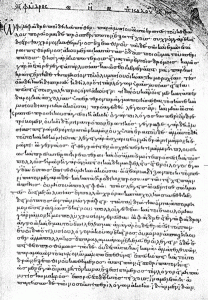
In it, Socrates recounts to Phaedrus the Egyptian legend of Theuth, the god who invented “numbers and arithmetic and geometry and astronomy, also draughts and dice, and, most important of all, letters.” Theuth presents the Egyptian king Thamus with his many inventions, and Thamus

…said many things to Theuth in praise or blame of the various arts, which it would take too long to repeat; but when they came to the letters, “This invention, O king,” said Theuth, “will make the Egyptians wiser and will improve their memories; for it is an elixir of memory and wisdom that I have discovered.”

But Thamus replied, “Most ingenious Theuth, one man has the ability to beget arts, but the ability to judge of their usefulness or harmfulness to their users belongs to another; and now you, who are the father of letters, have been led by your affection to ascribe to them a power the opposite of that which they really possess.

“For this invention will produce forgetfulness in the minds of those who learn to use it, because they will not practice their memory. Their trust in writing, produced by external characters which are no part of themselves, will discourage the use of their own memory within them. You have invented an elixir not of memory, but of reminding; and you offer your pupils the appearance of wisdom, not true wisdom, for they will read many things without instruction and will therefore seem to know many things, when they are for the most part ignorant and hard to get along with, since they are not wise, but only appear wise.” (Phaedrus 274c-275b)

To which Phaedrus calmly replies: “Socrates, you easily make up stories of Egypt or any country you please.”

Socrates continues:

Socrates
He who thinks, then, that he has left behind him any art in writing, and he who receives it in the belief that anything in writing will be clear and certain, would be an utterly simple person, and in truth ignorant of the prophecy of Ammon, if he thinks written words are of any use except to remind him who knows the matter about which they are written.

Phaedrus
Very true.

Socrates
Writing, Phaedrus, has this strange quality, and is very like painting; for the creatures of painting stand like living beings, but if one asks them a question, they preserve a solemn silence. And so it is with written words; you might think they spoke as if they had intelligence, but if you question them, wishing to know about their sayings, they always say only one and the same thing. And every word, when once it is written, is bandied about, alike among those who understand and those who have no interest in it, and it knows not to whom to speak or not to speak; when ill-treated or unjustly reviled it always needs its father to help it; for it has no power to protect or help itself.

Now tell me; is there not another kind of speech, or word, which shows itself to be the legitimate brother of this bastard one, both in the manner of its begetting and in its better and more powerful nature?

Phaedrus
What is this word and how is it begotten, as you say?

Socrates

The word which is written with intelligence in the mind of the learner, which is able to defend itself and knows to whom it should speak, and before whom to be silent.

Phaedrus

You mean the living and breathing word of him who knows, of which the written word may justly be called the image.

Socrates

Exactly. Now tell me this. Would a sensible husbandman, who has seeds which he cares for and which he wishes to bear fruit, plant them with serious purpose in the heat of summer in some garden of Adonis, and delight in seeing them appear in beauty in eight days, or would he do that sort of thing, when he did it at all, only in play and for amusement? Would he not, when he was in earnest, follow the rules of husbandry, plant his seeds in fitting ground, and be pleased when those which he had sowed reached their perfection in the eighth month?

Phaedrus

Yes, Socrates, he would, as you say, act in that way when in earnest and in the other way only for amusement.

Socrates

And shall we suppose that he who has knowledge of the just and the good and beautiful has less sense about his seeds than the husbandman?

Phaedrus

By no means.

Socrates

Then he will not, when in earnest, write them in ink, sowing them through a pen with words which cannot defend themselves by argument and cannot teach the truth effectually.

Socrates lays out an argument that the written word cannot defend itself in dialogue, and thus cannot effectively teach anything worth knowing. For only through banter, through back-and-forth discussion and rhetorical argument and the working out of problems, can true knowledge be conveyed. Reading mere words, in his mind, is akin to looking at a lake rather than swimming in it — or worse, looking at a lake and thinking that now you know how to swim.

Plato (the transcriber of this dialogue) expounds further on the concept in his Seventh Epistle:

After much effort, as names, definitions, sights, and other data of sense, are brought into contact and friction one with another, in the course of scrutiny and kindly testing by men who proceed by question and answer without ill will, with a sudden flash there shines forth understanding about every problem, and an intelligence whose efforts reach the furthest limits of human powers. Therefore every man of worth, when dealing with matters of worth, will be far from exposing them to ill feeling and misunderstanding among men by committing them to writing…

Anyone who has followed this discourse and digression will know well that, if Dionysios or anyone else, great or small, has written a treatise on the highest matters and the first principles of things, he has, so I say, neither heard nor learnt any sound teaching about the subject of his treatise; otherwise, he would have had the same reverence for it, which I have, and would have shrunk from putting it forth into a world of discord and uncomeliness.

Dionysios here is Dionysios the Younger of Syracuse, a brutal tyrant, who has written a treatise on philosophy. Plato argues that he must have done it for fame or glory, because it’s clearly a scam — philosophy can’t be taught in writing; it can only be felt, experienced, argued out and sensed.

In a way this is an argument very similar to that of Trithemius against the printing press — that a perceived flattening or automating of a form necessarily involves a loss; that truth (whether it be philosophy or Scripture) is best consumed and absorbed experientially. I think this is a great sentiment and one worth considering even now.

Where I think they misstep, however, is in their belief that it’s either/or: the old way is superior ergo the new format has no value. Though often conflated, in my mind those are two separate arguments; one can’t necessarily measure a new thing by how great the old thing was. (And of course, we wouldn’t have Plato’s records at all if he hadn’t written them down — which Socrates, true to his word, never did — and similarly, Trimethius had to have his treatise printed in order to achieve any sort of mass circulation.)

Interestingly, the speech-vs-text argument appears again in the 1880s, but in reverse: with the advent of the telephone, hands are wrung that communication will become rife with error and misunderstanding because unlike the telegraph, the newfangled telephone leaves no written record!

This is a particular problem in the case of business transactions that may end up in court, and also, curiously, in the rarefied world of railroad switching, where track orders are routinely communicated ahead of a train by an army of telegraph operators. Without written records of each communication, any errors that cause accidents down the line couldn’t be tracked to their source.

Luckily for the telephone, smart people were on hand with sure-fire solutions:

At the recent meeting at Detroit of the Association of Railroad Telegraph Superintendents. Mr. M. C. Selden of the Baltimore & Ohio read a paper upon the subject of the telephone in railroad service. The objection made to the telephone in comparison with the telegraph, that there would be no written record, is answered by Mr. Selden. He calls attention to the fact that the ordinary telegraph instrument gives no written record, and that the element of personal fallibility is present in its use; and that if a telephone message is written before sending and spelled out, as it should be if of importance, the receiver will have ample time to write it out while receiving it, and records are thus preserved at both ends of the line. In matters of less vital importance the telephone offers advantages which can not be approximated by the telegraph. — Railway Age magazine, 1894

In other words, to create a written record on the telephone, the sender should write down what he’s going to say, and the receiver should write down what he hears. Perfectly convenient!

In fairness, most of the documents I’ve been able to uncover only obliquely reference the supposed problem, and treat it as minor. Another suggestion:

Although the telephone is thus largely availed of as a time-saver, there is still a curious prejudice in many minds against telephoning telegrams all the way, without any intervention of the telegraph with its record — that supposedly holy talisman against errors in transmission. Considering the enormous amount of important business that is daily transmitted by telephone, without an appreciable percentage of error and at an immeasurably greater speed than that of the telegraph, it is remarkable that this unreasonable prejudice against telephoning written messages should still obtain in circles where there is sufficient common sense to use either the telegraph or telephone at all.

That it does still exist, however, is indisputable. No doubt this is largely due to the fact that the telephone companies, having had so far as much as they can do to attend to their immediate business of supplying telephone service pure and simple, have not yet taken any steps to cultivate a profitable field that lies ready to their hands, the transmission and delivery of local telegrams. In every large town there is plenty of demand for a cheap telegraph service, and the telephone company has just the plant and organization to furnish such a service. It will yet be many years before every man with whom occasional quick communication is desired by someone else has his own telegraph station in his own place, in the form of a telephone. Meanwhile the telephone company has its wires and stations, public and private, in all directions, its messenger force and its supervisory force, all the machinery, in short, with which to organize in a few days a rapid, efficient and cheap local telegraph service. At, say, 10 cents a message of twenty words of text, such a service would be profitable to the telephone company and would meet with a ready demand from the public. — The American Telephone Journal, Volume 6 (1902)

In other words, if folks think telegraphy is less convenient but more secure, then the answer is to make telegraphy just as convenient as telephones have become.

We have now, 100+ years later, 2000+ years later even, come full circle on this issue once again, with the issue of texting. I’ve noticed that most people of my generation and younger now prefer to text rather than talk on the phone, and this is borne out by some data:

The decline in voice communications is well documented. “The fall of the call is driven by 18 to 34-year-olds, whose average monthly voice minutes have plunged from about 1,200 to 900 in the past two years, according to research by Nielsen.

“Texting among 18 to 24-year-olds has more than doubled in the same period,” wrote Ian Shapira of the Washington Post earlier this year.

The Nielsen Co. also notes that folks below the age of 24 text more often than they call, viewing the out-of-the-blue call as tantamount to an intrusion. (Source)

But I know not everyone agrees. A quick Google was all it took to uncover more modern-day curmudgeons:

…People always say texting is more convenient than talking on the phone, but in many situations, it would take less time to do it the old-fashioned way. Why not just call the person and get the conversation over in five seconds rather than continuing a long string of text messages that takes 10 minutes? It’s called efficiency. — Minnesota Public Radio, January 2010

Which is not to minimize the legitimate issues with communicating via text — for example, sarcasm and tone of voice can often be misinterpreted.

In fact, for everyone who’s sent an email or Facebook message that’s provoked the opposite reaction than you intended (myself included), I don’t mean to add insult to injury here, but…

Socrates is laughing at all of us.


Source: Hacker News

HERMES radio enables voice and data communication over vast distances

Shortwave radios offer a way to connect one location on Earth to practically anywhere else with minimal infrastructure. But these radios come with some drawbacks—a significant one being that, unlike satellite communications, their transmission rates for digital data are typically measured in just hundreds of bits per second.

Peter Bloom

Peter Bloom is the founder of Rhizomatica, a nonprofit that works with remote, indigenous, and off-grid communities around the world to build shortwave and cellular-communication infrastructure.

Peter Bloom is the founder of Rhizomatica, a Philadelphia-based nonprofit that has open-sourced a digital shortwave-radio set called the High-frequency Emergency and Rural Multimedia Exchange System, or HERMES. The set operates in the high-frequency (HF) band from 3 to 30 megahertz, as does Mercury, its digital modem. Rhizomatica staff travel around the globe to remote locations in countries like Bangladesh, Brazil, and Ecuador. Wherever they go, they use HERMES to help connect locals to the rest of the world.

Bloom spoke with IEEE Spectrum about how HERMES brings better data rates and encryption to shortwave radios.

How does HERMES connect remote locations?

Peter Bloom: We use the ionosphere as our satellite—or mirror—which helps us move information, voice, and data over really long distances. We’re using small radios that put out about 20 watts of power, and we can pretty reliably do 400- to 600-kilometer links between two radios. We’re talking about places that are not easy to reach, where it’s not simple to put terrestrial infrastructure.

What can HERMES send that a basic voice radio can’t?

Bloom: HERMES is a software stack—it’s a set of different programs that all work together in order to be able to send data over HF. HERMES allows you to send pretty much any file. Depending on what the file is, whether it’s a photo or an email or a voice memo, it just sends it as a file. It’s like a data pipeline over HF.

Why does sending files and data matter more than just voice?

Bloom: In emergency situations, people send their latitude and longitude over HF to say, “Hey, I’m here at this place.” People need to be able to send data over HF if there’s a manifest, a parts list, telemedicine—here’s what we have, here’s what we need. Instead of trying to read that out over the air, it’s much easier to just send the file. Same with a photo—if we need evidence that an area was logged illegally, we can just have someone send that over HF, rather than spending days getting down the river to get the photo where it needs to go.

Why did you build in encryption that amateur-radio regulations in many countries don’t allow?

Bloom: Encryption [regulations] for ham radio operators are different in each country. So it’s all optional—you turn it on, you turn it off. The reason we built the encryption is that some of the partners we work with are in very sensitive areas and don’t want to be sending out information that can be easily captured and used against them.

How has HERMES made an impact?

Bloom: We’ve been working with artisanal fishers in Bangladesh on a pilot project. There’s 10 or 11 boats that have HERMES systems on them. Pretty soon after we installed those, one of the boats had a mechanical issue in the Bay of Bengal, 100 or 200 kilometers offshore. They were able to send their GPS position and an SOS that they were having trouble. They were able to coordinate the rescue of the crew and the boat. So that was a really cool moment of HERMES in action that we’re super happy about.

This article appears in the October 2026 print issue as “Peter Bloom.”


Source: Hacker News

Looking forward to Git 2.56 – and 3.0

LWN needs you

LWN counts on its subscribing readers to support its mission of creating relevant human-written news coverage of the Linux and free-software communities. Please subscribe to LWN and help to keep us on the net.

As a special offer, subscribe to LWN now for at least six months, and receive a 25% discount on your subscription.


Source: Hacker News

How do traffic signals work? (2019)


Source: Hacker News