Preloader

News

Using AI to ‘talk to animals’ might make us feel clever – but what, if anything, does it do for them?

Vivek Thakker/The Guardian

Using AI to ‘talk to animals’ might make us feel clever – but what, if anything, does it do for them?

As animal behaviorists increasingly use AI in their research, they grapple with how to wield the technology responsibly

I’m sitting in a small boat in Shark Bay, Australia, eavesdropping on a conversation between some of Earth’s most intelligent beings. The motor is off, the turquoise sea is glassy, and Stephanie King and I are motionless, transfixed by the whistles, clicks and squeezy, whirring noises made by the dolphins swimming below us.

If anyone could tell me what these big-brained social mammals are saying, it would be her. Based at the University of Bristol, she co-leads Shark Bay Dolphin Research, one of the longest-running wild dolphin research projects in the world. She has spent thousands of hours watching and listening to this population.

Like most other animal behaviorists, King is increasingly integrating artificial intelligence into her research process. “If it’s used responsibly, AI can transform what we can do with the data we collect,” she says. But when I ask her if AI will someday allow us to “speak dolphin”, she stiffens a little. “I think we’re doing the animals a disservice by focusing on that question,” she says.

Dolphins chit-chat in Shark Bay, western Australia

  • Dolphins communicate, navigate and find food using buzzes, pops, whistles and other acoustic signals. These sounds were recorded in Shark Bay, western Australia via an underwater microphone by Amy Martin for the podcast Threshold

The problem, King says, is not AI itself, but the narrative being built around it. She sees her field increasingly framed as a quest for an AI-assisted animal interpreter, with headlines declaring that we’ve almost “cracked the secret language” of various creatures or are about to “decode animals’ speech”. There are even cash prizes for breakthroughs, including the Coller Dolittle Challenge, which seeks an algorithm for communicating with non-human organisms.

“It’s a sexy topic,” King acknowledges, but in her view, fundamentally misguided. She believes the allure of tech dollars and media attention is priming the pump of research in some unhealthy ways – nudging scientists to make premature claims about AI-assisted findings, and encouraging them to describe their work in sensational terms. “They tend to be biasing themselves towards the most exciting discovery,” says King, which “misleads us to what we know about these animals”.
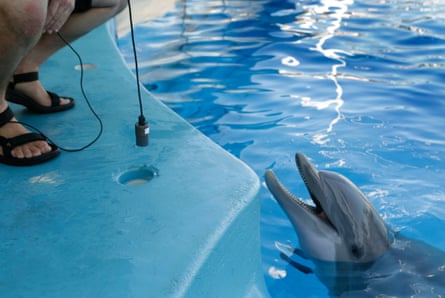
Bella, a pregnant dolphin at Six Flags Discovery Kingdom, watches trainer Adam Gilbert place a hydrophone into the pool to record her underwater sounds in Vallejo, California. Bella had been observed possibly communicating with her unborn baby and is the focus of new research project. Photograph: San Francisco Chronicle/Hearst Newspapers/Getty Images

What we know, in many cases, is in fact very little. Take dolphins. “They’ve been studied for decades, but we’re still scratching the surface with what many of the sounds mean,” King says. Sound itself likely means something different to dolphins than it does to us. They can detect pitches far outside our range of hearing, they process acoustic information much faster than we do, and our sensory systems are wired differently in important ways.

For example, both humans and dolphins can echolate – or use sound to navigate – but dolphins process echolocation information in the part of the brain connected to touch, while for us, it’s more connected to vision. In other words, instead of “seeing” with sound, dolphins might be hear-feeling, or feel-hearing, their way through their watery world. Whatever that experience is, it may be fundamentally inaccessible to us – and it’s not something we can comprehend by plugging their whistles and squeaks into a large language model. “We need to appreciate that they have a complex communication system that we barely understand,” says King. She believes our focus should be learning about that system – piecing together what dolphin behavior and communication means to other dolphins – rather than trying to hack into it, and start a conversation.

Dolphins whistle in Shark Bay

  • These high-pitched whistles are a very important part of dolphins’ social communication. Mothers use them to keep in contact with their calves and some whistles are even used as individual identifiers, or name-like calls. Credit: Stephanie King, Shark Bay Dolphin Research

Elephant researcher Joyce Poole agrees. “I get quite exasperated by this goal of being able to talk to the animals,” she says. “I think it’s kind of gimmicky.” One of the world’s leading experts on African savanna elephants, Poole has spent decades observing the animals in the wild, building up a treasure trove of annotated field recordings of their vocalizations, movements and interactions. She’s convinced that there are many layers and nuances of elephant communication that we don’t yet understand, but, like King, she’s skeptical about the concept of inserting ourselves into their dialogues. “Just the basic ability to understand what they have to say and what they are thinking about – that’s enough for me,” she says. “I don’t need to interfere in their lives more than necessary.”

Female elephants make noises when a musth male arrives in their group

  • Joyce Poole has documented female elephants making these overlapping sounds when a musth male arrives in their group, looking to breed. She refers to the sounds as “Female Chorus Rumbles” and they may include snorts, trumpets and roars, as well as low-pitched rumbles. Credit: The Elephant Ethogram, ElephantVoices

At the same time, Poole believes making the inner lives of elephants more legible to humans could transform how we treat them. “I hope that by showing that they’re capable of a more sophisticated kind of communication that we gain them some respect from our fellow humans, and save a place for them in the world, together with their ecosystems and their other fellow travelers,” she says.

Poole’s hope is widely shared, and is likely one of the main reasons so many of us are prone to click on stories with headlines about how AI is going to help us talk to animals. As extinction numbers rise and biodiversity declines, we’re desperate for some good news. Humans are also inherently fascinated by other animals; we’ve been telling stories about listening to and learning from them for as long as we’ve walked the Earth. Our technologies have in many ways cut us off from the rest of the living world – could this be a case when a new tool helps us to better tune into and care for our planetmates?

“I do see AI as a potentially promising avenue for knowing more, and understanding better, non-human animal lives,” says César Rodríguez-Garavito, founding director of the More Than Human Life (Moth) program at NYU, a leading hub for research and discourse on the rights of nature. He thinks AI could help give animals a voice in the decisions that shape their lives.

“More and more researchers and practitioners are asking themselves, ‘Well, how do we bring in the voices of, say, the whales in the regulation of a marine-protected area,’” he says. It may sound far-fetched to us now, but Rodríguez-Garavito says attempts to bring non-human voices into the realms of law and policy are already under way in countries around the world. “I think that this is no longer a science fiction question,” he says. Of course, we don’t need AI to tell us that whales are being negatively impacted by noise, ship strikes, climate disruption and pollution, but perhaps if we heard a direct translation of them expressing pain from underwater seismic testing, or mourning the loss of a calf killed by a ship, we would be more likely to act.

“But I cannot speak about potential benefits without speaking about risks,” Rodríguez-Garavito says. “We have, as human beings, a very mixed track record, to put it gently, in using technologies.” That record tells us that we can’t simply deploy AI in the wild and see what happens; we need to think through the risks ahead of time. There’s the possibility of intentional harm, like using AI-powered tools to trick or coerce animals, perhaps moving them into areas where they’re easier to kill (“I mean, think of trophy hunters,” says Poole). But if the past predicts the future, the greatest threats are not a few people using a new technology with malicious intent, but a whole lot of us using it without thinking about – or choosing to care about – the consequences.

“The nightmare scenario is one where we interrupt their communications and their lives at will, just for our entertainment,” says Rodríguez-Garavito. It’s not hard to imagine whale-watching companies using AI to lure animals toward boats, for example, or visitors to Yellowstone national park using apps to provoke wolves to howl, elk to bugle, or bison to bellow, exhausting and confusing the animals. Technologies are not beholden to the intentions of their makers. A tool created with the sincere goal of enhancing our respect for animals could end up having the opposite effect by turning them into playthings that we can pester and control.

Researchers in the field talk while recording dolphin buzzes and whistles

  • Researchers Stephanie King and Laura Palmer document the movements and behaviors of a group of dolphins in Shark Bay. Buzzes and whistles from the dolphins are being picked up by underwater microphones and played through a speaker on the boat. Credit: Amy Martin, Threshold

In an attempt to help steer the field away from these dark scenarios, the Moth program recently published the Pepp framework (prepare, engage, prevent and protect), a set of ethical guidelines for the use of non-human animal communication technologies. But if and how it will actually get put into practice is uncertain. Rodríguez-Garavito says this is a trickle-down effect of the larger absence of legal and ethical boundaries around AI development. “At this point, there is no international agreement on AI,” he says. “It is a free-for-all. I would be much less concerned if we had general principles on what can and cannot be done with AI. There’s nothing like that, and this is why we’re having to develop them from scratch based on what’s been done in other fields of legal practice.”
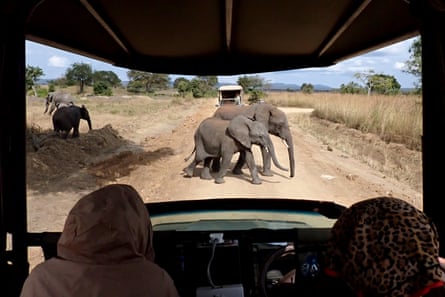
An adult African elephant and a younger calf crossing a dirt track during a game drive in Mikumi, Tanzania. Photograph: Vincenzo Izzo/LightRocket/Getty Images

Female elephants rumble

Mickey Pardo, who works with Joyce Poole as a senior scientist at ElephantVoices, also sees potential benefits and risks of AI-assisted animal communication tools, but he also wonders if the speculation is a bit overblown on both sides. “Playbacks can be stressful for animals even without AI – when you’re just taking prerecorded sounds and playing them back – especially if you don’t know the context of those sounds,” he says. Maybe a more sophisticated AI version could add to that stress, but Pardo sees it more as turning up the dial on a problem we already have, versus opening an entirely new can of worms.

He also questions whether we’re focusing too much on possible harms from AI when there are so many other ways we negatively impact animals’ lives, including in research settings.

“The way that animals are treated in biomedical science is so incredibly horrific compared to anything that anybody’s doing in the field of animal communication,” he says. “Not that we shouldn’t be thinking about the ethical implications [of AI] ahead of time. I just worry that perhaps we’re sucking up too much oxygen worrying about a hypothetical ethical problem when there are many very real, present ethical problems that we’re essentially ignoring.”

This oxygen-sucking, mesmerizing effect of AI – the attention and money poured toward it, and the almost magical powers we’re willing to ascribe to it – also concerns marine mammal researcher Luke Rendell, based at the University of St Andrews. “There’s been this idea put about that AI is going to find something that we couldn’t,” he says. “It’s something of a confidence trick, I think.”

Rendell believes the AI hype has gotten way ahead of the science, and that the public is being led to believe that we know – or are about to know – much more than we actually do about animal communication. For example, Earth Species Project claims on their website that “with exponential advances in AI and Large Language Models, decoding animal communication is no longer a question of if – it’s when” and states that they have already found support for their hypothesis that “AI can decode the shared structures of language across the Tree of Life”.

Researcher Stephanie King on waiting for the right context to record animals

  • King says AI can be a very helpful tool when used in the right ways, but spending time with the animals in their habitat is essential for understanding what their vocal communication means to them. Credit: Amy Martin, Threshold

This is the sort of framing that gives Rendell hives. Like Stephanie King, he believes pursuing a quest to reveal the “language” of animals is loaded with humancentric bias that could actually limit our understanding of their unique and wildly diverse ways of getting their messages across. He’s also concerned about long-term damage to his field when the Dr Dolittle machine fails to materialize.

The study of animal communication has attracted a fair number of charlatans over the years, leading to boom-and-bust cycles of funding and credibility. Rendell says he entered the field of cetacean communication “just as it was recovering from a 15-year hangover” from the work of John Lilly, whose efforts to teach dolphins English using controversial methods – like giving them LSD – brought Lilly a lot of fame, but ultimately led to nothing but a tragic end for one of the dolphins at the center of his experiments. For more than a decade after that, the study of dolphin communication was “the punchline of a joke in scientific circles”. says Rendell, but “we’ve had this flowering in the last 15 to 20 years of understanding and knowledge about cetacean society and communication”, which he says has “taken the whole field on to a new level of credibility. And my main fear is that it is being undermined by these irresponsible claims.”
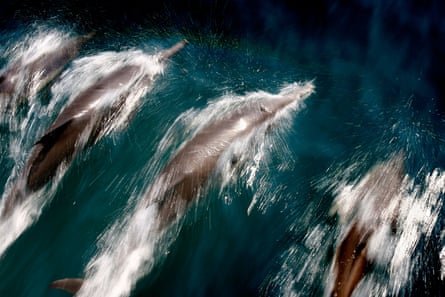
A pod of common dolphins surf the bow wake of a boat in the Catalina Channel near Long Beach, California. Photograph: David McNew/Getty Images

King says it all comes back to testing any AI findings with the experts: the animals themselves. “I think you have to use these AI and machine learning approaches alongside careful examination of the animals: when they produce calls, and in what context, and how they behave,” she says. This is patient, painstaking work that requires careful studies in the field, often conducted over years – the opposite of Silicon Valley’s “move fast and break things” ethos.

King describes how dolphins produce sound

  • Dolphins detect sound waves through their lower jaws and produce sounds through the top of their heads. King describes how that works as buzzes made by a nearby dolphin are picked up by underwater microphones. Credit: Amy Martin, Threshold

The days I spent on the water with King involved a lot of quiet waiting, scanning the horizon for the glint of dolphins rising to the surface. When we spotted an animal, King would immediately beginning calling out names – Juicy, Jungle, Piccolo – while the scientists-in-training on the boat with us snapped photographs and took notes. King can identify hundreds of individual dolphins after the briefest glimpse of their dorsal fins, a skill she attributes to the countless hours she has spent in Shark Bay, observing the animals on site. “I come every year, and it’s a really important part of my life,” she says.

She also believes it’s a really important part of doing good science. When they return from the field, her students will spend time looking through the photographs of the fins, matching them to pictures from previous years in their dolphin “look book”. King says lately some students have been asking her to let AI do that work. It would, of course, be much faster. But she insists they do it manually. “If you really want to understand behavior, then the details matter,” she says. “And the details take time. You can’t rush it.”

Meanwhile, a larger question looms for all of us: as exciting as it might be to imagine walking around with an animal translator in our pockets, do we have to wait for new technology to pay more attention to our planetmates? Because whether or not AI ever allows us to talk with animals, there’s nothing stopping us from listening to them, and caring about their lives.

  • Amy Martin is the founder and executive producer of Threshold, a Peabody award-winning documentary podcast. She is now writing her first book


Source: Technology

OpenAI’s George Osborne says datacentre nimbys holding back Britain

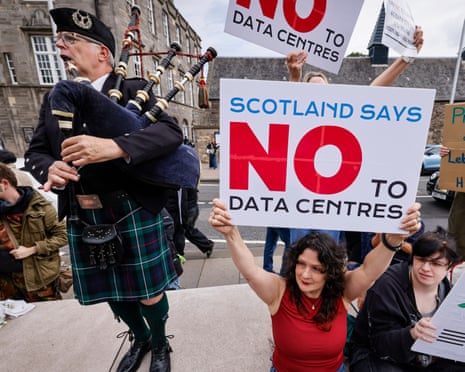
A bagpiper plays next to protesters holding signs reading 'Scotland says not to datacentres'.

Protests have sprung up across the UK in opposition to the construction of datacentres, including outside the Scottish parliament. Photograph: Murdo MacLeod/The Guardian

Protests have sprung up across the UK in opposition to the construction of datacentres, including outside the Scottish parliament. Photograph: Murdo MacLeod/The Guardian

OpenAI’s George Osborne says datacentre nimbys holding back Britain

Former chancellor, now senior figure at OpenAI, says UK needs datacentres to maintain ‘sovereignty’ over AI tech

Datacentre nimbys are holding Britain back, George Osborne has said in reaction to nationwide protests about the giant water- and energy-guzzling structures.

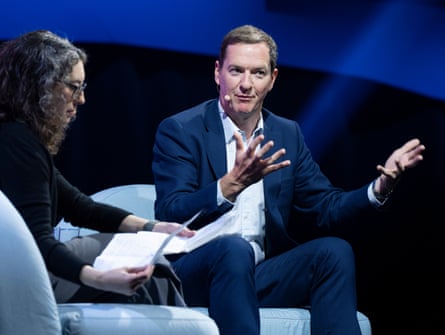
The former Tory chancellor is now the head of AI for countries at OpenAI, the developer of ChatGPT. His job is to represent the company to governments around the world and he also has a role in enabling the building of datacentres and other infrastructure.

Speaking at the Big Brue festival in Somerset on Sunday, Osborne said: “You try and build a datacentre in Britain … I spent my life when I was politician trying to get people to agree to have new roads and railway lines and airport runways, and communities go up in arms – it’s really hard to build a datacentre.”

George Osborne, who was Britain’s chancellor in David Cameron’s cabinet, now leads OpenAI’s relationship-building with governments around the world. Photograph: Christinne Muschi/The Canadian Press/AP

He said the UK would lose its “sovereignty” over tech to the US if it failed to allow datacentres to be built.

He explained: “You can either choose to have these datacentres in Ohio and Georgia and Michigan, which is where they’re all being built … we don’t allow these things to be built. They’re going to be built elsewhere, and you know that’s a loss of some sovereign control over the physical location where these things are.”

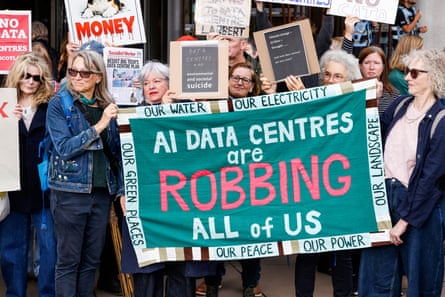
There have been protests about datacentres across the UK, including in central London, Devon and outside Holyrood in Edinburgh. People have said they are a blight on the landscape, questioned whether they will bring jobs to the local area, and argued they will take investment and space that could be used for affordable housing. There are also concerns about the vast water and energy use.

The government has classified AI datacentres as critical national infrastructure to get them built more quickly. But the Green party in England has called for a moratorium on building them.

Osborne dismissed the concerns over datacentres as nimbyism. He said: “I think a lot of the to opposition datacentres is very much like ‘not in my back yard’. There’s an enormous building boom going on in the United States of datacentres, even as the political opposition undoubtedly is growing.”

The protest outside Holyrood. Photograph: Murdo MacLeod/The Guardian

Verity Harding, the head of the AI and geopolitics project at Cambridge University’s Bennett School for Public Policy, said people had wider concerns over these centres.

skip past newsletter promotion


She said: “The reason everyone hates datacentres has nothing to do with datacentres. It’s the only tangible thing to protest against … [people] just don’t like what’s happening and they don’t feel that anybody’s in control or thinking about the impact of it.

“It’s exactly because the tech industry execs are talking in this ridiculous way … You know, you cannot go out on the one hand and say this [AI] might kill everybody one week and then the next week go and appear at a big sales conference saying that you should integrate it into your business.”

Bosses of OpenAI and Anthropic, two of the largest AI companies, will be meeting world leaders at the UN general assembly in New York City this week amid debate over the prospect of dangerous, superintelligent AI and whether and how it should be regulated.

Osborne said: “The fact that corporate leaders are sitting down with the presidents and prime ministers of the world in the UN security council I would say actually shouldn’t be alarming. It’s actually reassuring that people are beginning to try and use the kind of institutions of the world to think about how we regulate this new technology.”


Source: Technology

Control Resonant review – save New York from paranormal phenomena

In Control, a person shoots fire from their hand at a monstrous red creature in a rainy city

New York state of mind … Control Resonant. Photograph: Remedy Entertainment

New York state of mind … Control Resonant. Photograph: Remedy Entertainment

Control Resonant review – save New York from paranormal phenomena

PlayStation 5, Xbox, PC; Remedy
A surprisingly conventional game from a famously weird developer, this sequel to 2019’s Control is accomplished but safe

This is an arthouse action game from Finnish developer Remedy, masters of exactly this type of thing. It’s a sequel, however, so not only must it clear the high bar that its strikingly distinctive predecessor has set – it must also ideally arrive with a bushel of new ideas. There are clear and valuable strengths here in character progression and the lustrous presentation of its paranormal world, but Resonant doesn’t feel as enjoyably recondite or expansive in its influences as 2019’s Control did. As you wander New York brandishing supernatural abilities against glowing orange foes, the sad sense creeps in that you might be playing any number of games.

As paranormal event survivor Jesse Faden, your journey through the original Control was like a sequence of playable Twilight Zone episodes, battling prosaic household objects with supernatural properties that teased and twisted reality inside an endlessly fascinating supernatural government bureau called the Oldest House. You’d navigate architecturally impossible spaces bridging the subconscious and the bricks-and-mortar world, in order to defeat a malevolent fridge. That’s broadly true again in Resonant, albeit with diminishing returns. This time you’re playing as Jesse’s brother Dylan, waking up after years of containment in the Oldest House to find its contents have escaped into downtown Manhattan. So you head out of the interesting place, and into a setting you’ve explored before in Marvel’s Spider-Man, The Division, Max Payne, and others ad infinitum.

It’s disappointing because being bewitchingly strange has historically been Remedy’s great strength. It’s not unusual for games to give a reverent nod to Twin Peaks now and then, but this studio is the alpha and omega of interactive Lynchian nightmares. It’s been refining that skill since 2001’s Max Payne, and at this point there’s really nobody better at nonlinear storytelling or unnerving dream sequences.

Inception-like gravitational spins … Control Resonant. Photograph: Remedy Entertainment

Remedy’s take on New York has an exhilaratingly free-form structure that lets you take on enemies, missions and places in roughly the order you want. The main missions are fairly rigid, but you can engage with the rest however and whenever you want. You fight a malevolent paranormal force with an imaginative collection of supernatural kung fu moves, whose power and combo potential level up satisfyingly. Your shapeshifting weapon can take many forms, from a dagger-like blade to a scythe or a hammer. Secondary attacks, ranged weapons and passive abilities lend more interest to fights against paranormal entity the Hiss as time goes on, but compared to something like the surgically precise swordplay of Onimusha: Way of the Sword, battles feel a bit blunt here.

Your ultimate tests come in the form of the Resonants themselves, a series of bosses lying in wait throughout Manhattan. Remedy’s knack for otherworldly horror comes to the fore in their visual design, which I won’t spoil, and like so much of the game they can be hunted down in any order. Beware, though – beating them changes other enemies’ presence, strength and behaviour afterwards.

Dylan’s movement is more imaginative and enjoyable than his arsenal. Here, trading off a fascinating indoor setting for more outdoor space starts to make sense, as you triple-jump your way across rooftops and shift your gravitational grounding to walk on streets that have been bent upwards vertically à la Inception. It’s playful about it, too – soon after gaining that latter ability, your bureau handler pumps some EDM down the radio to soundtrack your run through a multistorey car park whose levels fold and distort at impossible angles.

It is the little moments like this, not the grand story beats, that prove the most memorable and gratifying. Where Control evoked an oppressive feeling of distorted reality, here there’s a more conventional tale about a man on a mission of redemption, and there’s even the odd moment of human warmth in Dylan’s interactions with his bureau colleagues and his elusive sister. Just like the gameplay, the story has made a tonal shift towards easily digestible mainstream convention, and while there’s nothing inherently wrong with that, I’m left craving the original’s more hallucinogenic vision of the action-RPG.


Source: Technology

AI could be a bubble and is not yet making Australia more productive, Michele Bullock says

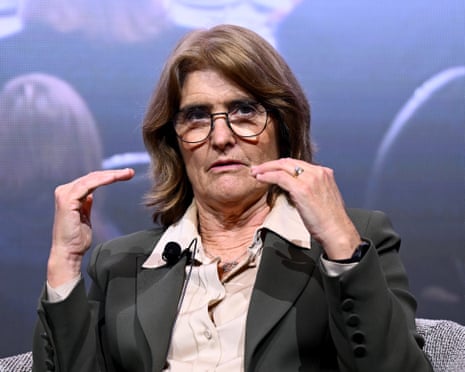
RBA governor Michele Bullock speaks at the CEDA event on Tuesday.

RBA governor Michele Bullock speaks at the CEDA event on Tuesday. Photograph: Dan Himbrechts/AAP

RBA governor Michele Bullock speaks at the CEDA event on Tuesday. Photograph: Dan Himbrechts/AAP

AI could be a bubble and is not yet making Australia more productive, Michele Bullock says

RBA governor says AI is ‘great white hope’ but its adoption is so far adding to inflation, rather than economic growth

The Reserve Bank governor said AI could be a bubble and there was no evidence it is making the economy more efficient, as the Albanese government claims the technology will solve Australia’s economic malaise.

Ahead of an expected interest rate rise next week Michele Bullock also said the slump in house prices was deeper than others in Australia’s recent history.

Resurgent oil prices and inflation are weighing on markets but US tech stocks surged on Monday after Facebook owner Meta debuted its new Muse AI agent and saw its shares rise 11%.

Bullock said a messy slump in tech values could hurt economic activity, speaking at a CEDA event in Sydney.

Sign up for the Breaking News Australia email

“All central banks are a little bit worried about that,” Bullock said.

“Some people think it’s a bubble, some people don’t. I don’t have a particular view one way or the other, but it’s a risk that I think we’re watching.”

Bullock said the RBA and its overseas colleagues believed AI was “the great white hope” to make economies more productive but had seen little sign of any effect yet, with rapid adoption and investment in datacentres adding to inflation instead.

She cited research from the RBA’s South Korean counterpart that found employees adopting AI tended to produce the same output but work 1.5 hours less each week.

“[While] people fiddle around and try and figure out what to do with this new technology, productivity actually can decline,” Bullock said. “But once we reimagine our business processes… then you might see productivity take off.”

The Australian government’s intergenerational report, released on Tuesday, relied on the potential “profound” boost from AI in its projection that Australians’ inflation-adjusted per-person economic activity would rise from $99,200 today to $157,300 by 2066.

The treasurer, Jim Chalmers, told the Guardian’s Australian Politics podcast: “It’s the most transformative thing that will happen in our lifetime.”

The report assumed productivity would return to its long run level of improving by 1.2% a year, which economists have said appears unlikely. If productivity only rose by 0.8%, per-person activity would only hit $136,600 by 2066.

Bullock said on Tuesday: “Many have put it, ‘well, it’s an unrealistic assumption, we’re not going to get that.’ I guess the way I’m trying to think about it is, ‘OK, that’s what we’ve got to aim at.”

Housing downturn

As the government defends Australia’s easing rate of immigration, Bullock said immigration was almost entirely responsible for Australia’s economic growth in the last year.

skip past newsletter promotion


Bullock said new arrivals did not add to inflation as they typically worked as well as spending money. She said the exception was the housing market, as new immigrants did not immediately generate new housing supply.

“Where it bites is the housing market, because the housing market can’t respond,” she said.

One Nation has called for more migrants to leave Australia than arrive over three years, including reducing the number of temporary migrants by more than 750,000.

Labor has instead planned to tighten the existing immigration intake, which home affairs minister Tony Burke said would be “part of the solution for the housing crisis” – but Burke warned more severe cuts could “trash the economy”.

House prices have fallen 3.1% over the past three months after the RBA lifted interest rates three times and the government reformed property investor tax breaks. Bullock said home loan approvals had slumped, in her most explicit public comments on the budget to date.

“They’ve dropped for everyone but they’ve really dropped a long way for investors, so it has changed the dynamic for investors, whether it’s worth investing in housing or not,” she said.

Bullock said housing had become “pretty unaffordable” before the decline, which she described as “a slight dip down after a very long run up”.

“The downturn is sort of in the lower range … but it’s certainly not out of the ballpark of the sorts of downturns we’ve seen in the past,” she said.

She declined to say whether she would recommend an interest rate increase next Tuesday. Traders are betting on more than a 90% chance rates will rise from 4.35% to 4.6%, which would be a 14-year high.


Source: Technology

The rise of Big Toothbrush: how did our mouths become such a lucrative market?

All hail the Big Toothbrush! Animation: Pig Meat/The Guardian

The rise of Big Toothbrush: how did our mouths become such a lucrative market?

People in the UK are more interested in oral health than ever – and you can now buy prebiotic toothpastes and brushes that cost up to £600. Yet we remain in the midst of a serious dental crisis

A December 1969 report from the consumer magazine Which? explored a relatively new gadget that, it predicted, many people would be giving as Christmas presents: the electric toothbrush. For those who hadn’t yet seen one, the magazine described it as “not that much different in principle from an ordinary brush – you have a stick with a brush on the end. The difference is that an electric one moves the brush head for you”. Progress indeed.

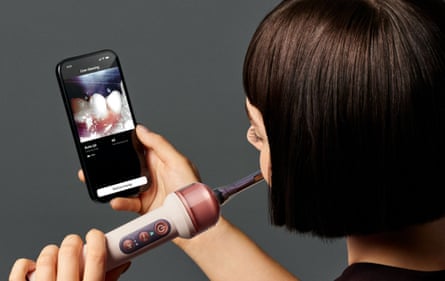
Nearly six decades on, electric toothbrushes can do a lot more than merely jiggle, offering multiple speeds and movement sensors for real-time tracking of where you’ve brushed – some even promise gum-massage or tongue-cleaning modes. Prices range from about £25 for a basic Oral B model to £599.99 for a Philips Sonicare model that gives “smart coverage feedback”. The latest super-toothbrush – a mere £419.99 – features a camera and a built-in water jet to clean between teeth, using AI to identify gaps. Created by Dyson, it’s still, essentially, a stick with a brush on the end (although there is another toothbrush on the market that’s shaped like a mouthguard, with individual brushes, that claims to clean your teeth in 20 seconds).

The Dyson CameraJet toothbrush. Photograph: Dyson

In the UK, 59% of adults use an electric toothbrush and sales, including replacement heads, reached £361m in the last year, according to market intelligence company Mintel. Any product launch by Dyson – still associated with reinventing the vacuum cleaner – feels like something of an event, so its incursion into oral health does feel significant, says Rachel Bairsto, the head of museum services at the British Dental Association. “We’re seeing more and more expensive toothbrushes,” she says. “Expensive toothpaste as well.”

These highly designed everyday objects have become symbols of affluence. “If you see a picture of a swanky bathroom, it will definitely have plug sockets for some kind of rechargeable electric toothbrush,” says Bairsto. “Whereas I’ve tried to look through the archives to find pictures of bathrooms with toothbrushes in them, and I can’t. Was everybody appalled at the sight of a toothbrush in the bathroom? I don’t know.” With many toothbrushes now, she says, “I think there’s definitely a status symbol [aspect] to it.”

We’re more interested in oral health than ever, says Dr Zaeem Jafri, a dentist and the founder of Nova Smiles, an online advice website. “From what I’ve seen from my patients, people are more conscious about it, wanting to avoid dental treatment, wanting their teeth to look nice and feel nice, and I think a lot of people are turning to gadgets to help.” Another dentist, Dr Reena Wadia, known as Dr Reena, a periodontist or gum specialist at the RW Perio clinic in London, says: “Gum health has become super topical. One reason why is because there’s really good evidence now that gum health is linked to your general health, so gum health is now part of the wellness conversation. People are taking it more seriously.” There is growing evidence that gum disease, she says, comes with an “increased risk of diabetes and cardiovascular disease. Those are the two key ones, [but] there’s lots of other conditions related to it.” A poor oral microbiome has been associated with a range of diseases, including Alzheimer’s and several types of cancer, as well as depression.

Both Dr Reena and Jafri recommend rechargeable electric toothbrushes over manual ones, but neither are urging their patients to go out and buy a Dyson brush, or spend similar sums on other brands. “There’s no robust research that says a certain kind of electric brush removes plaque at a better rate than others,” says Jafri.

Jafri has tested Dyson’s CameraJet, along with many other electric toothbrushes. He found it messy – the water jet was hard to angle, and he says it didn’t seem to find all the gaps between his teeth. He points out that a non-foaming toothpaste is needed for an adequate camera view – sold by Dyson, with the cheapest at £8.49. The live stream to a phone app was a novelty, but in reality he says it was hard to see much with water, teeth and the inside of his cheeks in the way. Cameras in toothbrushes, says Jafri, “have the potential to be good. If patients had cameras that were detecting chipped and broken fillings and can send those images to a dentist to review [and] spot things early, that would be a phenomenal advancement. For Dyson right now, it’s using the camera to detect when the brush is in the right position to shoot the water jet – it didn’t really work that well for me. It’s a bit of an overkill.”

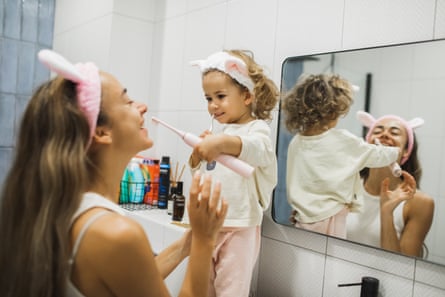
Good brushing habits start early. Photograph: Oleg Breslavtsev/Getty Images

Another concern is that the water jet rinses away the toothpaste when most dentists now recommend spitting, not rinsing, so the fluoride in it stays on and around the teeth for longer. Dr Reena adds: “[The water jet may] make people think, oh, I don’t need to floss, or I don’t need to use interdental brushes. But actually, that jet is an adjunct, not a replacement.” Niamh Turney, a Dyson engineer who worked on the CameraJet, says, however, “The goal is to make interdental cleaning easier and more convenient for those who aren’t already managing to fit flossing into their routine.”

There have been reports of some brushes overheating, and charging problems; at the time of writing, the brush was unavailable to buy. Dyson says it is aware that “a small number of early batches may have experienced a component issue. We are isolating those batches and are taking all the necessary steps to support our customers,” and that there are “some shortages of supply as we are in the process of scaling up production. We expect the next wave to be available in the coming weeks.”

Meanwhile, we are in the midst of an oral health crisis. It is slowly improving on previous years, but access to NHS dentists remains low – 60% of the adult population in England have not seen an NHS dentist in the two years to March 2026. Inequality has a huge effect on oral health – in the most deprived areas, adults are less likely to brush their teeth twice a day, and children are more than three times more likely to have tooth extractions related to decay. The proportion of adults who use an electric toothbrush is 47% in the lowest income groups, compared with 76% in the highest income. Jafri says that the people who are considering spending hundreds of pounds on an electric toothbrush, or those who track their brushing on apps, are likely to be “health-conscious individuals who are brushing their teeth well to begin with, and [this is] probably not solving the bigger problem we have”.

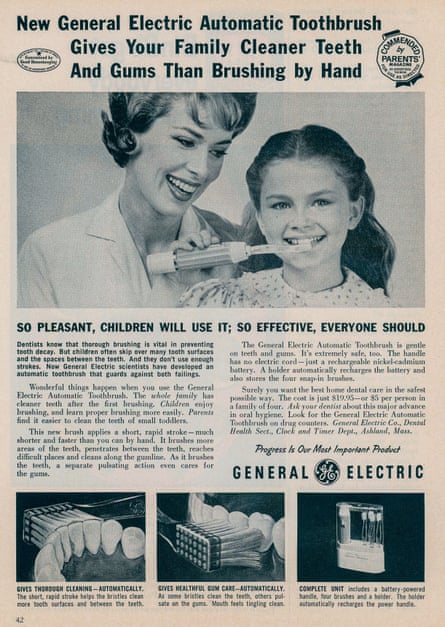
‘Wonderful things happen!’ A 1962 advert for GE’s electric toothbrush. Photograph: Patti McConville/Alamy

The first electric toothbrushes, says Bairsto, had a “clunky side-to-side action, and that’s about all they could do.” There was an increased interest in dental and oral health in the 1960s – programmes to add fluoride to drinking water were rolled out – and electric toothbrushes were part of this, even if they were slow to take off. That 1969 Which? report tested “all 11 we could find on the market”, including those made by Bosch and Boots, alongside several by US manufacturer Ronson, more famous at the time for its cigarette lighters. Women, it claimed, preferred brushes with a softer touch; men liked something more vigorous “as you might expect”. Children liked them, the report said, “perhaps because they are a good way of doing action paintings with toothpaste on the bathroom mirror”.

Now the market is dominated by Oral B, owned by Procter & Gamble. Jafri says dentists don’t earn commission from selling products but, he adds, “in dental school, they come in with free pizzas and give everyone an Oral B brush. All the dental students kind of associate with Oral B quite quickly. There will be the ‘Oral B lecture’ that everybody talks about because it’s free pizza.”

It has a market share of approximately 60% according to Ziyu Tian, a personal care research analyst at Mintel. “Other brands like Philips, [own labels such as] Superdrug and Boots, and Colgate are also the big players,” she says. The Dyson launch, says Tian, while a premium product that won’t appeal to everyone, will raise the bar for consumer expectations and may force existing players in the sector to innovate. Alongside the increased awareness around oral health’s links to general health, she says, “teeth whitening and the beauty element of oral care is something that the younger generation is really embracing. So oral care is not only about cleaning the teeth or freshening the breath, it’s more about the beauty and wellness routines in general.”

As more evidence emerges, particularly links to the gut microbiome, companies will lean on this in their marketing, says Tian. You can already see it in products such as toothpaste that contains “prebiotics and probiotics for our microbiome, magnesium for evening wind-down, and exosomes [“messengers” between cells, already used in skincare] for tissue regeneration, anti-ageing and longevity”. Toothpaste flavours are branching out, too, from the traditional mint, with berries, chocolate and even fried chicken. “I think it is tied to the rise of the GLP-1 [weight loss injections],” says Tian. “Consumers might not get these indulgent flavours from food and drink, and oral care like toothpaste and other things can be a substitute.”

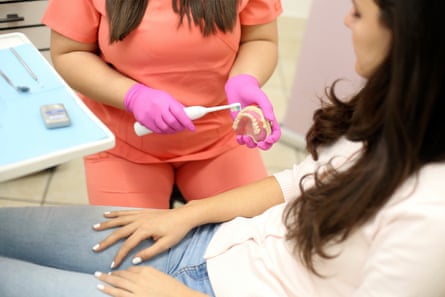
‘Dental professionals should be showing their patients how to brush.’ Photograph: GoodLifeStudio/Getty Images

One of the more recent incomers to the toothbrush market is Suri (from £65), launched in 2022, which makes nicely designed, recyclable, largely plastic-free electric toothbrushes. Its founders, Mark Rushmore and Gyve Safavi, both previously worked in marketing for Procter & Gamble. They were driven, says Rushmore, by the environmental impact of toothbrushes. “Billions of brushes are thrown away – manual, electric – and end up in landfills and oceans. Every brush you’ve probably ever used since you were a child still exists somewhere.”

Damien Walmsley, an emeritus professor of dentistry at the University of Birmingham, has worked with all the big powered toothbrush companies, and most recently with Suri. He says he is probably still under non-disclosure agreements so won’t go into detail; “but I’ve seen some wacky ideas out there, some strange ones”. Companies are constantly trying to add new features, “so that people feel they’re getting a newer product, and people will then be attracted to it. If it’s something new, it will catch the imagination, and that’s what this new Dyson has done.” If it encourages people to brush their teeth more effectively, and more often, “that’s really good”. But Walmsley questions how long the novelty lasts. “We’d like to see more long-term studies evaluating the cost. Was it worth paying the extra money, and did it bring about extra value from that? Those studies aren’t out there.”

Walmsley was one of a number of scientists involved in the 2003 review of literature by the Cochrane library, with the latest update in 2014, concluding that powered toothbrushes were more effective in removing plaque than manual brushes – by 11% in the short term, and 21% after three months – and at reducing gingivitis (early-stage gum disease). Many of the studies were small, short-lived – and run by Oral B. Should consumers be concerned about that? Research studies are expensive, says Walmsley, and over the years Oral B was among the few companies doing them. “We have certain criteria, and we checked that [studies] followed that, and we followed up the evidence,” says Walmsley. “It was as open as it can be.” He also points out that toothbrushing technique and usage in a controlled trial may be different compared to use by a wider population in everyday life.

“Dental professionals should be showing their patients how to brush,” says Dr Reena. “It sounds basic, but actually, [many people have] never been shown. Essentially brushing along the gum line [at around a 45-degree angle] to remove bacteria that are trapped. The bristles should be going under your gum line a little bit.” But not too hard, which can lead to gum recession. A pressure sensor is a valuable feature. “Different modes [in speed for instance] are quite helpful as well, if someone’s got sensitivity or gum issues.” She is interested in the idea of a camera in a toothbrush, especially if it can provide “real-time feedback on what a patient is doing. But the key thing it always comes back to is that technique and consistency are more important.”


Source: Technology

Black Tesla employees accuse company of fostering racial discrimination in major trial

Aerial view of the Tesla Fremont Factory with a parking lot full of cars

Brett Watson started by showing the court photographs taken throughout Tesla’s Fremont factory, including the N-word, swastikas, the Confederate flag, white supremacist logos and more scratched on to walls. Photograph: Justin Sullivan/Getty Images

Brett Watson started by showing the court photographs taken throughout Tesla’s Fremont factory, including the N-word, swastikas, the Confederate flag, white supremacist logos and more scratched on to walls. Photograph: Justin Sullivan/Getty Images

Black Tesla employees accuse company of fostering racial discrimination in major trial

Lawyers say Black employees at Tesla experienced ‘rampant racism’ that was left unchecked for years at their flagship factory in California

Dozens of Black employees at Tesla’s flagship plant in California said they were subject to racist slurs, unequal pay and promotions, and bullying by supervisors on a daily basis, a situation management did little to nothing to fix.

Their complaints form the basis of a lawsuit brought against the Elon Musk-owned electric car company by the state of California, which began trial with opening statements on Monday.

Brett Watson, a lawyer for the California Civil Rights Department, started by showing the court a series of photographs taken throughout Tesla’s Fremont factory. There was the N-word scratched on to a grey-blue metal surface and written in black marker on a wall. “KKK”, swastikas, the Confederate flag, a white supremacist logo and “go back to Africa” had also been found scrawled in bathrooms, lockers, workplace benches and lunch tables, according to court documents.

Watson listed a long string of racial epithets workers said were directed personally at them, including one incident where a Black worker said he was asked: “You want to hang from a tree?”

“Despite what Tesla might argue, you will hear Black workers were deeply offended,” Watson said. “These experiences cannot be dismissed as a few bad apples … hundreds of complaints to Tesla and [the Civil Rights Department] will show these experiences were not isolated.”

Watson said Black employees at Tesla experienced “rampant racism” that was left unchecked for years, and that workers referred to the factory as a “slaveship”, “the plantation” and “The Elon Slave Labor Association” – spelling out TESLA. One Black worker told state lawyers that he heard racial slurs as often as 50-100 times a day.

The lawsuit was filed against Tesla in February 2022 and alleges that the company did not comply with the law, violating California’s Fair Employment and Housing Act. It alleges that the factory was racially segregated and Black workers were paid less, promoted less and terminated more frequently than their white counterparts.

The state is seeking financial damages and injunctive relief, which could force Tesla to change its labor practices and internal policies. Judge Peter Borkon will make the final ruling in the bench trial, which proceeds without a jury.

It’s the first such lawsuit brought against Tesla by a government agency on behalf of dozens of workers to go to trial. Legal experts say the outcome of the trial could have sweeping consequences for the company since the state is not bound by the same arbitration agreements as employees. The trial is expected to continue through the end of October.

The car manufacturer has denied any wrongdoing and called the lawsuit “misguided”, saying it has “always disciplined and terminated employees who engage in misconduct, including those who use racial slurs or harass others in different ways”. Tesla said its Fremont factory has a majority-minority workforce and provides “the best paying jobs in the automotive industry” to tens of thousands of Californians.

Tyree Jones, the lead lawyer for Tesla, began his opening statements repeatedly saying the N-word in a familiar tone. “What’s up my [N-word], my [N-word] …,” Jones said, adding that “none of which is used as a racial slur.”

“By this action, the state of California attacks the way many Black people greet each other,” Jones said. “It’s offensive.”

Jones touted Tesla’s accomplishments as an innovative electric car manufacturer and reiterated that the company provides thousands of jobs in the state. “The most prolific employer of California is on trial and under attack by the state,” Jones said. Referring to the racist graffiti around the factory, Jones said: “The state is blaming the employer, when it’s the victim.”

After both sides presented opening arguments, the state called three witnesses. All were former Black employees at Tesla who said they either witnessed or were subject to racism at the company. The first witness worked at Tesla from 2021 to 2024 and said he was repeatedly bullied for being Black. In one incident, he alleged he was called the N-word by another employee, and the company gave him a write-up on the situation instead of the instigator.

The second witness was a senior security manager who worked at Tesla for six years. He said he habitually worked with human resources when complaints of discrimination came in, and that he witnessed Black employees treated differently than workers of other races. In one incident, he alleged Musk got involved when white employees were caught drinking alcohol on site and the CEO directed management to override company policy and not terminate the workers.

skip past newsletter promotion


Nadia Clark, who previously worked as a police officer and an army officer for decades, was employed as a security manager at Tesla’s Fremont facility from 2020 to 2022. She testified about an incident where a white employee called her the N-word more than ten times in a row in front of other workers.

“I likened Tesla to some experiences I had on the street and in the military. It was like a pressure cooker,” Clark said. “These words have a violent landing.”

She said the incident shook her and she immediately reported it to human resources, but never got a response. Clark decided to leave Tesla that day. “There were these continuous patterns that were never addressed,” Clark said. “The work environment was unsafe, hostile, and I never returned.”

This lawsuit is one of dozens of discrimination suits brought against Tesla, including a case brought by the Equal Employment Opportunity Commission, a federal agency. The suits allege the company has routinely ignored complaints of repeated racial harassment. In 2022, a federal jury awarded Owen Diaz, a former Tesla employee, $137m for these claims – one of the largest awards given in a discrimination lawsuit brought by a single worker, although a judge later reduced that sum.

Similar suits have been filed by female employees, who allege they experienced physical assaults, harassment and catcalling at Tesla facilities across the country.

Tesla has denied wrongdoing in all cases, and has said it implemented various policies in recent years to prevent racist and sexist conduct and punish it when it does occur.

Musk, who joined Tesla in 2004 and became the CEO in 2008, has also been accused of racist behavior, including promoting white supremacist conspiracy theories like “white genocide”. The CEO also tends to broadcast his thoughts on X, a social media platform he owns, fixating on anti-immigrant content and theories that the white race is under threat.

Musk is not expected to be called as a witness in the trial. He hasn’t publicly addressed the legal proceedings under way and did not return a request for comment.


Source: Technology

Jason Eaton found guilty of attempting to kill 3 Palestinian students

Sept. 21 (UPI) — A jury found Jason Eaton guilty on three counts of attempted murder on Monday for the 2023 shooting of three Palestinian American college students in Burlington, Vt.

The jury deliberated for about 2 hours before reaching its verdict. The victims, Hisham Awartani, Kinnan Abdal Hamid and Tahseen Ali Ahmad, survived the shooting.

Eaton sought an insanity defense but his bid was rejected by the jury. He was arrested the day after the Nov. 25, 2023, shooting while federal agents were searching his apartment complex.

“Jason Eaton never disputed that he was the shooter,” Elizabeth Price, Awartani’s mother, told reporters after the verdict came down. “During the trial, we had to listen to him use hateful words to describe our sons over and over again. They were not the words of a man confused about who he shot or why.”

Eaton was represented by public defenders in the six-day trial.

The survivors of the shooting all testified during the first day of the trial. They said they were approached by Eaton, who drew a pistol and opened fire without speaking to them.

Bullet casings that matched ammunition that Eaton possessed in his apartment were submitted into evidence. A Ruger pistol that was also in Eaton’s apartment was believed to be the weapon used in the shooting, a firearms expert testified.

Eaton’s attorneys argued that he was legally insane at the time of the shooting as he reported receiving messages from the CIA while listening to Vermont Public radio. He claims he was given orders to commit the attack on the night that it happened.

“I was either talking to my ancestors and the divine consult or talking to an intelligence agency using an incredible AI that could come through my FM radio, through my Bluetooth headset, through my phone — or I’ve had this incredible psychotic break,” Eaton said in an interview recorded days after the shooting.


Source: U.S. News

U.N. investigator: U.S. strikes on alleged drug boats may be crimes against humanity

Sept. 21 (UPI) — A special rapporteur for the United Nations human rights council said in a new briefing that there are “reasonable grounds to believe” that U.S. attacks over the past year on boats allegedly carrying illegal drugs may be crimes against humanity.

Special rapporteur Ben Saul said in his briefing note that the attacks are “serial extrajudicial killings in violation of the right to life, being unjustified in national or personal self-defense or under international humanitarian law, the international law of the sea, narcotics suppression conventions or international counter-terrorism law.”

“There are reasonable grounds to believe that the reported 68 attacks that killed 223 people constituted crimes against humanity of murder under customary international law,” Saul’s note said.

The investigator said that while U.S. President Donald Trump has told Congress that the attacks are “self-defense” against “designated terrorist organizations,” they are, however, “contrary to international law, violate the human right to life, and plausibly constitute crimes against humanity.”

Saul noted that the attacks have been condemned by the U.N. High Commissioner for Human Rights, U.N. independent experts, the president of the International Narcotics Control Board, the Inter-American Commission on Human Rights, many international lawyers and others.

“There is no right to use force in self-defense against the criminal groups listed as terrorist organization,” he wrote. “Firstly, even assuming that the vessels and crew attacked were members of the criminal groups listed as terrorist, such organizations have not mounted any ‘armed attack’ on the United States so as to trigger a right of self-defense.”

In the latest attack Saturday, U.S. Southern Command posted on social media that it “executed a lethal, kinetic strike on a go-fast vessel operating along established narco-trafficking routes in the Caribbean. Confirmed intelligence revealed the vessel’s active involvement in narco-trafficking.The operation killed four narco-terrorists.”

It did not name those killed or give any information about the alleged intelligence that led to the fatal attack.

The Guardian reported that while Trump has said these attacks have stopped 97% of all illegal drugs entering the country by sea, reports show that the attacks have had no impact on the amount of cocaine entering the United States.

Further, The Guardian reported, those who’ve identified some of the victims have found they were sometimes innocent and sometimes “at best low-ranked participants in trafficking networks.”


Source: U.S. News

Sen. Gary Peters to lead USC politics center

Sept. 21 (UPI) — Retiring Michigan Sen. Gary Peters is set to lead USC’s Dornsife’s Center for the Political Future, the university announced on Monday.

The Democrat, who announced he would not seek re-election earlier this year, has been named the Warschaw Chair. Peters began his professional career as an educator at several institutions in Michigan, including Michigan State University.

Peters is serving his second term in the U.S. Senate. His term will end in January as former Rep. Mike Rogers, R-Mich., and Democrat Abdul El Sayed seek to succeed him in November’s midterm elections.

“I look at this as a capstone of my years in public service at the local, state and federal level,” Peters said in a statement. “It’s never been more important to bring people together, and there’s no better place to start than working with students and getting them engaged in civic activism.”

Peters will work alongside Republican strategist Mike Murphy, who has been named the center’s co-director.

Peters first entered government in 2008 when he was elected to the U.S. House of Representatives.

“Gary Peters brings an extraordinary combination of public service, bipartisan leadership and real experience getting things done in Washington,” James Bullock, Dean of USC Dorsife’s Center, said in a statement. “He has spent his career showing that you can hold strong political convictions and still work productively with people who see the world differently. I’m especially excited about what his leadership will make possible for our students, both in Los Angeles and in Washington.”

This week in Washington

President Donald Trump speaks to more than 100 hunters and fisherman at a dinner in the Rose Garden of the White House on Thursday. Photo by Jim Lo Scalzo/UPI | License Photo

Source: U.S. News

News outlets decline press duties, sue Trump over White House ban

Sept. 21 (UPI) — CNN, MS Now and Politico announced Monday they filed a lawsuit and other news organizations declined to participate in White House coverage after President Donald Trump banned the three outlets.

CNN, MS Now and Politico filed the emergency request seeking to restore their access to the White House in U.S. District Court for the District of Columbia. In a joint statement, they said the government should not be allowed to decide what the press reports.

“Without notice or process, the White House revoked our journalists’ credentials because it objected to our reporting,” the statement read. “Left unchallenged, this threatens press freedom and the public’s right to independent journalism free from government interference.”

The lawsuit said Trump’s ban threatened the Constitution’s due process and First Amendment protections.

CNN had been scheduled to serve as the White House press pool representative for television Monday. Multiple news outlets take part in a rotating schedule to share television, radio and written coverage of the president each day.

Instead of replacing CNN, the White House press corps decided to decline television coverage of presidential events Monday, The New York Times reported.

“Effective today, the TV pool will not be covering events designated as pool coverage of the president,” a pool note from Bryan Boughton, Fox News Washington bureau chief, said.

“This follows the White House’s position preventing CNN from fulfilling its assigned pool duties. There will be no replacement pool put in place. All other pool coverage will continue as normal.

“We will provide updates as this situation develops.”

The five networks that share television coverage — ABC, CBS, CNN, Fox News and NBC — issued a separate statement.

“The public has a vital interest in receiving accurate, independent information about its government. No administration should restrict a news organization because it objects to its reporting.”

In a post on Truth Social on Monday morning, Trump denied the allegation that the ban was “an assault on the Free Press.”

“It is instituting an assault on the FAKE News, something that has grown like Cancer in our beloved United States of America,” he wrote. “It is corrupt, purposeful, pervasive, fully coordinated and totally out of control. It is a threat to our National Security, and must be stopped, NOW!”

Trump on Friday announced he was banning reporters from the three outlets from the White House “effective immediately,” citing allegations of “fake news.”

“Media Outlets shouldn’t be able to constantly write or report FICTION and LIES when they’re covering the President of the United States, the Trump Administration, or the United States of America,” the president wrote on Truth Social. “Other Fake News Media Outlets to follow.”

CNN, MS Now and Politico aren’t the first news organizations to face a ban at the White House. In 2025, the administration banned the Associated Press from multiple events after it refused to stop using the term “Gulf of Mexico” despite Trump’s efforts to rename the body of water the “Gulf of America.”

This week in Washington

President Donald Trump speaks to more than 100 hunters and fisherman at a dinner in the Rose Garden of the White House on Thursday. Photo by Jim Lo Scalzo/UPI | License Photo

Source: U.S. News