In the Olympus blog you'll find the latest news about the community, tutorials, helpful resources and much more! React to the news with the emotion stickers and have fun!
A global sell-off in government bonds has put fresh upward pressure on UK borrowing costs, before a tough budget for John Healey next month.
The yield – effectively the interest rate – on 10-year UK bonds, known as gilts, had risen to 5.38% by mid-morning on Thursday, approaching the 19-year high set last week.
Higher interest rates raise the upfront cost of government investment and feed through into Office for Budget Responsibility forecasts of whether the chancellor is on course to meet Labour’s fiscal rules.
Analysts believe recent increases in yields have wiped out more than half of the £24bn “headroom” against the rules that the former chancellor Rachel Reeves had built up at the time of the spring statement in March.
Healey, her successor, has repeatedly promised to meet the rules with a “buffer against uncertainty” but this is widely expected to be significantly lower than £24bn.
Rebuilding it to that level would be likely to require large tax increases or spending cuts; but Treasury sources insist the budget will be “focused”, with important spending decisions postponed to a review next year.
Investors across the main markets have been ditching bonds in recent weeks in a wave of selling prompted by fears of higher inflation and interest rates as the conflict in the Middle East rumbles on.
The Bank of England chief economist, Clare Lombardelli, said in a speech on Thursday that the longer oil prices remained elevated as a result of the war, the more likely it was that UK interest rates would have to rise.
“The longer higher energy prices persist, the greater the risk that indirect effects build and that inflation expectations, wage bargaining and price-setting behaviour begin to adjust in response,” she told an economic conference in Warsaw, Poland.
“On that basis, policy is increasingly likely to need to tighten if elevated energy prices persist, absent clear evidence of disinflation or weaker activity.”
Higher rates would mean increased mortgage costs for homeowners, at a time when Andy Burnham’s government has promised to offer consumers a “breathing space” against the rising cost of living.
The Bank is also expecting an eye-watering 24% rise in the quarterly energy price cap that determines household utility bills in January, if oil prices remain high.
She stressed that high oil prices had had less impact on other prices across the economy than the Bank had feared; but the longer they remained high, the greater the risk of inflation becoming entrenched.
As the bond sell-off continued to worsen on Thursday, yields on 30-year US Treasury bonds surged to 5.444% – the highest level since 2004.
Alongside higher inflation, investors appear to be concerned about the risks of uncontrolled US government spending. Some analysts also suggest large-scale bond issuance by AI firms is undermining demand for treasuries.
Sept. 24 (UPI) — Legal experts and lawmakers are warning that the Trump administration may be planning to send federal agents to the polls ahead of the Nov. 3 midterms.
Non-profit government watchdog American Oversight released a memo from the Department of Homeland Security to states’ attorneys general, sharing a legal theory to circumvent the Posse Comitatus Act to allow the use of military forces for domestic law enforcement.
With President Donald Trump and his administration’s unfounded claims of rampant election fraud and non-citizen voting, the organization warns that this legal theory offers a playbook for putting government agents near polling places.
DHS Secretary Markwayne Mullin said during an appearance on Fox News last weekend that the department is investigating more than 300,000 cases of suspected non-citizen voting.
Peter Kenny, vice president of litigation and investigations with American Oversight, told UPI that the focus of the Trump administration on non-citizen voting, paired with the memo outlining a legal theory for deploying armed troops to polls, has drawn the attention of legal experts.
“What we’ve been focused on, especially here we are in the run-up to the midterm election, is that we’re seeing more and more claims of non-citizen voting,” Kenny said. “We’re seeing more and more federal officials at the most senior levels opening the door to deploying armed officers at polling locations, ostensibly to enforce immigration laws.”
“Truly, this is an extraordinary use of the National Guard, and as many legal experts have noted, quite an unprecedented application of the specific legal provisions that they are citing,” he continued.
Federal forces are banned from polling places by federal law as their presence may intimidate and deter voters from exercising their constitutional right to vote.
The memo that American Oversight received as part of a Freedom of Information Act request outlines circumstances that it says would allow states’ National Guards to carry out immigration policing functions outside of their own states. It argues that if the National Guard is activated under Title 10 of U.S. Code and deputized by the Secretary of Homeland Security, it would not “run afoul” of the Posse Comitatus Act, a law that prohibits the use of military forces to enforce domestic laws without Congressional approval.
“When National Guard members are activated in a federal status under Title 10, they are employees of the United States,” the memo reads. “This is supported by a fair reading of the statute’s plain language, its broad grant of authority to the Secretary of immigration enforcement, use of the term ’employee’ in other areas of federal law, and Article 1 of the Constitution, which provides that activated State militias are ’employed in the service of the United States.'”
Kenny said the memo is important, particularly in light of an approaching election, because it shows the department’s thinking on Posse Comitatus and the use of the National Guard.
“It really shows a lack of any barrier to them accomplishing their goals in deploying National Guards in truly unusual and extraordinary ways,” Kenny said.
Mary McCord is the executive director of the Institute for Constitutional Advocacy and Protection at Georgetown University and a former acting assistant attorney general for national security at the Justice Department beginning under the Obama administration through May 12, 2017, under the Trump administration. She told UPI that the DHS memo is part of a “constellation” of actions that have legal experts on alert about the midterms.
“I’ve been looking at this now for a year and there’s nothing that the administration has said to quell the concerns or the fears that people would be intimated from voting and worse, that people would be potentially stopped, detained unlawfully, potentially U.S. citizens attempting to vote,” McCord said.
One of the more recent actions that caught the attention of McCord, as well as Democrats in the Senate, was the Justice Department’s removal of a 281-page manual “Federal Prosecution of Election Offenses” from its website without notice or explanation.
The document was removed in June.
A group of Senators issued a letter to then-Acting Attorney General Todd Blanche to explain the decision to remove the guidance. Blanche has yet to provide an explanation publicly.
Public statements by Blanche, the president and more recently FBI Director Kash Patel have not eased concerns about the election.
Patel, during his testimony before the Senate Judiciary Committee last week, declined to directly rule out sending agents to the polls when asked by Sen. Amy Klobuchar, D-Minn., and Sen. Richard Blumenthal, D-Conn.
“So would you agree with me that deploying FBI agents to the polls on Election Day would be contrary to the law?” Blumenthal asked, repeating his question after a response from Patel.
“I don’t know that we can’t legally do it. I’m telling you we’re going to house our agents and intel officers in our field offices for election security purposes,” Patel answered.
“I’m dissatisfied that you are unwilling to give us an unequivocal, clear, unambiguous commitment that the FBI will be kept out of election interference,” Blumenthal said. “You are involved in seven voter-related subpoenas issued to the Nevada Secretary of State’s Office. You were involved in the seizure of election records from Fulton County Georgia. Clearly the FBI has been involved in possible election interference. That is why your committing to avoiding that kind of interference moving forward is so important today.”
In January, Trump told The New York Times that he regrets not directing the National Guard to seize voting machines after his loss in the 2020 presidential election. Though Trump questioned the capability of the National Guard to carry out such a task.
“I don’t know that they are sophisticated enough,” Trump said of the National Guard. You know, they’re good warriors. I’m not sure that they’re sophisticated enough in the ways of crooked Democrats and the way they cheat to figure that out.”
McCord said that legal teams for voting rights and civil rights organizations have prepared to act in the case that federal agents or military members are sent to the polls on Election Day.
Two lawsuits have been filed in the last two weeks to block the Trump administration from deploying federal officers to the polls.
The lawsuit from a coalition including the League of United Latin American Citizens and Common Cause argues that the Trump administration, specifically DHS Secretary Mullin, have made enough public comments and taken enough action to warrant the court’s intervention.
The lawsuit points to Mullin publicly stating that the administration has a policy authorizing Immigration and Customs Enforcement officers to go to polling places to serve warrants and detain people for suspected immigration violations. It adds that the department, under Mullin and acting ICE Director David Venturella, have adopted and are implementing a Polling Place Policy to direct agents in performing immigration enforcement activities at polling places.
The second lawsuit brought by the NAACP and a coalition of other organizations argues that the administration’s purported plans violate the Voting Rights Act as it will intimidate voters, particularly minorities who may fear being confronted by immigration officers regardless of legal status.
For the service members who face the prospect of being asked to perform immigration duties around polling places, they and their commanding officers would first look for guidance from Judge Advocates General.
Eugene R. Fidell teaches military justice at Yale Law School. He is also a former JAG officer for the U.S. Coast Guard.
“If an order were disseminated to send federal troops to suppress disorder at the polling places, a JAG would be duty-bound to say you can’t do that unless the president declares an insurrection,” Fidell told UPI. “If the president does that, the constitutional fat will be on the fire. We will be watching a legal civil war go on.”
In February 2025, Defense Secretary Pete Hegseth fired two of the top JAG officers in the armed forces, Lt. Gen. Joseph B. Berger III of the U.S. Army and Lt. Gen. Charles Plummer of the U.S. Navy. He did not note any conduct or other reason for their firings.
Like McCord, Fidell said that between public statements from administration officials, Trump’s continued claims of rampant election security issues and actions taken by the administration on immigration, there is plenty of reason people to be concerned about the administration’s actions around the election in November.
However, Fidell added that the judicial system is equipped to act swiftly if voting rights are violated.
“The protections against the plot against the election are several. One is the courts,” Fidell said. “An alert civil society and state attorneys general and local authorities who are ready, willing and able to proceed immediately to court at the first sign of trouble. It’s going to be touch and go but three will be people racing to courthouses. The very effective core of lawyers who have been carrying the banner so effectively in our country have long since drafted the necessary legal papers and they’ll be coming into court at a time when the federal government will defend at the hilt anything the government does here.”
More specifically, RLCD is a schema-conditioned Plackett–Luce objective. Jev turns that objective into a product by adding typed outputs and parallel inference.
That is the secret: the reward model is no longer hidden behind a generator. The reward model becomes the model.
Figure 1. The learned object changes at each step: a scalar reward becomes a preference, the preference becomes a multiway distribution, and calibration turns that distribution into a decision interface.
Reward Modeling Started with a Scalar
A conventional reward model receives a context (x) and a candidate answer (a), then produces a scalar:
[
r_theta(x,a)inmathbb{R}
]
Outcome reward models score the final answer. Process reward models score individual reasoning steps. In both cases, the learned object is an absolute-looking number.
The problem is that this number is not actually absolute.
A reward of (0.8) does not have a stable meaning across problems, candidate pools, checkpoints, or model families. It is mainly useful for comparing candidates generated under similar conditions:
[
r_theta(x,a_1) > r_theta(x,a_2)
]
The operational signal was always relative preference. The scalar merely hid it.
PPRM Made the Preference Explicit
LLaMA-Berry’s Pairwise Preference Reward Model, or PPRM, exposes the comparison directly.
Given a problem (x) and two solutions (a_1) and (a_2), PPRM answers:
Is the first answer better than the second answer?
LLaMA-Berry implements the comparison as a constrained language-model decision over Yes and No tokens. It trains the evaluator on almost 7.8 million mathematical-solution pairs and uses DPO to improve the pairwise prediction task. The essential change is conceptual: reward modeling becomes preference-probability modeling. See the LLaMA-Berry paper.
PPRM still contains a latent scalar utility (u_theta(x,a)), but that utility is no longer presented as an absolute reward. It becomes meaningful through a normalized comparison.
LLaMA-Berry subsequently uses Enhanced Borda Count to aggregate pairwise comparisons inside MCTS. That is downstream search machinery. EBC neither defines PPRM’s preference loss nor provides the bridge from PPRM to RLCD.
That is the first stage of the Plackett–Luce likelihood: a multiway extension of PPRM.
This is the mathematical center of RLCD.
Figure 2. Bradley–Terry and PPRM are the two-candidate case of the same Luce choice geometry. Plackett–Luce extends that normalization from one choice to a complete or partial ranking.
RLCD Adds Calibration
Plackett–Luce gives us a probability distribution, but normalization is not calibration.
A softmax vector always sums to one. That does not mean a prediction reported as (0.8) is correct 80% of the time.
Calibration adds that empirical meaning:
[
P(Y=hat{Y}mid hat{P}=p)approx p
]
Across predictions assigned probability (0.8), approximately 80% should be correct. This is also the contract TypeSafe gives for RLCD: Jev returns decisions and probabilities, and higher reported probabilities should correspond to higher observed accuracy. See TypeSafe’s RLCD primer.
A minimal implementation uses a proper scoring rule such as log loss:
[
mathcal{L}_{mathrm{NLL}}=-log p_y
]
Brier calibration: confidence gets a price
The Brier score makes the calibration objective concrete. For a binary Noul decision, let (p=P(Y=1mid x)) and (yin{0,1}). The score is:
[
operatorname{BS}(p,y)=(p-y)^2
]
If the model reports (p=0.8), it receives a score of (0.04) when the event occurs and (0.64) when it does not. The confidently wrong forecast costs sixteen times as much as the confidently correct one.
This is why the Brier score fits a decision model. It is a strictly proper scoring rule: in expectation, the model minimizes the score by reporting the true conditional probability instead of gaming the threshold. The score was introduced for probabilistic forecasts by Glenn Brier; its role as a proper scoring rule is developed by Gneiting and Raftery.
For a multiway Choice, the score extends to the full probability vector. Using the normalization that makes the two-class case match the binary formula:
This matters because top-1 accuracy discards probability quality. Two models can choose the same action while reporting (0.55) and (0.99). Once outcomes arrive, Brier score tells us whether that extra confidence was earned.
For binary outcomes, the Murphy decomposition separates the mean score into three terms:
Reliability (operatorname{REL}) measures the gap between reported probabilities and observed frequencies. Lower is better.
Resolution (operatorname{RES}) measures whether the model separates cases with different outcome rates. Higher is better.
Uncertainty (operatorname{UNC}) is the base-rate difficulty of the evaluation set. It is fixed when models are compared on the same data.
A lower Brier score can therefore come from better calibration, better separation of easy and hard cases, or both. A constant base-rate predictor can be calibrated while having zero resolution; Brier exposes that weakness.
Figure 3. Brier score prices confidence, decomposes forecast quality, and closes the loop from observed outcomes to an operational decision policy.
An RLCD implementation can apply Brier score to the decision probabilities during training and use it again as a held-out objective for post-hoc calibration. With temperature scaling, the calibration parameter can be selected directly on validation outcomes:
Temperature scaling then adjusts the sharpness of the distribution:
[
p_i
=
frac{exp(u_i/T)}
{sum_jexp(u_j/T)}
]
Here (T) controls how concentrated the probabilities are without changing their ordering. Brier is the objective; temperature scaling is the calibrator. One measures probability quality, while the other changes the distribution.
This separates two objectives that ordinary reward modeling often conflates:
Ranking asks whether the best candidate appears first.
Calibration asks whether the model knows how often that decision is right.
Automation needs both. Ranking selects an action; calibration determines whether software should execute it, defer it, or escalate it.
Figure 4. Calibration attaches empirical meaning to confidence, allowing application-specific policies to decide when to gather context, escalate, or execute. The reliability curve is conceptual, not a Jev benchmark.
Jev Turns the Reward Model into the Product
In the conventional RLHF stack, the reward model is an internal component:
There is no need to generate an explanation and parse it back into an action. The evaluator itself becomes the runtime interface.
Jev exposes three primitives:
Jev primitive
Preference-model interpretation
Noul
Binary Bradley–Terry decision between true and false
Choice
Luce distribution over (K) unordered alternatives
Score
Distribution over an ordered set of levels
A Choice returns the selected option, the complete probability distribution, and a confidence value. A Score returns a position along user-defined levels together with the distribution across those levels. A Noul returns the probability that a proposition is true. See Jev’s primitive documentation.
These are not three unrelated capabilities. They are three schemas over the same underlying object:
Jev is therefore a reward model generalized from “Which answer is better?” to “Which typed outcome should the program select?”
Figure 5. Conventional stacks use the reward model behind the generator. Jev serves the evaluator itself: state and schema in, typed probability distributions out.
The Decision Head Produces the Utilities
The Plackett–Luce equations leave the utility (u_theta(x,a_i)) abstract. The decision head is the component that computes it.
In Jevre, the encoder processes the state, question, and every candidate under the tree attention mask. The model mean-pools the normalized hidden states of the three spans:
The candidate utility is their scaled inner product:
[
u_{f,i}
=
frac{q_f^top k_{f,i}}{sqrt{r}}
]
The released model uses (r=512). This rank is the dimension of the learned interaction space; the encoder and decision head are trained together. A softmax across the candidates of the same question turns the utilities into the RLCD distribution:
Figure 6. The decision head is a shared compatibility function: state and question form the query, each runtime candidate forms a key, and their rank-512 interaction produces the utilities normalized by Plackett–Luce.
This head scores contextual representations rather than vocabulary labels. Candidate names and descriptions arrive at runtime as text, so the same parameters can score a new schema without adding a class-specific output layer. Noul, Choice, and Score all use these logits; the schema decoder determines how the resulting distribution is returned.
Images enter through the state span and change (bar{h}_S), while the decision head stays unchanged. The same utility function therefore covers text and multimodal decisions. The full implementation is visible in the scorer model and the released Jevre checkpoint.
The decision head is the bridge between representation learning and RLCD: the encoder builds state-, question-, and candidate-aware representations; the head turns their compatibility into utilities; Plackett–Luce and Brier training shape those utilities into calibrated decisions.
Why Jev Can Run in Parallel
Strip away the branding: Jev’s parallel sampler is sequence packing plus an attention mask, followed by one shared decision head and typed schema decoding. This is the serving trick behind the speed claim.
Autoregressive language models represent an answer as a token sequence:
[
P(ymid x)
=
prod_{t=1}^{T}
P(y_tmid x,y_{<t})
]
Every token depends on the previous tokens. Latency grows with output length.
A decision model already knows its output space. It only needs to estimate utilities and normalize them:
Now pack the shared state, questions, and candidate branches into one sequence:
[
Z
=
[S;Q_1;C_{1,1};dots;C_{1,K_1};Q_2;C_{2,1};dots;C_{m,K_m}]
]
The packed sequence is only the physical layout. Its logical layout is a tree:
[
S
rightarrow
Q_q
rightarrow
C_{q,k}
]
The attention mask preserves that tree. A question reads the shared state and itself. A candidate reads the shared state, its own question, and its own candidate tokens. It cannot read another question or a sibling candidate. Let (v(i)) denote the tree node containing token (i), and let (v(j)preceq v(i)) mean that (v(j)) is an ancestor of, or identical to, (v(i)). Then:
For a causal backbone, this structural mask is combined with causal order inside each branch. Position IDs reset at every branch: all questions start after the same state prefix, and all candidates under a question start after the same state-plus-question prefix. Candidate (C_{q,2}) therefore gains no information merely because it was packed after (C_{q,1}).
The result is one accelerator-friendly forward pass that produces every candidate score together. Packing removes repeated prefixes. Tree attention prevents cross-question and cross-candidate contamination. The decision head produces utilities, and the schema decoder returns them as Noul, Choice, or Score probabilities. There is no token-by-token generation loop.
Figure 7. The packed token buffer is logically a tree: state → question → candidate. The mask exposes only a branch’s ancestral path, so all candidates can be scored in one forward pass without seeing their siblings.
This behavior is exactly the contract in TypeSafe’s documentation: questions share the same state, are evaluated independently, and return in parallel. The mechanism itself is established Transformer engineering. Sequence packing with attention masks that prevent cross-contamination was already documented as a general throughput technique in the sequence-packing literature.
TypeSafe’s launch post names a “new model architecture” and a “parallel sampler,” but it publishes no new attention operator, no sampler algorithm, no complexity result, and no ablation that isolates a novel sampling mechanism. A real sampling breakthrough would make those artifacts the center of the announcement. They are absent. What remains is a productized composition of familiar primitives:
For very high-cardinality choices, Jev adds a two-stage procedure: score candidates independently, then make an explicit choice. That is another scheduling decomposition, not a new sampling law. See TypeSafe’s Jev announcement.
RLCD explains what the model learns. Packing and masking explain how the learned decision function is served efficiently. The engineering is useful. It is not a new class of sampler.
RLCD Is Not a Third Kind of Reward Source
TypeSafe presents RLHF, RLVR, and RLCD as three post-training paths. They are not three mutually exclusive mathematical categories.
RLHF and RLVR primarily describe where the reward comes from:
RLHF: human preference.
RLVR: programmatically verifiable outcomes.
RLCD describes what the model is trained to return:
a constrained decision;
a probability distribution;
calibrated uncertainty.
Human comparisons can train RLCD. Verifiable outcomes can train RLCD. Synthetic judges can train RLCD. Logged production outcomes can train RLCD.
The word reinforcement learning describes the broader post-training pipeline. The statistical heart of the objective is preference estimation under a proper probabilistic loss. PPO is not required to obtain this structure.
The cleaner taxonomy is:
Method
Primary training signal
Product output
RLHF
Human preference
Generated response
RLVR
Verifiable reward
Generated reasoning or answer
RLCD
Decision outcome and calibration
Typed probability distribution
RLCD is defined by the output contract, not by a unique source of reward.
The Thesis Produces Testable Predictions
If Jev is a calibrated, schema-conditioned Plackett–Luce model, its behavior should expose several measurable properties.
1. Binary equivalence
A two-option Choice and an equivalent Noul question should produce closely aligned probabilities:
Their relative odds should match a direct pairwise comparison when the context and wording are held constant.
3. Candidate-set sensitivity
Vanilla Plackett–Luce satisfies independence of irrelevant alternatives. Adding an unrelated candidate should preserve the odds between existing candidates:
Violations measure how strongly Jev’s utility encoder jointly represents the candidate set.
4. Empirical calibration
Predictions can be placed into probability bins. For the (0.8) bin, observed accuracy should approach (0.8). For Noul, report the reliability curve, mean Brier score, and Murphy decomposition together. For Choice, report multiclass Brier score and classwise reliability. These views distinguish a useful calibrated model from one that stays safe by predicting the base rate for every case.
5. Order symmetry
Permuting the order of candidate definitions should permute the returned probabilities without changing their values. Any systematic position effect reveals schema-order bias.
These tests turn the RLCD interpretation into a falsifiable model of Jev’s behavior.
Conclusion
Jev is not fundamentally a language model that learned to emit cleaner JSON. It is a preference model promoted into a software interface.
Jev packages the result as typed, parallel inference. Its decision head turns contextual representations into candidate utilities, and RLCD turns those utilities into a calibrated multiway distribution served as an API.
The deepest shift is not from one reinforcement-learning algorithm to another. It is from generating an unconstrained answer to estimating a calibrated distribution over actions already defined by software.
Jev is what happens when the reward model stops grading the product and becomes the product.
Citation
Di Zhang. “What Is RLCD? The Secret Behind Jev.” Di Zhang Blog, September 21, 2026.
BibTeX
@misc{zhang2026whatisrlcdthesecretbehin,
  title = { What Is RLCD? The Secret Behind Jev },
  author = { Di Zhang },
  year = { 2026 },
  month = { September },
  howpublished = {url{ https://di-zhang-llm.github.io/blog/what-is-rlcd-the-secret-behind-jev/ }},
  note = {Blog post}
}
Sept. 24 (UPI) — The U.S. Navy said that eight crew serving in the record-long deployment of the USS Abraham Lincoln Strike Group attempted suicide.
Acting Navy Secretary Hung Cao wrote that a rescue helicopter from the Abraham Lincoln pulled a service member serving in the carrier’s air wing from the sea in early August after the sailor “went overboard” and that in March crew members stopped another sailor who was attempting to do the same thing.
Tuesday’s letter detailing the incidents on the Abraham Lincoln and other ships in the strike group, which spent months in the Middle East as part of the U.S. conflict with Iran, was in response to pressure from Senate Armed Forces Committee member Sen. Kirsten Gillibrand, D-N.Y.
No one had succeeded in taking their own life among the approximately 6,000 sailors serving on the Abraham Lincoln, its air wing and the destroyers guarding it.
Gillibrand rebuked President Donald Trump and the Pentagon on Wednesday for downplaying the impact the more than 250-day at-sea deployment had on the approximately 5,000 sailors on the Abraham Lincoln, saying the information provided by the Navy showed that conditions on the ship were “serious and deteriorating.”
Gillibrand accused Trump and Defense Secretary Pete Hegseth of openly disrespecting sailors’ grievances after Trump said he was not concerned about the mental health of the crew and that the deployment actually should’ve been even longer while Hegseth said the reality had been “misrepresented.”
“What Trump and Secretary Hegseth dismissed as ‘fake news’ turned out to be serious and deteriorating conditions for our service members,” she said.
“That this administration can find endless taxpayer dollars for bombs, ballrooms and billionaires, but cannot take care of our armed services members, is completely unacceptable,” added Gillibrand.
The Navy’s former top lawyer, Rear Admiral Donald Guter, said the attempted suicides was a “disturbingly high number indicating a serious stress level.”
The Abraham Lincoln’s record long deployment, which began in November, faced reports of food and supply shortages, as well as problems with the plumbing, while crew members’ loved ones flagged up issues regarding a slide in the mental health of those on board.
The Defense Department has pushed back, pointing out that the number of suicide attempts has not risen and that counselors, chaplains and other support is available to service members.
However, Cao separately acknowledged there was an underlying problem, saying in a video post online at the weekend, “We must confront the rising tide of suicide head-on.”
This week in Washington
President Donald Trump speaks to more than 100 hunters and fisherman at a dinner in the Rose Garden of the White House on Thursday. Photo by Jim Lo Scalzo/UPI | License Photo
Some Samsung smart fridges stopped working on Tuesday due to a firmware update.
Korean outlets were the first to report the problems, which affect Samsung’s Bespoke AI line of fridges. Star News Korea, per a Google-provided translation, said that most of the affected devices were four-door fridges from 2024 or later.
Affected fridges “suddenly lost power and stopped functioning immediately after” trying to issue a firmware update through SmartThings, Samsung’s smart home platform, per Star News Korea. The SmartThings app then showed the devices as offline. Some users said that their fridge’s internal display was stuck showing the message “Checking SmartThings app during update.”
There are numerousreportson Samsung’s Korean community forum detailing the problem. Some users claim that they have owned their affected fridge for just a year or less.
“[T]he refrigeration and refrigeration functions themselves did not work normally, so all the food in the refrigerator had to be disposed of,” one user wrote, per a translation.
Samsung didn’t respond to Ars’ questions about what it will do to prevent this from happening in the future or how many units are affected and in which countries. SBS Korea reported that customers have filed hundreds of cases.
The complaints seem to originate only from Korea, where the problem has been made worse because it’s happening during a major Korean holiday, Chuseok, which celebrates the autumn harvest and starts Thursday.
“Customers only trusted Samsung Electronics and made an official update, but it is so absurd and embarrassing that they can’t even use refrigeration and refrigeration functions before the Chuseok,” a forum user wrote, per a Google-provided translation.
Some Samsung forum users said support agents initially told them that there are limited technicians and executives available, and a repair person might not be available until October.
“The customers who bought Samsung refrigerators have had their holidays completely ruined, while those Samsung employees are just having a good time at home,” a Samsung forum member wrote.
Samsung stopped issuing the update as of September 23 and is aiming to have some fridges fixed by September 24, ZDNET Korea reported.
Today, a Samsung representative posted a response to user complaints on the forum, saying, per a Google translation:
Yesterday (9/22), an error occurred during the testing process for a Samsung refrigerator software update[.]
Abnormal symptoms have been observed in the refrigerator power and screen of some customers.
We are currently taking emergency measures as a top priority through Samsung Electronics Service Centers. If you have confirmed this symptom, please contact the Samsung Electronics Service Center … .
We will do our best to ensure that our customers do not suffer any losses during the Chuseok holiday period.
“Never update your Samsung refrigerator!”
Out of frustration with having a broken fridge ahead of the food-centric holiday, one member of Samsung’s forum users declared, “Never update your Samsung refrigerator!”
The obvious alternative, of course, is to avoid fridges that get updates altogether. Dumb fridges can suddenly break too, but that usually doesn’t happen if that fridge’s hardware components are all working properly and if it’s just a year or two old.
While most of the complaints this week center on rotten food, an abruptly broken fridge can cause other serious problems, like ruining medication. As other poorly issued smart home gadget updates have proven, extraneous technology can spoil a simple product.
Scharon is a Senior Technology Reporter at Ars Technica writing news, reviews, and analysis on consumer gadgets and services. She’s been reporting on technology for over 10 years, with bylines at Tom’s Hardware, Channelnomics, and CRN UK.
Sept. 24 (UPI) — Elizabeth Holmes, the founder of Theranos who was convicted of wire fraud and conspiracy to commit fraud by misleading investors, is moving to a halfway house in Texas.
She is scheduled to move to the Austin Transitional Center in Del Valle, Texas, in August 2027, ABC News reported, citing an update from the Department of Justice Victim Notification System.
Holmes is now at Federal Prison Camp Bryan, which is about 90 miles from her hometown of Houston. The Austin Transitional Center is a 460-bed “community corrections center” owned by a private prison company.
The Federal Bureau of Prisons would not give information on the move, saying it doesn’t discuss “the conditions of confinement for any individual, including release plans,” CNN reported.
“BOP assigns individuals to facilities based on several factors. These include the level of security and supervision required, medical or programmatic needs, separation or security considerations necessary for the individual’s safety, and other relevant factors, such as proximity to the individual’s release residence,” the spokesperson told CNN Wednesday.
Last year, Holmes’ attorneys argued that she “maintained an excellent record post-sentencing” and did not have any citations or disciplinary infractions during her time in prison. Holmes “dedicated herself to being an engaged prisoner, serving other women and actively seeking opportunities to make a difference,” the attorneys wrote in their motion.
But the government argued that she had created “substantial financial hardship” to victims, hadn’t accepted responsibility for her crimes, paid minimal restitution and could reoffend, according to court documents.
Judge Edward Davila found Holmes eligible for reduced sentence but said it “does not diminish the enormity of Holmes’s crimes.”
Theranos was once valued at $9 billion. Holmes founded the company as a college student. The company claimed it had the technology to test for many diseases and conditions with just a single pin prick of blood. It gained $945 million in financing, a board of well-known political figures and notable retail outlets.
A new documentary about Holmes, You Can See Everything, is being released in theaters Oct 16.
This week in Washington
Left to right, Chinese President Xi Jinping, Peng Liyuan, China’s first lady, and President Donald Trump pose during an arrival ceremony at Joint Base Andrews in Maryland on September 23, 2026. Photo by Al Drago/UPI | License Photo
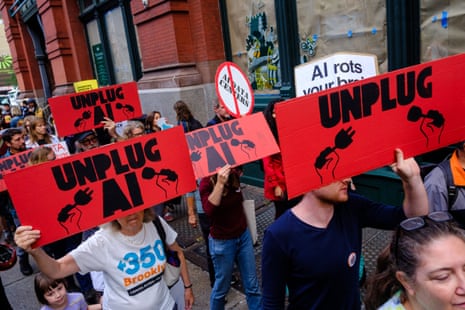
People protest outside OpenAI’s office in New York City on 21 September. Photograph: Julius Constantine Motal/The Guardian
People protest outside OpenAI’s office in New York City on 21 September. Photograph: Julius Constantine Motal/The Guardian
Climate protesters say tech companies, not AI, are the real ‘danger to humankind’ – and the planet
Activists gathered outside the OpenAI offices on Monday during climate week in New York City
On Monday evening, protesters gathered outside the unmarked Manhattan offices of OpenAI, maker of ChatGPT, holding signs calling to “Eat the rich, save the planet”. Over the next two days, groups also picketed outside the offices of fellow tech giants Google and Amazon; other protesters, including clergy, were arrested while disrupting a closed-door AI health summit in the city. Tonight, protesters will target a Brooklyn gas power plant that was set to close – until it was purchased to power AI datacenters.
The protests come on the heels of an Anthropic employee quitting his job with a warning that intensified an already-growing AI panic: “The people building AI earnestly believe that it could kill us all by the end of the decade.”
Though it was far from the first time an AI expert had issued a doomsday message about the threat the tech poses, this time it dominated public attention, arriving as trust in big tech has hit an all-time low and communities across the country are trying to stop the building of datacenters. From 2024 to 2026, at least $64bn in proposed datacenter buildout was blocked by local organizing. Today, bans have been passed in at least 18 states at the local or county level, and New York passed a statewide moratorium this summer.
The protest outside OpenAI’s New York City office on Monday. Photograph: Julius Constantine Motal/The Guardian
“They are claiming that they have the power to end humanity, but at the same time can’t get AI to do a lot of major things that they’re pushing for,” said Jonathan Westin of Climate Defenders and the Stop Funding Billionaires campaign, which organized the “unplug AI” week of action.
Like Westin, many of the protesters at the anti-AI protests this week were part of climate organizations, in town for New York’s climate week, a global gathering of elected officials, policy experts and advocates timed to the meeting of the United Nations general assembly. Datacenters require significant amounts of water to function and an immense amount of energy to power, often using fossil fuels, bringing pollution into communities. Organizers are calling for more datacenter moratoriums and stronger commitments to protect water access and to block fossil fuels. They say tech companies’ greed is the real threat to the environment.
Even Wall Street has warned the AI boom could cause another economic bubble to burst – one that, protesters say, will be carried on the backs of working Americans. “Regular people shouldn’t be left holding the bag for a bunch of billionaires and trillionaires to play Monopoly with our economy,” Westin said.
Daisy Maldonado (right) of New Mexico at the protest outside OpenAI’s office building in New York City on Monday. Photograph: Julius Constantine Motal/The Guardian
Other groups at this week’s protests, like the anti-war organization Code Pink, called attention to how many big tech corporations work with the US military: the US has used tech made by Palantir, xAI and Anthropic to establish targets and rain down bombs in the war in Iran – all with far-from-perfect accuracy.
Alex Hanna, director of research at the Dair Institute, an AI research organization centering communities facing environmental damage and extraction from AI, said the doomsday prophesying from tech companies and former employees are a distraction amid “the climate and ecological crisis, the rising fascism that is borne out of climate politics, the making of climate refugees, and the growing inability of people just to get by from day to day. It’s such a disconnect from what seems to be actually happening.”
Some protesters outside the OpenAI offices Monday had traveled from New Mexico, where a planned datacenter threatens the already-sapped Rio Grande and a community facing a 20-year drought. Oracle’s Project Jupiter, which is contracted to OpenAI, was pitched as a job creator for the community, but organizers say the companies aren’t talking about how it would drain the area’s limited water resources.
“There’s just so much misinformation that’s being sold, not only to the elected [officials], but to the community, and I think it’s really a disservice to the people of New Mexico for these companies to come in and just basically lie about what they’re going to do and how these projects are going to benefit communities,” said Daisy Maldonado, a resident of Doña Ana county, the planned site of the datacenter.
Justin Jones, the Tennessee state representative, wears anti-AI buttons on his bag at the protest on Monday. Photograph: Julius Constantine Motal/The Guardian
At an AI sustainability conference elsewhere in the city on Tuesday, five protesters were arrested for disrupting a keynote on using AI to solve the energy grid crisis. Activists called out the conference framing as “greenwashing”, or using misleading descriptions to brand something as eco-friendly or less harmful. “We do not want to greenwash these datacenters that are being built,” said Adrosto de Silva, who also traveled from New Mexico to the OpenAI protest. “There is no way that you can do harm reduction in any sort of datacenter whatsoever.”
At Monday’s protest, attendees – including the Tennessee state representative Justin Jones, who dropped in while in town for climate week – emphasized that many of these fights are happening in communities of color and poor communities, where the companies thought they wouldn’t face local backlash.
“This building behind me is a danger to humankind,” said Jones, gesturing at the OpenAI offices. “The confluence of this techno oligarchy is a threat to us all. I’m here because if they come for one of us, they’re coming for all of us.”
Price hikes, ads and lower quality: has ‘streamflation’ ruined the TV experience?
US consumers are starting to opt out of the streaming world as several services raise prices without offering many perks
It may not be quite as politically buzzy as the price of gasoline or eggs, but another household expense is going up for millions of people. Disney has brought the price-gouging experience of its theme park home again by raising the prices of most iterations and bundles of its Disney+ and Hulu streaming services. Whether you pay to watch them with or without ads, separately or bundled together, you’re probably getting a price hike of a couple of bucks per month. The few bundles that will remain the same price feature ad-supported versions of both services (plus ESPN). Don’t worry, though; paying extra to avoid the ad-supported versions of those services won’t mean that you’re missing out on some cross-promotional opportunities. Disney’s terms of service note that they reserve the right to insert ads before and after programming on whatever subscription tier they want, regardless of what you’re paying for. True magic!
This particular magic isn’t reserved for Disney, though. Price hikes among streaming services have become so common that The Verge has a dedicated page aggregating the news of them, which tends to arrive every few months. Apple, apparently high on Emmy fumes, has raised its prices four times in four years, keeping pace with many of its competitors despite a vastly smaller dedicated catalog. Depending on which version of Peacock subscribers use, they’ve seen their bills padded by five or six dollars a month just since the summer of 2025, including another increase last month. Netflix, meanwhile, hasn’t gone up since March 2026. That’s not a reprieve; that’s a sign another hike must be around the corner.
Consumers have noticed. Reportedly an estimated 39% of Americans canceled a streaming service in the past six months due to what’s been dubbed “streamflation”. Another survey indicates that a majority of people subscribe to at least three such services, which is consistent with estimates of streaming households spending about $70 per month. Access to the six big streaming services (Netflix, Disney+/Hulu, HBO Max, Paramount+, Apple TV, Peacock) will boost that number somewhere in the neighborhood of $120, on top of which subscribers need broadband internet for the services to actually work. For the total price, you might as well call the whole thing Cable+, in that it’s like your old cable bill, only there’s more of it. No wonder cancellations are rampant.
To retain subscribers without putting the screws directly to them, it might be viable for streaming companies to stabilize annual prices – typically a discounted lump-sum payment covering a full year of a service – even when raising monthly costs. Some, like Netflix, don’t offer this option. While those that do have kept annual subscriptions cheaper than the a year’s worth of month-to-month, companies don’t seem interested in maintaining bargain levels. The annual price for Disney+ at launch was $70. Now it’s $190, an increase of 170% – presumably to stay competitive with eggs. Amazon Prime, whose streaming service began as a perk for members already paying an annual membership fee for unlimited shipping and other benefits, has also risen while inserting more ads into its programming and downgrading the picture quality. You want higher resolution and fewer ads? That’s another $50 a year.
Matthew Rhys in Widow’s Bay, a big hit for Apple. Photograph: Robert Clark/Apple
The reasons for all this shameless gauging are pretty simple: Wall Street doesn’t just demand profits (though those have sometimes been scarce in the streaming world) but endless growth, and some services don’t have all that much more room, realistically, to sign up more users any more. Netflix has 325 million subscribers worldwide. What’s their reach goal? 500 million? Three billion? What happens when everyone on Earth with an internet connection and a credit card already has Netflix?
Not every service is so close to a saturation point (unless you count electricity as a streaming service). But it’s notable that even a supposedly lower-tier streamer like Peacock commands over 40 million monthly subscribers, equivalent to more than 10% of the United States population. (It’s a heavily US-skewing service, so unlike Netflix those users aren’t especially global.) By comparison, the biggest magazine in the US has a subscriber base of around half that (and that’s the AARP magazine, an outlier in that it’s distributed to paying members). The New York Times, considered an especially successful recent example of the subscription model, has 13 million subscribers. The AMC Stubs A-List program that allows moviegoers to see four films a week has about 1 million.
That’s all to say that streaming has unprecedented reach, which means the only realistic way to boost profits is to either raise subscription prices, or make less stuff. The latter might sound ridiculous, especially given that we’ve been living in the post-boom age for streaming shows for a while now. Then again, that’s worked out well for the catalog-based Tubi, whose original works are lower-profile and lower-budget than its competitors. One of several free streaming services, Tubi outstrips some of those paid competitors in market share and turns a profit based only on its ads.
Watching a movie or a show on a free service isn’t exactly an optimal experience; there are those ad breaks, sometimes the transfers aren’t top-notch, and the content churn tends to be a little faster than the subscription streamers. It’s definitely not a place where you can catch much of anything nominated for an Emmy in the past five or six years (though some Oscar movies or second-tier popular hits from that period might turn up). On the other hand, free streamers often manage to under-promise and over-deliver; at a time when paid subscriptions seem eager to offer less than ever, especially in the quite broad field of films made before 1995, Tubi, PlutoTV and their ilk always have at least a couple dozen stone-cold classics on hand that more than make up for not including the latest big-name time-wasters (looking at you, Matthew McConaughey/Woody Harrelson sitcom where they play themselves!). And the price always stays the same.
Tubi’s original works are lower-profile and lower-budget than its competitors. Photograph: Tubi
Still, some free streaming services with surprisingly robust and shifting catalogs aren’t exactly the dream of cord-cutting that was fed to consumers throughout the 2010s. The initial idea was to shed the bloat from all-or-nothing cable services that hold monopolies, or something close to it, in plenty of geographic areas. Competition for subscribers would keep good deals in the offing. Instead, what’s been happening over the past five years or so is a redistribution of that money from one set of giant companies to another. There’s slightly more consumer control over the size of the bills, in the sense that, yes, it’s possible to cancel a couple of services in a way that picking and choosing individual cable channels wasn’t possible outsidea few premium subscriptions. But there’s also far less clarity about how to catch the best shows and movies of any given year. For ages, it was mostly a simple formulation: have cable, add HBO. Now even the prestige of HBO seems a little more niche – a Game of Thrones spin-off; a well-liked Green Lantern show – than in the past.
There’s also a strange sense that this scramble of greed isn’t paying off as well as it should; many streaming services feel like they’re in far more precarious financial positions than most cable companies or channels were at their peak. It’s a dystopian development: corporations still want consumers on the hook for endless subscription payments, but also seem to want them to share in the nervous stock-checking of a shareholder, without any particular upside. Each month, you check your streaming holdings and see if you’re about to be charged even more, and whether you need to pick one to divest (cancel, whether for good or for now). You can toggle some of them on and off timed to the occasional appearance of a major series like Severance or The Pitt, but the onus for keeping track of erratic streaming schedules is on the subscriber. None of these shows are as necessary as basic groceries. But the ability to relax and watch TV after a long day is still in danger of becoming another budget-related stressor – an unholy combination of cable bloat and the endless doomscroll.
Blended cost per 1M tokens (3:1 input:output, log scale) against the Intelligence Index. Hover or tab to a point for details.
The frontier as a lookup table. Find the row your budget falls in; the pick is the highest-scoring model you can get at that price, and the runner-up is the next best that also fits.
Diff between consecutive daily fetches: new models, removed models, and re-scored or re-priced ones.
Click a column header to sort. Names link to the model's Artificial Analysis page.
Source: Artificial Analysis free data API, fetched daily by a GitHub Actions cron. Code and data: github.com/terryds/bestvaluemodel.
Just weeks before the pivotal midterm elections, Texas election officials have discovered that an unknown number of voter registration applications have not been processed due to an error by the Texas Department of Public Safety.
DPS failed to send the applications, which were submitted by voters through its online driver’s license portal, to county voter registrars for processing, according to an email sent to county officials and provided to Votebeat. The state confirmed to Votebeat that it would begin delivering the unsent registrations to county officials overnight.
State officials said the affected transactions produced incomplete voter registration records, which prevented them from being transmitted to county registrars. Officials have not said what information was missing, what caused the records to be incomplete, how many voters were affected, or exactly when the problem began.
The DPS portal is a major voter registration channel in Texas. From 2020 through 2024, about 6 million Texans used it to register to vote, according to testimony DPS officials provided to state lawmakers in 2025. Texas has more than 18 million registered voters.
By Texans, for Texans.
Stay in the know on elections across the state with on-the-ground reporting by Natalia Contreras. Get her newsletter, delivered twice a month.
The Texas Association of County Election Officials is collecting information from its members to determine the scale of the issue. DPS officials did not immediately respond to a request for comment Tuesday.
The problem comes less than two weeks before the Oct. 5 voter registration deadline, and the sudden arrival of older applications from DPS is likely to add to counties’ voter registration processing backlogs at one of the busiest points in the election calendar.
Voters whose registrations were affected by this issue can still have their ballots counted as long as they submitted their registration before the Oct. 5 deadline, said Alicia Pierce, a spokesperson for the secretary of state’s office.
“A voter who registered through DPS online services but does not appear on the rolls can cast a provisional ballot,” Pierce said in an email to Votebeat. “Election officials have an established method with DPS to check the transaction. If that voter did register, the provisional vote will be counted.”
The secretary of state’s office became aware of the problem last week, when election officials flagged that they’d noticed a surge in “older” voter registration applications coming from DPS in TEAM, the state’s voter registration system.
In an email to county election officials sent after the discovery and obtained by Votebeat, state elections director Christina Adkins said the agency was “actively investigating this issue to determine the source of these historical records.” She said the agency asked Civix, the voter registration vendor that developed the latest version of TEAM, to “temporarily remove the files from county dashboards while we work to address this issue.”
In a second email sent Tuesday, Adkins said DPS had determined that some voter registration records from its online transactions were incomplete, which prevented them from being sent to counties. She said the state and DPS had identified the affected records and that the state was “working with DPS to ensure that the modifications they made to their system to address this issue are not impacting daily files going forward,” Adkins said.
Counties will now have to process the older registrations while making sure they do not overwrite more recent updates submitted by the same voters. For counties that work directly in TEAM, the state said it was able to identify voters with newer registration information and would withhold the older DPS record, Adkins wrote.
The task will be more complicated for counties that use their own voter registration software rather than working directly in TEAM. The state cannot perform the same check for those counties, so they will receive all of the affected DPS records and will have to determine whether individual voters subsequently submitted newer registration information. Adkins said the state said it would send those records in batches and work with the counties’ voter registration vendors to process them.
This is a developing story.
Natalia Contreras covers election administration and voting access for Votebeat in partnership with the Texas Tribune. Contact Natalia at ncontreras@votebeat.org.