


The other day, I found myself wondering how big 52! (52 factorial) is,
and that led me to ponder how these could be estimated without a
calculator or a computer.
It turns out there’s some fairly interesting math behind being able to
estimate the size (number of digits) of a factorial reasonably
accurately. This post will start by stating how to do the estimate, and
if you’re curious you can read on for the math background.
Without further ado, the approximation is:
As an example, let’s use my original question, by estimating this for
52!
Well, 52 divided by is… 20-ish? And is
about 1.3 [1]; therefore our estimate comes out to:
The real answer is 68, so this is very close! In estimates like this –
when you’re dealing with enormous numbers – being off by a couple of
digits usually isn’t a big deal.
The Gamma function
The Gamma function for real is defined [2] as:
This integral does not have an analytic expression in the general case,
but it does have a very useful property that we can take advantage of.
Let’s see what is:
And now use integration by parts with:
Then:
So:
But notice that the last integral is just ; therefore,
we’ve shown that:
Let’s also calculate – it’s a special case that has an
analytical solution:
This helps establish an induction argument:
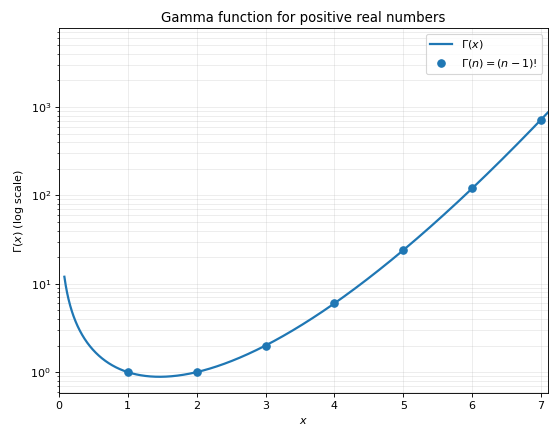
In other words – the Gamma function is an interpolation of the factorial
over all positive reals. Here’s a plot of the Gamma function over a
small range; note that the y axis is log-scale because of the function’s
fast growth:
Stirling’s approximation
You may have encountered Stirling’s approximation before:
It’s a great approximation that works reasonably well even for small
 . This section is a brief overview of how Stirling’s formula is
derived from the Gamma function.
Taking:
We’ll start by massaging the integrand a bit:
And making a change of variables , which means that
:
These steps make the integral amenable to applying Laplace’s
method, which allows
us to approximate definite integrals of the form:
Where  is a twice-differentiable function and some
large number. By Laplace’s method, such integrals can be approximated
by:
Where  is the global maximum of .
Let’s see how to apply this method [3] to the latest equation we have
for (renaming the dummy integration variable back to
):
In our case, . It’s easy to show that this
function is twice differentiable and has a global maximum at
 . Moreover:
Substituting these into the proper places in Laplace’s approximation, we
get:
Number of digits from Stirling’s approximation
We can calculate the number of digits in by taking the
base-10 logarithm of Stirling’s formula:
Note that the first term is not multiplied by itself;
therefore, as grows, it will become less and less noticeable.
That said, it still adds a couple of digits – so you should take it into
account if you want a more accurate approximation [4]
| [1] | Mental tricks for calculating is a different topic, but it really helps to remember that , , and from here using the various logarithm laws to estimate multiples. |
| [2] | As a matter of fact, the Gamma function is defined for complex numbers, but for our purpose talking about the reals is sufficient. |
| [3] | As much as I’d like to dive into why this approximation works, the rabbit hole in this post is already deep enough! |
| [4] | It adds up to 2 extra digits as long as is less than 1600 or so, and may add more than 2 after that, though no more than 3 until n is 160000. It’s not clear why anyone would like to estimate the number of digits of 1600! (about 4450, in case you were wondering), let alone 160000! |
For comments, please send me
an email.
Source: Hacker News




You must be logged in to post a comment.