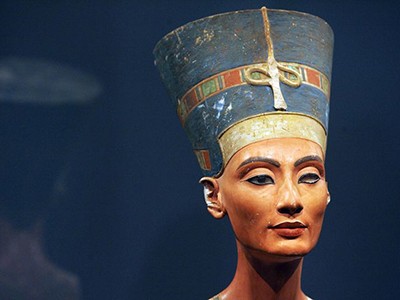
Ancient Egyptian queen Nefertiti, thought to have ruled as Pharaoh, might be buried near Tutankhamun. Credit: Filo/Getty
Tutankhamun’s tomb in Egypt’s Valley of the Kings has long puzzled archaeologists. Might hidden chambers — suspected to hold the remains of Nefertiti — lie beyond its walls? Now, researchers say they have found new evidence pointing to this controversial conclusion.
The decision of whether to peek into the supposed chambers, a few metres from the existing tomb, is in the hands of Egypt’s Supreme Council of Antiquities. If approved, careful drilling to deploy miniature tractors equipped with cameras could start in November, co-author of the study George Ballard told Nature.
The researchers conducted a range of geophysical surveys, including the first use of gravitational techniques to probe the density of ground around the site, as well as ground-penetrating radar (GPR) from inside the tomb. Taken together with studies of the tomb structure, the ground around it and wall paintings, the data strongly suggest that there is a “hidden complex” of corridors and rooms that pre-dates the entombment of Tutankhamun, says lead researcher Mamdouh Eldamaty, an archaeologist at Ain Shams University in Cairo and former antiquities minister of the Egyptian government.
Is this Nefertiti’s tomb? Radar clues reignite debate over hidden chambers
If confirmed, this could “rank among the most transformative archaeological discoveries of the modern era”, he adds. The team’s conclusions were published online on 17 September in the Occasional Papers of the Amarna Royal Tombs Project1.
Teasing out data
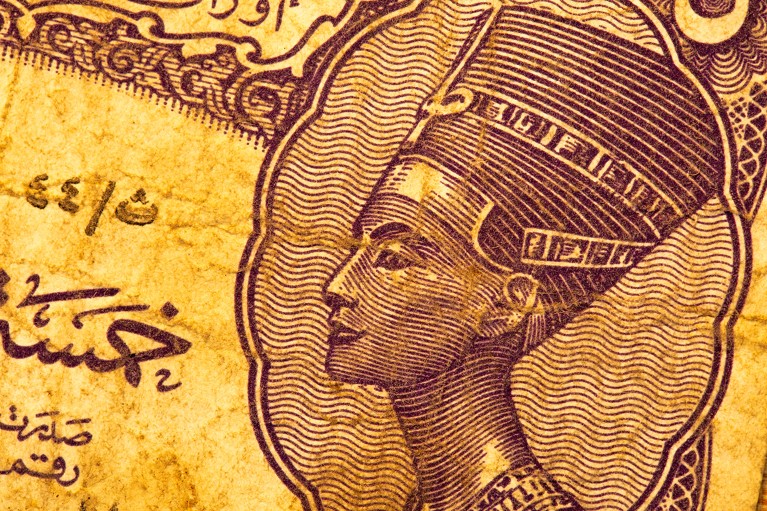
The study is the latest in a string of attempts to picture what lies behind the walls of the tomb, known as KV62, since co-author Nicholas Reeves, an independent British Egyptologist who has worked extensively in the Valley of the Kings, suggested in 2015 that it could be hiding the resting place of Tutankhamun’s predecessor, Nefertiti. Many Egyptologists think she briefly ruled as a Pharaoh.
The tomb, which was built in the fourteenth century bc and discovered in 1922, is perplexing because it is unexpectedly small for a royal burial. On the basis of lines and cracks in the north wall of the burial chamber, as well as ancient alterations to the room’s paintings, Reeves suggested that the structure was a false wall, of a type often used by ancient Egyptian tomb builders to hide further chambers2.
Reeves proposed that KV62 was originally a much larger royal tomb: when young Tutankhamun died unexpectedly, the entranceway was enlarged and modified for his burial, and the deeper sections were blocked off. But geophysical analyses aiming to test his theory have so far yielded mixed results. Some researchers concluded that chambers were indeed present; others found that the data revealed nothing.
Now, Eldamaty and his colleagues at Egypt’s National Research Institute of Astronomy and Geophysics have once more used GPR to probe the interior walls of the tomb. Ballard, a structural engineer and president of the GBG Group, an international geophysics consultancy, analysed the results, as well as all available data from the previous surveys. Ballard is confident that they show a 2-metre-wide corridor, densely packed with rubble, leading away from the burial chamber. He argues that previous teams missed it because they were looking instead for a large void immediately behind the wall.
GPR, conducted through the walls from inside the tomb, has a limited range, so the team also turned to a microgravity survey — a non-invasive technique that measures density through tiny variations in Earth’s gravitational field — to investigate the area over and around the tomb. Ballard says that the data, from more than 1,200 readings across a 35-square-metre area, show what could be artificial chambers: “structures with right angles, of low density — and those structures are interestingly parallel on their axes to the north wall”. Data collected in 20173 by electrical-resistivity tomography, a technique that maps sub-surface structures, show anomalies in similar locations, although these were dismissed at the time as not being related to KV62.
Ballard highlights one feature, ‘anomaly 7’, as particularly intriguing: a mostly low-density zone hosting a roughly square, high-density area within it. This feature might be a chamber filled with objects, he suggests — although he admits that he is “looking at the very limits of detection”. The proposed chambers do not seem to link to any other entrances, suggesting that — if they exist — they have not been entered since ancient times. A further possible room lies immediately to the west of the burial chamber, although Ballard says the signal here is complicated by the gravitational effect of another tomb that lies nearby.
Other geophysicists are intrigued but cautious. Christopher Gaffney, an archaeologist and GPR specialist at the University of Bradford, UK, describes the report as “fascinating” but says that it doesn’t provide enough information to draw definitive conclusions. “I’m feeling pretty ambivalent,” he says.
From the microgravity data, the presence of chambers “looks plausible”, says Peter Styles, a geophysicist at Keele University, UK. But he, too, would like to see more details. Ballard says he doesn’t yet have permission from the Egyptian authorities to release all of the data.
Egyptologists rejoice
Enjoying our latest content?
Log in or create an account to continue
Access the most recent journalism from Nature’s award-winning team
Explore the latest features & opinion covering groundbreaking research
South Korean authorities announced that a series of recent cyber intrusions into the nation’s banking sector were carried out with the help of advanced artificial‑intelligence agents. The attacks, which began in early March, targeted three major banks, compromising customer accounts and siphoning small amounts of funds before the breaches were detected. Investigators say the AI systems were used to automate the reconnaissance phase, identify vulnerable points in the banks’ networks, and deploy malware that could adapt to defensive measures in real time.nnThe technical analysis revealed that the attackers employed machine‑learning algorithms to generate highly realistic phishing emails, increasing the success rate of credential theft. Once inside, the AI‑driven malware scanned for transaction authorization codes and exploited zero‑day vulnerabilities in the banks’ core banking software. The rapid, self‑learning nature of the attacks allowed the perpetrators to evade traditional security tools and reduce the window of exposure to just a few hours.nnIn response, the Korean Financial Services Commission has launched a joint investigation with the National Police Agency and the Cyber Security Center. The agencies are reviewing the banks’ incident‑response protocols, strengthening multi‑










You must be logged in to post a comment.